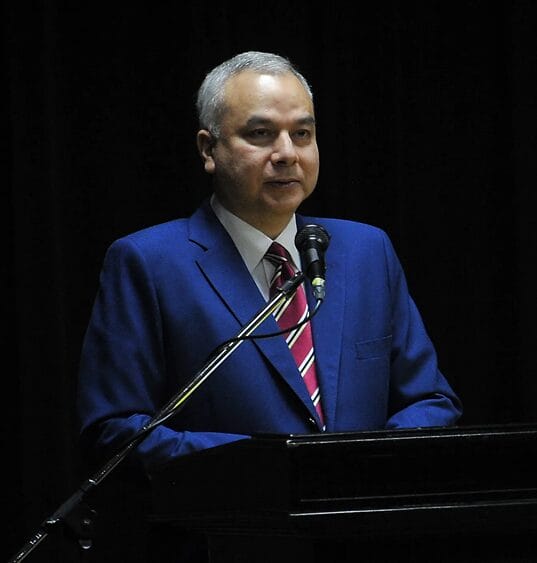
Photo Credit: Sultan Nazrin Shah Official Website
KUALA LUMPUR, July 27: Sultan Nazrin Muizzuddin Shah today delivered a forthright call to revive and reimagine the institution of waqf, describing it as a timeless engine of barakah, governance, and sustainable development for the Muslim ummah.
Addressing delegates at the International Da’wah Convention 2026 here, the Perak ruler warned that neglect and mismanagement have left too many endowments dormant, undermining their potential to uplift communities.
“Waqf is sadaqah jariyah given institutional form,” he declared. “It is, in the truest sense, an investment whose dividends are paid in the Hereafter.” Sultan Nazrin reminded his audience of the Prophet Muhammad’s teaching that deeds end with death except for three, among them continuous charity.
He stressed that waqf embodies this principle, ensuring that wealth continues to nourish society long after its donor has passed.
Tracing waqf’s influence across history, the Sultan cited Caliph Umar’s endowment of land at Khaybar, which became a model for centuries of Muslim giving.
He highlighted Fatima al‑Fihri’s founding of the Qarawiyyin University in Fez in the ninth century, using her inheritance to create what UNESCO recognises as the world’s oldest continuously operating institution of higher learning.
He also recalled Gazi Husrev Bey’s vast endowment in Sarajevo in the 1530s, which built mosques, schools, hospitals, libraries, and water systems that still serve the community nearly 500 years later. “Most wealth is spent and gone,” he said. “Waqf is wealth that keeps working – the nearest thing our civilisation has devised to a spring that does not run dry.”
The Sultan drew parallels between waqf and stewardship of the natural world, urging Muslims to think in centuries rather than election cycles.
“The founders of these endowments planted trees under whose shade they knew they would never sit. That is the quality of mind our age most urgently needs to recover,” he said.
He linked waqf to contemporary challenges, especially climate change, citing Indonesia’s waqf forests, eco‑mosques, and green sukuk financing renewable energy projects. Initiatives such as the Green Waqf in East Nusa Tenggara, which powers rural schools with solar energy, exemplify how Islamic social finance can address existential threats.
Yet Sultan Nazrin cautioned against romanticising waqf while allowing it to decay. “Too much of our waqf today lies dormant. Its lands sit idle, its records are incomplete, its titles are disputed, and its potential goes unrealised,” he warned.
Governance, he stressed, must be seen not as bureaucracy but as amanah – a sacred trust. “The one who administers an endowment is not its owner. He holds it in trust for the poor, the students, the sick, and the generations to come. A well‑kept ledger, in the service of a waqf, is an act of worship.”
The Sultan urged administrators and trustees to hold themselves to higher standards than those demanded by secular auditors. “The eye of the auditor may miss a fault in this world. The eye of Allah does not,” he said.
He emphasised that reviving waqf is also a form of da’wah, reminding communities that Islam has never separated worship from social welfare.
“The one who gives to a waqf is not merely parting with wealth. They are sustaining a civilisation that measures success by what one leaves behind for others rather than by what one gathers for oneself.”
Turning to the future, Sultan Nazrin outlined four concrete proposals:
- Establishing an international working group to unify waqf governance principles, building on Indonesia’s Waqf Core Principles, the Accounting and Auditing Organisation for Islamic Financial Institutions, and frameworks from Kazakhstan.
- Accelerating digital cash‑waqf platforms with transparent dashboards, enabling donors to trace their contributions from pledge to project to outcome.
- Launching a pilot “Waqf for Peace and Planetary Resilience” across ASEAN, funding solar retrofits and climate‑resilient water infrastructure while embedding environmental ethics curricula.
- Embedding principles of balance, justice, mercy, and trusteeship into waqf charters as binding governance criteria.
He also praised innovations such as micro‑waqf in Indonesia, corporate waqf in Malaysia, and global platforms pooling donations for professionally managed funds.
“Far from being threats to our tradition, these are embodiments of its faithful continuation into a new century,” he said. “This is how we reimagine waqf.”
Sultan Nazrin’s address was both historical and forward‑looking, weaving examples from Baghdad, Cordoba, Cairo, and Fez with contemporary initiatives in Indonesia and Malaysia.
He reminded delegates that waqf once built libraries, hospitals, universities, fountains, and caravanserais – often endowed not by kings but by ordinary believers.
“We must never underestimate just how remarkable that is,” he said. “Waqf turns private wealth into a public good that does not expire, but continues to nurture individuals, communities, and entire civilisations across generations.”
The Sultan concluded with a forthright call to action: modernise waqf management, harness new financial instruments, and restore waqf to its rightful place at the heart of a self‑reliant ummah. “Let it not be said of our generation that we admired the achievements of our forefathers and added none of our own,” he declared. “The time for action is now.”
WE