By Dr Rahim Said
I am sitting at RUKO — Rumah Kopi — my favourite café in Canggu, sipping a cup of coffee and staring out at the corner that leads back to Villa Latina, where we’ve been staying this past week.
Something is different. That corner, normally a bottleneck of bronzed bodies and scooters locked in philosophical disagreement about who has the right of way, now breathes. Slowly. Almost suspiciously.
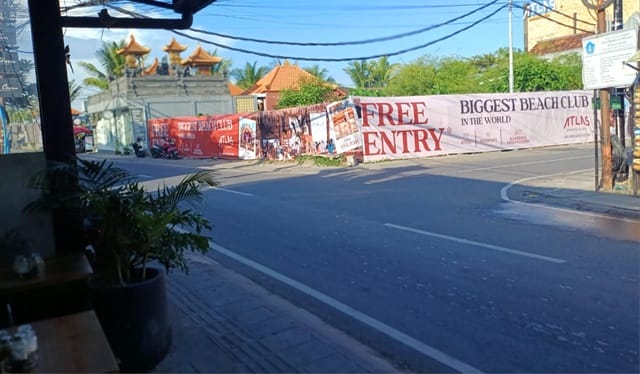
Then I notice it. Atlas — the nightclub that muscled its way between our villa and the sea, taking with it our view and, on festive nights, any hope of sleep — has put up a sign. Free Entry.
I mention it to our waiter, a quietly dignified Balinese man who has been attending to our two-table morning congregation with the same courteous precision one imagines he reserves for a full house.
He leans in just slightly. “Pak, low season. Tak ada orang. Sepi.”
Low season. No people. Quiet.
He says it the way a doctor delivers a diagnosis — matter-of-fact, not unkind, faintly apologetic. As though the emptiness is somehow his fault.
And empty it is. The roads to Canggu Beach are clear enough that you could hear your own thoughts, which, depending on the thoughts, may or may not be a blessing. The beach itself is surrendered almost entirely to the surfers — those reliably enthusiastic people for whom season, crowd, and common sense are entirely beside the point.
This version of Canggu feels like Nyepi, the Balinese Day of Silence observed once a year, when the whole island goes still by decree of the cosmos. Except nobody decreed this. The tourists simply… left.
At RUKO, our waiter apologises again. I assure him there is nothing to apologise for. We have the whole restaurant to ourselves, the coffee is excellent, and nobody is competing with us for the corner table with the partial view of the sea — partial, because Atlas’s back wall has made sure we cannot see very much of anything from here anymore.
That wall. Let me tell you about that wall.
Atlas arrived the way these things always do in Bali: suddenly, loudly, and with architectural ambition inversely proportional to neighbourly consideration. Its back wall now forms a kind of Berlin Wall between Villa Latina and the Indian Ocean. We are not separated from our view by nature, or distance, or graceful urban planning. We are separated from it by the rear end of a nightclub.
During high season — Christmas, New Year’s — this is compounded by the bass. The techno. The drum beats that penetrate walls, windows, and whatever peace you’d budgeted for the holiday. On New Year’s Eve last time we were here, Atlas reportedly pulled ten thousand visitors through its doors. Ten thousand. RUKO itself was full to capacity, the queue stretching all the way down to the corner where, today, the Free Entry sign flaps in the sea breeze.
How quickly a kingdom contracts.
But Atlas is not the only thing in Canggu that promised one thing and delivered another.
After Covid hollowed out Bali’s tourism economy, the local authorities did something genuinely thoughtful: they built a proper footpath along Canggu Beach Road, all the way down to the shore. A pedestrian walkway. Wide, paved, purposeful — the kind of infrastructure that whispers we want you to come back, and we want you to feel welcome when you do.
It was, in principle, a lovely gesture.
In practice, it is now a motorcycle parking lot.
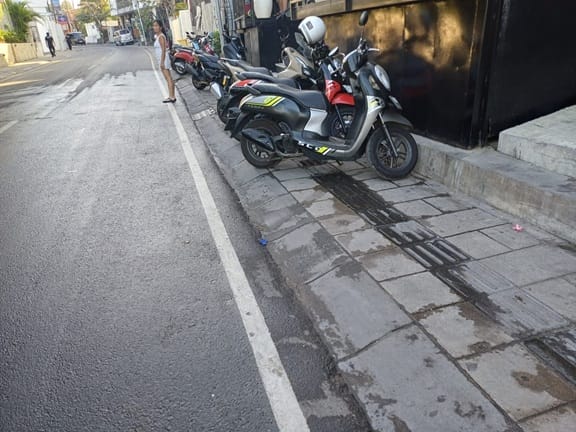
Row upon row of bikes — locals, delivery riders, the casually inconsiderate — have colonised every available metre of that footpath, bumper to bumper, handlebar to handlebar, with the quiet confidence of people who have never once been told otherwise. The pedestrian, confronted with this arrangement, must choose between walking on the road among live traffic or performing a kind of lateral shuffle between exhaust pipes and wing mirrors, hoping for the best.
I have done both. Neither builds character.
The footpath was built for tourists. It is apparently maintained for motorcycles. And somewhere in that gap between intention and outcome lies a very familiar story about infrastructure in places that are still negotiating what kind of destination they want to be.
Canggu wants your tourist dollar. It is less certain it wants your feet on its pavements.
I finish my coffee. The waiter refills it without being asked — the instinctive grace of someone who takes genuine pride in his work, regardless of how many people are watching.
Outside, Canggu exhales.
The surfers persist. The roads are quiet. The footpath remains faithfully occupied by motorcycles. And Atlas, that great wall of uninvited noise, stands there with its hand out, offering entry for free, hoping someone will come.
Sepi, indeed.