By Leslie Lim
It is probably the oldest running joke in the Klang Valley: if you want to experience a blissful, traffic-free Kuala Lumpur, wait for a long weekend or a major festive holiday.
Almost overnight, the capital’s gridlocked roads clear out as the city empties. Where do they all go? Straight onto the expressways. During major festive periods, traffic on the country’s major highways can climb well above two million vehicles a day.
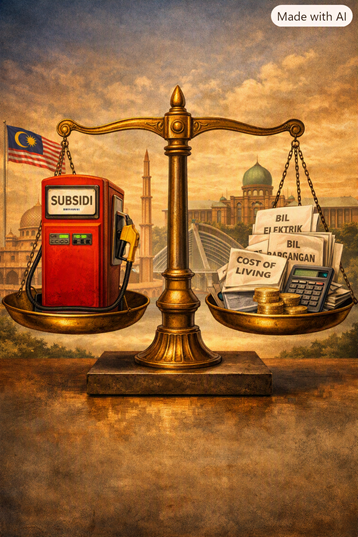
That annual exodus offers a useful metaphor for a broader Malaysian economic habit: a country accustomed to cushioning the real cost of mobility and energy through extensive government intervention.
The result is a difficult policy dilemma for Putrajaya. On paper, Malaysia’s macroeconomic indicators remain strong. The economy expanded by 6.0 per cent in the second quarter of 2026, bringing first-half growth to 5.7 per cent, supported by continued domestic activity, exports and investment.
Yet strong headline growth does not necessarily translate into an equally strong perception of household financial wellbeing. With food and other living costs weighing on household budgets, consumers can experience any move towards market-based pricing not as an abstract exercise in fiscal reform, but as an immediate increase in their monthly expenses.
The scale of the fiscal challenge is substantial. In July, the government warned that petroleum-product subsidies could approach RM40 billion for the whole of 2026 if prevailing global energy prices persisted — more than twice the RM15 billion initially allocated under Budget 2026.
Yet, ahead of the Merdeka celebrations, Putrajaya restored the basic BUDI95 subsidised petrol quota to 300 litres a month from September, while eligible diesel users can receive up to 400 litres under additional quota provisions.
The decision illustrates the difficulty of moving from broad price subsidies towards more tightly targeted assistance. The government has introduced mechanisms intended to better target support, but the framework still leaves a substantial number of Malaysians eligible for subsidised fuel within specified monthly limits.
The same tension is evident in electricity pricing.
When global fuel and generation costs feed through the Automatic Fuel Adjustment (AFA) mechanism, and seasonal heat increases household electricity consumption, higher TNB bills can be experienced as a direct cost-of-living shock. The technical explanation — that prices are adjusting to underlying energy costs — can easily be overshadowed by the immediate impact on a household’s monthly bill.
This is the fundamental political challenge of subsidy reform: economic rationality and household experience do not always point in the same direction.
Universal subsidies are expensive and can benefit higher-consuming households disproportionately. Targeted transfers, by contrast, can concentrate assistance on those who need it most while allowing prices to reflect more of their underlying economic cost.
But the transition is politically difficult.
That difficulty was illustrated last week by an informal Threads poll conducted by Bersama co-founder and former Setiawangsa MP Nik Nazmi Nik Ahmad, which asked whether fuel subsidies should instead be converted into direct cash assistance. Of 4,877 respondents, 81 per cent rejected the proposal.
The poll is not a nationally representative survey and cannot be treated as a definitive measure of Malaysian public opinion. Nevertheless, it provides a snapshot of the resistance that can accompany a shift from an immediate price subsidy to a less visible form of assistance.
There is a broader economic question behind that resistance. A subsidy at the pump is highly tangible: consumers see the lower price every time they fill their tanks. A cash transfer operates differently, and its real value can change as the cost of living changes.
None of this means subsidies are inherently misguided. They can cushion households from temporary global energy shocks, contain inflationary pressures and provide income support. The question is whether broad subsidies remain the most efficient way of achieving those objectives once their fiscal cost, distributional effects and impact on consumption are taken into account.
Once a benefit is granted, withdrawing it is considerably harder than introducing it. Recipients adapt their household budgets and expectations around the subsidised price. Any attempt to narrow eligibility therefore creates a visible group of people who perceive themselves as losing something, even when the reform is intended to redirect assistance towards those with greater need.
This helps explain why the government’s approach has evolved cautiously.
For years, Putrajaya signalled an intention to move away from blanket fuel subsidies towards a more targeted system based on eligibility and income. Yet the eventual framework has retained a relatively broad subsidised baseline, with quotas and eligibility rules rather than a complete transition to market pricing.
That approach can be interpreted in two ways. From a fiscal perspective, it represents an attempt to contain the cost of subsidies while retaining a degree of protection against volatile energy prices. From a political perspective, it reflects the difficulty of imposing a sudden and highly visible increase in the cost of fuel on a broad population.
Neither interpretation should be dismissed outright. Subsidy reform is not simply a contest between economic efficiency and political expediency. It involves a genuine trade-off between fiscal sustainability, price stability, household protection and the government’s ability to implement reform without creating disproportionate hardship.
The same consideration applies to electricity.
Greater cost-reflective pricing may improve economic efficiency and reduce incentives for excessive consumption. But if households are already facing higher food, transport and housing costs, the timing and design of such reforms matter.
The more difficult question is therefore not simply whether subsidies are good or bad. It is who should receive assistance, how much they should receive, and for how long.
A well-designed targeted system could preserve protection for lower-income and vulnerable households while reducing transfers to those with greater capacity to absorb market prices. But that system has to be trusted. Households need confidence that eligibility rules are fair, payments will arrive reliably, and assistance will keep pace with changing circumstances.
The informal Threads poll offers a small illustration of why that trust matters. An immediate subsidy is visible and predictable. A transfer requires consumers to trust the system behind it.
That distinction may be particularly important in an environment where headline economic growth is strong but households remain highly sensitive to monthly cash flow.
Ultimately, Malaysia faces a stubborn structural reality: once a benefit is granted, withdrawing it requires considerable political capital.
The policy challenge for Putrajaya is therefore not a lack of options or administrative data. It is designing a targeting framework that is transparent, credible and durable enough to command public confidence, while ensuring that those genuinely vulnerable to prices remain adequately protected.
The choice is not necessarily between subsidies and no subsidies. It is between different ways of providing protection, each carrying different fiscal, economic and political consequences.
Until that balance is found, subsidy reform will remain a recurring contest between long-term fiscal discipline and short-term household affordability — tested against what Malaysians see on the price display at the petrol station and the total at the bottom of their electricity bill.
WE