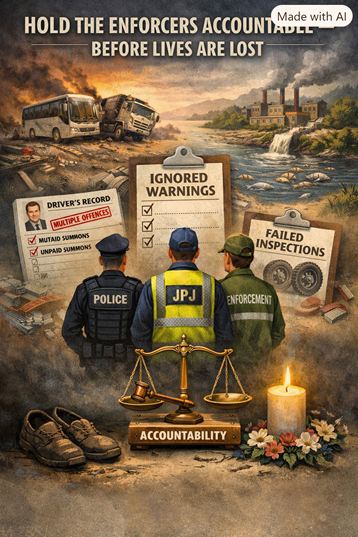
By Dr Pola Singh
Whenever tragedy strikes in Malaysia, we are quick to identify the culprit. A river is polluted, and we blame the factory. An express bus crashes, and we blame the driver or operator. An overloaded lorry causes a fatal accident, and we demand punishment for those responsible. Certainly, lawbreakers must face the consequences.
But accountability cannot end with them. We must also ask: where were those entrusted with enforcing the law before the tragedy happened?
An especially disturbing pattern emerges after serious accidents involving commercial vehicles. The police or other authorities reveal that the driver had dozens of outstanding summonses, sometimes for offences similar to those implicated in the crash. These records did not suddenly appear after the accident.
The information was already available. Why, then, did it become a matter of urgency only after lives had been lost? If the authorities can identify a driver’s repeated offences after a fatal crash, surely that history should trigger scrutiny beforehand.
Were the records shared with the relevant enforcement and licensing agencies? Was the employer alerted? Did anyone assess whether the driver should continue operating a commercial vehicle?
Above all, who was responsible for acting on those warning signs? A record of repeated offences is more than a collection of unpaid summonses. It is a warning that demands attention, particularly when a driver is responsible for passengers or a heavy vehicle. Such information should be shared promptly among the police, the Road Transport Department and the relevant licensing authorities, with clear responsibility for follow-up.
Where offences are established, penalties should escalate, including suspension or disqualification where warranted. Public safety cannot depend on whether different agencies happen to compare their records. The same questions arise when a vehicle involved in a crash is found to have defective brakes or worn tyres.
Commercial vehicles undergo mandatory inspections. How, then, does an unsafe vehicle remain on the road? Was a defect missed, did it develop subsequently, or was a requirement ignored? An investigation must examine the operator’s conduct and whether inspection and enforcement arrangements worked as intended.
River pollution reveals a similar failure of prevention. When contamination cuts water supplies to thousands of households, punishing the polluter is essential. But were earlier breaches detected? Were complaints investigated? Were corrective measures verified?
If violations persisted, why was the operation allowed to continue until the consequences reached people’s taps?
Regulation exists to prevent harm. Regular inspections, surprise checks where appropriate and firm action against repeat offenders must be routine responsibilities. A modest fine must not become an affordable fee for continuing to break the law.
Persistent violations should bring progressively stronger sanctions, including suspension of operations or loss of licence where justified.
Enforcement agencies must also answer for their own failures. Where warnings were ignored, inspections neglected or action unjustifiably delayed, the responsible officers and agencies should be required to explain their decisions. Proven negligence must carry consequences; corruption or deliberate protection of offenders must meet swift action.
Accountability requires establishing who knew what, when they knew it and what they did. We cannot keep accepting the same sequence: tragedy, revelations of previous offences, an investigation and fresh assurances of tougher enforcement. By then, prevention has failed. No statement can bring back a child, a parent or a breadwinner killed in an accident.
Get tough with those who break the law, and hold those entrusted with enforcing it to account. The true measure of enforcement is whether known dangers are acted upon while there is still time.
WE