By Dr Rahim Said
Approaching 80, I’ve discovered that keeping the body moving is only half the battle. The other half is finding people worth sitting down with.
I have discovered that staying fit is not quite what the fitness industry would have us believe. You do not necessarily need an expensive gym membership, a personal trainer who looks as though he was assembled from spare muscles, or some nutritional supplement promising to reverse the ageing process.
If any of these could make us young again, the manufacturers would have found a way to sell immortality by the bottle.
I still play tennis occasionally, provided I can find a doubles partner. That qualification is important. At my age, finding someone willing to play may be a greater challenge than finding the energy to do so.
Pickleball, the fashionable new kid on the block, has become another option. But my most dependable exercise is cycling an hour a day. Pedalling keeps my knees working and the rest of me from becoming a permanent fixture on the sofa.
For those who can’t manage racquets or outdoor rides, water exercises or stationary bikes are kinder alternatives. The point is to keep moving, not win medals for stubbornness.
Yet physical fitness alone misses something fundamental: social fitness. The body needs exercise, but the mind needs company. We count steps, calories and heartbeats, but rarely count conversations.
Retirement often strips away daily contact, leaving silence where colleagues once stood. Loneliness is not just being alone; it’s lacking regular human connection.
No man is an island, as the saying goes. Unfortunately, some people seem determined to become one, particularly after retirement. They stop going to work, lose their daily contact with colleagues, see their children less frequently and gradually discover that their social calendar has become as empty as their office desk.
At first, retirement feels like freedom. No meetings, no deadlines, no boss asking where the report is. You can wake up whenever you like and do absolutely nothing.
The trouble begins when doing nothing becomes your principal occupation. Days turn into weeks. Conversations become fewer. The telephone remains silent unless someone wants to sell you insurance, ask for a donation or inform you that your bank account is in danger of being emptied by a mysterious stranger.
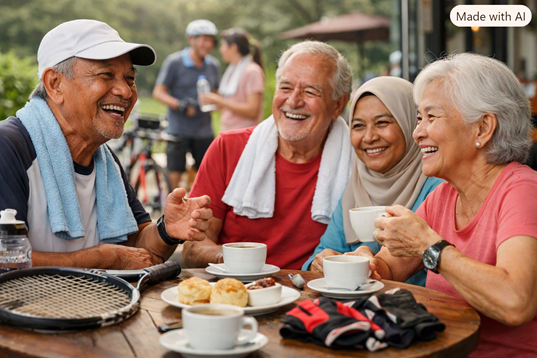
That’s why my gym has scones and conversation. After cycling, I head to a café where elderly neighbours gather. Nobody checks body fat or stopwatch times.
We sit, talk, laugh, and argue about groceries. The scones help, but the ritual matters more — exercise, shower, dress, and meet people. The café becomes a destination, the people a reason to go.
The fitness industry sells toned bodies and shiny equipment, but never shows the loneliness of ageing. No supplement bottle promises a friend. No treadmill comes with a companion who remembers your stories. Yet social contact supports emotional health and gives life purpose. Friendship, like muscle strength, deteriorates through neglect. It requires effort — a phone call, a coffee, a walk.
If I were designing a programme for older people, I’d include walking, cycling, balance training — and deliberate human contact. Find a companion, join a group, volunteer, reconnect. Even a brief conversation can brighten a monotonous day.
Developers, too, should think beyond gyms and pools: shaded benches, cafés and shared spaces can help turn apartments into communities. Architecture alone cannot manufacture friendship, but it can make friendship easier to cultivate.
As I near 80, I don’t expect to turn back the clock. My goal is simpler: to remain mobile, independent and engaged. Cycling keeps me fit, but meeting people afterwards gives me a reason to get out of bed.
We can become so obsessed with extending life that we forget to make it enjoyable. We monitor calories but neglect conversations. We strengthen muscles while allowing relationships to atrophy.
The real challenge of old age is not just staying alive, but avoiding becoming a spectator in your own life. An hour on a bicycle is useful. A walk with a friend is useful. A lively conversation over coffee can be useful too, even if it doesn’t register on a smartwatch.
And if that conversation happens over a scone, so be it. At 80, one learns to distinguish between the things that matter and the things that merely look good in a fitness advertisement.
My prescription is uncomplicated: keep moving, keep thinking, keep meeting people, keep laughing. Because staying alive is not the same as living.
WE