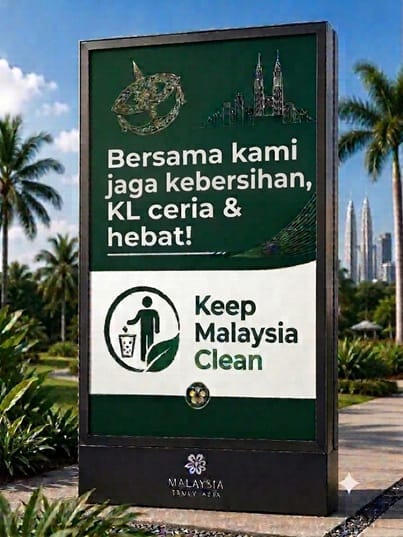
Image Credit: AI-assisted
By Leslie Lim
The unsightly mess left across Dataran Merdeka following the FIFA World Cup final viewing party remains fresh in the public mind. Images of the historic square blanketed in discarded food containers and makeshift mats served as a disappointing reminder of our recurring waste management struggles.
Now, as Malaysia steps in to host the rescheduled Bahrain Grand Prix at Sepang in early October, public commentary naturally centres on ticket rushes, hotel bookings, and logistics. Yet behind the grandstands lies an equally predictable reality: the mountain of rubbish left in the aftermath.
Every major international sporting event attracts massive crowds, bringing with them overflowing bins, plastic bottles, and discarded food containers. Across the globe, with Japan being a rare exception, post-event litter is routinely dismissed as an unavoidable by-product of large-scale entertainment.
Does it have to be?
Expecting an overnight shift to Japanese-style civic discipline is unrealistic. Cultural habits evolve over years, not across a single race weekend. However, halving the volume of rubbish at Sepang and fan zones elsewhere in Kuala Lumpur remains an achievable target through practical, low lead-time logistics – and that depends on how determined we are.
First, deploying heavy-duty, highly visible three-tier waste hubs – complemented by dedicated sorting teams at grandstand exits, shuttle pick-up points, and key pedestrian routes – can prevent conventional bins from overflowing within hours.
Second, organisers must move away from dry and predictable civic slogans and employ creative lifestyle messaging across giant screens and signage – anchored by engaging cues like “full speed, peak vibes, zero litter.”
Reinforced by clear and adequate signage featuring other creative slogans by DBKL on cleanliness elsewhere in the city, these messages ensure reminders resonate and remain impossible to ignore by Malaysians and foreign visitors.
Third, cleanliness efforts must not stop at the track perimeter; major transit hubs, MRT and LRT feeder links, and off-site fan hubs across Kuala Lumpur must be equipped with temporary surge waste capacity to cope with sudden crowd flows.
While quick-deploy logistics will manage the immediate Oct 2–4 crowd at the circuit, Malaysia must look beyond F1.
Sepang should serve as the pilot testing ground for a permanent, long-term urban cleanliness blueprint that will include stadiums, Dataran Merdeka, KLCC Park, Bukit Bintang, Chinatown KL, and public spaces.
Implementing comprehensive waste management measures and additional staffing will inevitably incur extra costs. But Malaysia must look at the bigger picture.
With Sepang continuing to host MotoGP and an extended Visit Malaysia year into 2027, these initiatives should not be viewed as one-off expenses.
Instead, additional cleanliness funding should be treated as a strategic investment to make Kuala Lumpur a cleaner city to be proud of.
Being a commendable host is not measured solely by warm hospitality or an impressive skyline.
Genuine hospitality also means presenting an environment that is orderly, well-managed, and clean.
When international visitors leave Sepang to explore Kuala Lumpur and beyond, their lasting impression should be of a country whose energy is matched by its civic standards.
Let us not settle for merely staging a good show at the F1 race. Sepang can become the immediate catalyst for establishing a lasting national benchmark for cleanliness, event management, and civic responsibility in Malaysia.
Leslie Lim is the Weekly Echo’s columnist
WE