By Leslie Lim
Call it coincidence, or simply impeccable timing — motorsport has reclaimed its spot as one of Malaysia’s hottest topics in recent weeks.
First came the cinematic spark: local cinema-goers flocked to catch Terbang in mid-September, the action drama inspired by national rally legend Karamjit Singh, who famously became a world champion in the WRC production car category in 2002.
By balancing high-revving dirt action with a personal, human story about family struggles, the movie showed that you don’t need to be a hardcore motorsport fan to appreciate the unscripted drama of rallying.
Then came the high-speed off-screen frenzy. The one-off staging of the Bahrain Grand Prix in Malaysia, followed by Singapore’s spectacular night street race, sent nostalgia into overdrive and reignited calls for F1’s permanent return to Sepang.
It’s an enticing thought. Who doesn’t love the roar of a GP grid? But FIA President Mohammed Ben Sulayem has stressed that world-class motorsport requires disciplined planning rather than emotional impulse, calling for a business plan covering at least five years.
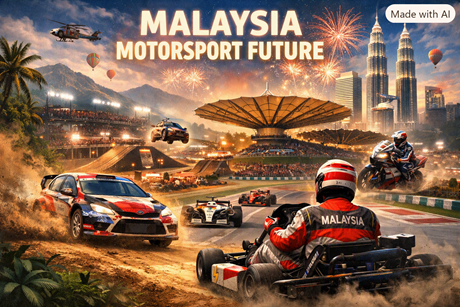
More importantly, he challenged Malaysia to look beyond F1, pointing to more accessible forms of racing — karting, cross-car and rallying — as building blocks for a sustainable motorsport hub.
When you consider the price tag, F1 is a heavyweight contest Malaysia doesn’t necessarily need to enter. With annual hosting fees and operating costs potentially running into RM300 million, competing against richer nations for a crowded calendar slot feels less like a strategic necessity and more like an expensive gamble, even if we succeed in securing a place.
A potentially more affordable alternative is the World Rally Championship (WRC), where Japan remains an established and immensely popular East Asian round, with no round currently in Southeast Asia.
So why not let our heads, rather than our hearts, take the wheel? After all, MotoGP already anchors our circuit-racing calendar, drawing strong crowds to Sepang.
Motorsport’s global appeal is evolving. While circuit events such as F1 and MotoGP can draw massive crowds to a venue like Sepang, WRC offers a different proposition: substantial international television reach and the potential to spread tourism benefits beyond a single venue.
While F1 remains the bigger television draw, with a cumulative global audience of 1.83 billion in 2025, WRC reached a respectable 1.3 billion. Rallying also has a dedicated international following, with fans travelling across countries and continents to follow the championship.
Much of this momentum comes from Munich-based WRC Promoter GmbH, which has spearheaded the championship’s commercial turnaround since 2014 through television production, streaming platforms such as Rally.TV, and a focus on festival-style spectator entertainment.
Borrowing a page from F1’s playbook, a Malaysian WRC round could transform the Sepang circuit precinct into a major lifestyle hub — pairing high-octane rallying with international concerts, hospitality suites, fan meet-and-greets, and local culinary carnivals.
The crown jewel could be a purpose-built Super Special Stage arena at Sepang, inspired by the spectacular stadium stages at Rally Japan’s Toyota Stadium in Toyota City. Designed to bring spectators close to the action, it could feature dual-car, head-to-head racing under night lights, with jumps, tight corners and spectacular drifts.
From there, the rally heads into the wild. Imagine three more days of international coverage following drivers across Melaka and Johor’s gravel tracks, red-dirt estate roads and challenging terrain. The contrast between lush greenery and modern Kuala Lumpur could showcase Malaysia in a distinctive light, with the potential to generate tourism benefits beyond the immediate event.
Re-establishing Malaysia’s presence in the Asia-Pacific Rally Championship, following our exit as a host nation in 2019, could be a sensible first step towards rebuilding our capabilities and developing local talent.
If Terbang taught us anything, it’s that Malaysia’s deepest motorsport magic wasn’t built on sterile asphalt alone. It can also be forged in the mud, gravel and grit of the open trail.
Perhaps it’s time we heeded the FIA’s call and brought the world back to our backyards.
WE