By Dr Rahim Said
Malaysia has spent millions trying to convince tourists to come to Borneo. Then Borneo quietly produced its own jazz festival — and we apparently forgot to tell anyone.
Yes.
Borneo Jazz. Not Java Jazz. Not Jakarta. Not somewhere in Europe where Malaysians fly 12 hours to listen to a saxophone solo. It’s Borneo.
The place we keep advertising to foreigners as a paradise of rainforests, wildlife, indigenous cultures and adventure — but somehow forgot could also produce something as sophisticated as an international music festival.
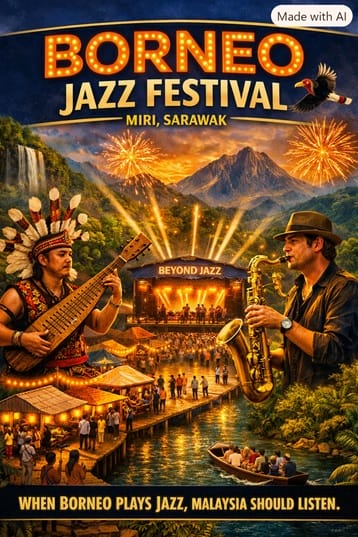
The festival returns to Miri on December 4 and 5 for its 20th edition, bringing international, regional and Malaysian musicians together under the theme “Beyond Jazz.”
Perhaps the organisers should add another theme: “Beyond Kuala Lumpur.”
Because if this festival were happening in Bukit Bintang, we would probably already have influencers telling us it was the next big thing. But it is happening in Miri.
Which means many Malaysians may discover it only after somebody overseas tells them about it. That would be very Malaysian.
We sometimes need foreigners to discover our own country before we do. And that is a pity, because Borneo Jazz is much more than two evenings of music. It is a tourism opportunity wearing a saxophone.
Imagine flying to Miri for the festival. You book a hotel. You eat. You travel. You shop. You visit the rainforest, caves, beaches and other attractions. You spend money. You take photographs. You post them. Someone in Singapore sees them. Someone in Tokyo sees them. Someone in Sydney sees them.
And suddenly they discover something that Malaysian tourism campaigns have spent years trying to explain: Borneo is worth visiting.
Music is one of the world’s great travel magnets. People will cross oceans for Glastonbury, Coachella, Montreux and Java Jazz.
So why shouldn’t people cross the South China Sea for Borneo Jazz? And then there is the part that really matters. Our musicians.
An international festival gives local musicians something money cannot easily manufacture: an audience.
Not just the usual crowd of relatives, friends and somebody’s uncle requesting Hotel California for the fifth time. A proper festival puts local musicians alongside international performers. It creates exposure.
Connections. Collaborations. Possibilities. And perhaps careers. That is how a music scene grows.
Then comes the really interesting possibility. Why should Borneo Jazz merely bring jazz to Borneo? Why not bring Borneo into jazz?
Imagine the sape alongside a jazz quartet. Indigenous rhythms meeting contemporary improvisation. Sabah, Sarawak, Brunei and Indonesian musicians creating something together. Suddenly Borneo is not merely a venue. Borneo becomes the sound. That is when a festival becomes a cultural brand.
The new Festival Village, bringing together food, arts, crafts, retail and performances, is already pointing in that direction. The stage should not be an island. The whole city should become the festival.
And perhaps this is where Malaysian tourism needs to think differently. Stop treating everything outside Kuala Lumpur as “regional.” Miri doesn’t need to become another Kuala Lumpur. That would defeat the purpose.
Miri has something Kuala Lumpur cannot manufacture: Borneo. Rainforests. Indigenous cultures. Wildlife. Food. Adventure. And now — jazz.
That is quite a tourism package. Java has Java Jazz. Borneo has Borneo Jazz. The question is not whether Borneo Jazz can become Java Jazz.
The more interesting question is: Why haven’t we made Borneo Jazz famous yet? Twenty editions are no longer a trial run. It is an asset. A cultural asset. A tourism asset. A platform for Malaysian musicians.
And potentially a global Borneo brand. Perhaps somebody should tell the tourism people. And perhaps somebody should tell Malaysians.
Because there is something slightly embarrassing about having an international jazz festival in Borneo for twenty editions and still having to introduce it with: “Ever heard of Borneo Jazz?”
Maybe the best-kept secret in Malaysian tourism should finally stop being a secret. The saxophone is already playing. Perhaps we should start listening.
WE