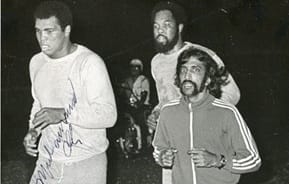
By George Das
I have interviewed almost an endless number of sports personalities during the course of my career as a sportswriter. However, it was the encounter with Muhammad Ali that stands out as the most memorable, as it was conducted in a rather special manner that I recall to this day — some 51 years later.
It was the early hours of June 15, 1975, in Kuala Lumpur. The city lay still, emptied of its usual noise, as though holding its breath.
The setting was the old Selangor Turf Club — a sprawling 100-acre horse racing venue along Jalan Ampang.
Had it survived, it would stand today as one of Malaysia’s great sporting landmarks. Instead, the grounds gave way to modernity; in 1993, the club moved to Sungai Besi, and today the towering Petronas Twin Towers rise where hoofbeats once thundered.
But on that quiet morning, history was not in the future — it was about to unfold. I was there on assignment for The Star newspaper, chasing my story. Not just any story, but one involving Muhammad Ali — “The Greatest.”
Of course, there was no question of stepping into a boxing ring with him. I valued my life and my dignity far too much.
But I had an idea — perhaps a foolish one. If I couldn’t box with Ali, I could run with him. I took the idea to Angelo Dundee, the legendary trainer.
He smiled. “That’s something no media guy has done before,” he said. “When do you want to do it?”
“Tomorrow morning,” I replied, before common sense could intervene.
He told me to be at the turf club before 3 a.m. I arrived at 2:30 a.m. — late, as it turned out. Ali had already come and gone!
But I wasn’t about to lose the story. Dundee arranged for another attempt. This time, I stayed overnight, bunking with Dundee in his room.
And so, I found myself there again — at an unearthly hour, stepping into darkness. The turf was empty. No horses. No movement. Just the thick Kuala Lumpur humidity pressing down, the air already heavy on the skin.
The track lay uneven beneath my feet, scarred by hoof marks, invisible in the dimness. Ali’s morning runs were unannounced. No crowds, no press. Just a few devoted followers who somehow always knew.
When he arrived, I noticed something immediately. His entourage wore heavy military boots. I stood there in my worn-out Adidas running shoes.
The boots, I realised, were no accident — they protected the ankles and added resistance, turning every stride into strength training. This was no casual jog. It was preparation — hard, deliberate, punishing — ahead of his fight with Joe Bugner at Merdeka Stadium on July 1st, 1975.
I began to question my own sanity. Then, without warning, Ali took off. There was no race, no signal — just motion.
We ran through darkness, across damp grass, navigating instinctively along the 16-furlong (about 3,219 metres) or two-lap track. My breaths came quicker than his. For every stride he took, I needed two to keep pace.
Yet, strangely, I found myself enjoying it. The rhythm. The effort. The sheer absurdity of it.
Here I was — an ordinary sports reporter — running shoulder to shoulder with the greatest boxer, nay, the greatest athlete in the world.
We finished together, drenched in sweat. No applause.
No spectators. Just silence, and the hollow vastness of the empty stands.
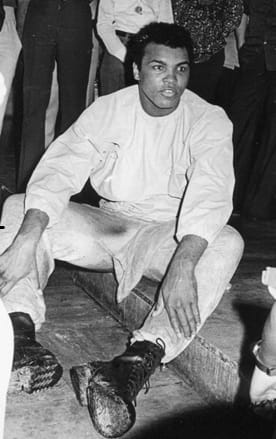
Heavy Boots and All After the Run
As we walked toward the waiting limousine, I made a split-second decision — and climbed in with Ali. A local security officer assigned to Ali objected to my getting into the limousine.
Ali waved him off. “It’s okay,” he said. “He’s my brother.”
In that moment, I wasn’t a reporter anymore. I was part of his world. We talked as the car moved through the waking city. Or rather — he asked, I answered. About my work, my family, my life.
Soon, I found myself in his Presidential Suite at the KL Hilton. He went about his callisthenics while I sat there, absorbing the moment, wishing for something that didn’t exist then — a mobile phone to capture it all.
What I witnessed was not the Ali of the ring. Not the loud, brash showman that the media portrayed him as being, but a quieter man.
He picked up a book and began to recite poetry — softly, almost intimately — just for me.
“The greatness of the smallness of man does not depend upon his wealth
Regardless of how wealthy a man is
Regardless of his Rank or position
If his heart is not great, then he cannot be great
But if his heart is great
Then he remains great under all circumstances
Rich or poor
So, it is the heart that makes one great or small.”
(A verse from The Heart)
Ali may have won his fights with his fists, but he captured the world with his heart. I wasn’t much of an Ali fan.
However, on that particular day, being in his presence converted me into one. This was the real Ali I got to know.
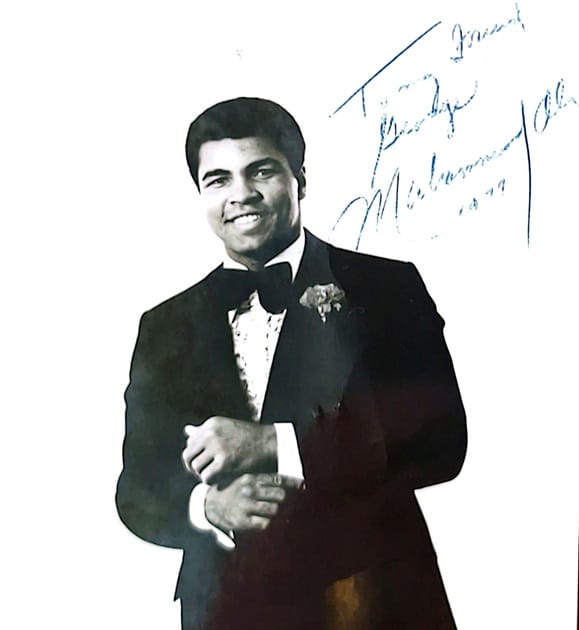
An autographed picture from Ali to me
There was another side that the public hardly knew about — away from the boxing ring and the glare of the media. The humane character I never knew before this. He was so different from all the other international sports icons.
Muhammad Ali in Arabic means “The Praiseworthy and Exalted One”, and that’s exactly who he turned out to be.
He stood up for certain principles and championed freedom, justice and peace.
“The rest of us were just boxers. Ali brought something far greater,” said George Foreman, who lost his heavyweight title to Ali in the famed Rumble in the Jungle.
For over half a century, Ali was the voice for millions who otherwise had none. There has never been an athlete like him, even to this day.
Ali, who claimed the heavyweight boxing title on three occasions, was probably misunderstood by many. He never wanted to be a “political figure”. He just wanted to be a good human being.
That is the Ali I remember. Not the champion. But the man with that mischievous twinkle in his eye mouthing, “I AM THE GREATEST.”
The Fight on July 1, 1975
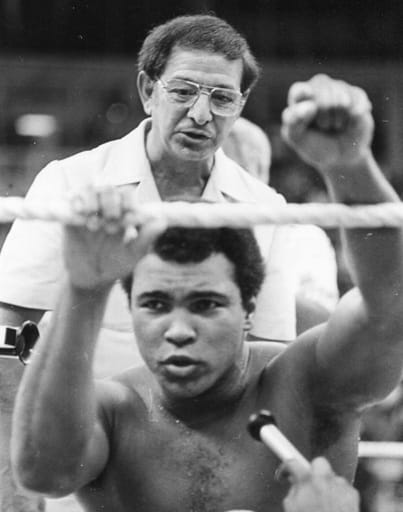
Ali with Angelo Dundee, his trainer
Stadium Merdeka was packed. The hot and humid Malaysian morning added to the drama — sweat and anticipation mingled in the air. The atmosphere was electric, humid, and unforgettable. Ali entered with his trademark swagger, smiling, talking, radiating confidence. Bugner looked stoic, prepared for a long, punishing session.
The fight itself was tactical rather than explosive. Ali controlled the pace, dancing, jabbing, taunting. Bugner absorbed punishment, refusing to crumble. Round after round, Ali’s superiority was evident, but Bugner’s resilience drew grudging admiration.
Ali spoke to the crowd mid-fight, gesturing, entertaining, turning the bout into theatre. Bugner, ever the survivor, kept his guard, endured the blows, and lasted all 15 rounds.
When the final bell rang, the decision was unanimous: Ali retained his title.
George Das currently manages mysportsflame.com, a website dedicated to sports personalities who have done Malaysia proud in the past