By Steve Darby, Football Coach
Coaching Team Johor FA (JFA) between 1998 and 2000, compared to today’s Johor Darul Takzim (JDT) is like comparing life before and after the internet — the differences are huge, and all positive.
JDT have raised the bar for Malaysian football, and other clubs must now follow suit. The whole game will benefit, including the national teams and youth development.
The Differences
To put it simply: we trained on the polo fields in Johor Bahru without dressing rooms. Players changed in cars under trees and used a hose as a shower.
There was no training kit; players brought their own. My battered Proton carried the balls, nets, and bibs. If I forgot to wash the bibs, they stank — and I often forgot!
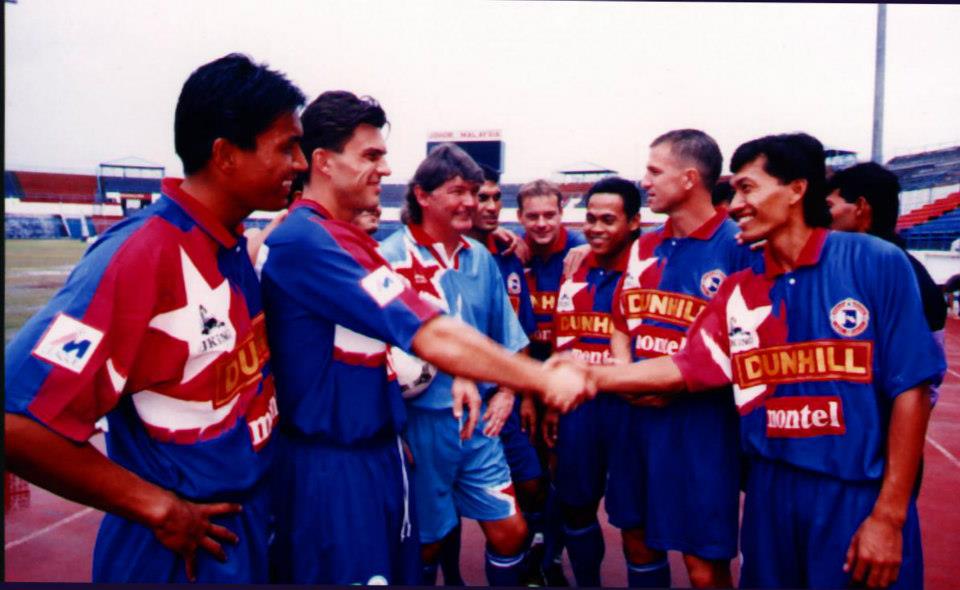
I recently saw a photo of the JDT staff and team, incomparable to what we had. At JFA, the staff consisted of me, one assistant, and a part-time physio. In reality, that was two and a half staff for 20 players, though we relied on a core of 16.
We had three foreigners: Darren Stewart, an outstanding leader who adapted to Johor life and became almost local; Milan Blagojevic, a classy midfielder who sacrificed being present for his son’s birth in Australia to play in the FA Cup — and scored the winning goal in the final; and Freddy, who was unfortunately always injured. With today’s recovery methods, he might have returned.

When I arrived on an eight-game contract at the end of the 1998 season, I saw talented local players and couldn’t understand why they were struggling at the bottom of Division Two. There were internationals like Azmil Azeli, Rizal Sukiman, Idris Karim, Rosdee Sulong, Salim Khamis, and Azmi Mohammad.
I also spotted youth talent in Rizal Zambry. They weren’t just good players — they had character and a genuine desire to succeed. Remarkably, they were all Johorean, something I doubt will ever happen again.
Training and Facilities
The first change I made was reducing the training load: short, high-quality sessions never longer than 90 minutes, held in the morning to aid recovery. Afternoon rain and lightning often disrupted training, so mornings worked better.
We occasionally trained at Larkin Stadium, but the facilities were poor — filthy dressing rooms, broken toilets, even rats. By contrast, JDT’s current stadium rivals many in the EPL, offering fans comfort and appreciation.
Management and Politics
One stroke of luck was having a brilliant team manager, Ahmad Mohammad. Without him, I wouldn’t have survived three years in Johor — perhaps not even the 1998 season. He shielded me from the football politics of the Johor Corporation, which funded JFA but also had its own team, JFC, in the same division.
By 2000, they had cut our budget by 50%. Ahmad taught me to “be like bamboo” — knowing which battles to fight and which to walk away from. That lesson served me well across Asia for the next 20 years.
I also learned much from journalist Rizal Abdullah, who advised me on players and discreetly withheld comments that could have landed me in trouble.
Life on a Small Budget
Budget constraints meant long bus journeys — sometimes 14 hours to Kelantan. We’d arrive, stay overnight, play, then travel back immediately to save money. The silver lining was learning Bahasa Malaysia by watching P. Ramlee movies during those trips.
Luck in Football
I tell young players that three things are vital: talent, hard work, and luck. Bad luck can be an injury; good luck can be playing well when a scout is watching. That’s why I urge players to treat every game as if it’s their last.
My own luck came in my first game — an FA Cup match against Police. No one had even mentioned we were in the Cup; survival in Division Two seemed the only concern. Police hit the post, we scored on a breakaway, and that sparked an unbeaten run. We finished second in the league and won the FA Cup — the first Division Two team ever to do so. In the final against Premier League Sabah, Milan’s magnificent goal and Omar Salim’s brilliant save secured a 1–0 victory.
Legacy

The 1998 season was unforgettable. I remain in contact with many of those players, and Johor football gave me my start in Malaysia and Southeast Asia. I owe the state a great deal.
What JDT are achieving now is tremendous. They could soon become an Asian powerhouse. It’s also wonderful to see former players like Alistair Edwards, Suresh Nair, and Farouk Yahya still involved, providing footballers with a second career — something that is often overlooked in Malaysian football.

Steve Darby, besides coaching the Johor state team in the late 1990s, also coached the Thai national team at the 2009 SEA Games in Laos and later coached Vietnam’s national women’s team.
WE