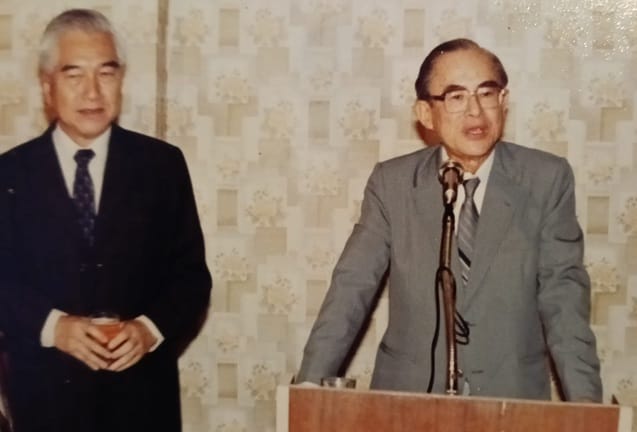
Yap Thiam Huat (left) with Tan Sri Chang Ming Tat
By Phillip Das
There are people we meet when we are young whose lives we only begin to understand many years later. In the 1960s, George Yap Koi Ming and I were simply two boys growing up in the same government quarters on Jalan Peel, Kuala Lumpur.
Those early days continued into our seventies, passing almost in the blink of an eye. Rows of detached houses stood alongside one another, and the children knew almost everyone in the neighbourhood.
We attended the same primary school, La Salle School Peel Road, came home for lunch, and in the evenings gathered outside to play the games that children seemed to invent naturally.
We did not think much about what our fathers did. To us, George’s father was simply Mr Yap, the father of our friend.
Only much later did I begin to appreciate that the quiet man living in one of those houses had spent much of his working life helping to build something far larger than any of us children could have imagined.
His name was Yap Thiam Huat, known to us as Mr Yap. His career, which began in 1947, spanned one of the most consequential periods in the constitutional and legal history of the country: the end of British colonial administration, the establishment of the Federation of Malaya, independence in 1957, the creation of Malaysia in 1963, and the consolidation of the Malaysian legal system through the 1960s, 1970s and 1980s.
He was a disciplined and dedicated public servant, a distinguished legal administrator, an outstanding and meticulous compiler, and a team builder at the Attorney-General’s Chambers.
He was also a keen custodian of Malaysian legislation. His name appears in legal publications spanning the formative decades of Malaya and Malaysia, particularly from the 1950s through the 1980s.
His work was not the sort that normally makes newspaper headlines. He was not a politician. He was not seeking public recognition. His contribution was largely behind the scenes, helping to ensure that the laws of a young and changing country were recorded, consolidated, updated and made accessible to the people whose work depended upon them. That may sound technical. It was anything but insignificant.
Building a Legal System for a New Country
Mr Yap belonged to a generation that witnessed an extraordinary transformation. He lived through the final years of British rule, the achievement of independence in 1957, his involvement as a compiler of the Federal Constitution, the formation of Malaysia in 1963 and its Constitution, the national crisis of May 13, 1969, when Emergency Ordinances and curfews were introduced to restore order, and the subsequent period of reconstruction and institutional development.
Documentary records place his legislative compilation work as far back as 1957, when he was identified as the compiler of the Income Tax Ordinance 1947, incorporating amendments up to 30 April that year. In other words, his work with legislation was already part of the machinery of the Federation of Malaya before Malaysia was formed.
He served in the Attorney-General’s Chambers from the period of British rule through to the 1980s, witnessing and contributing to the development of Malaysia’s legal framework through decades of significant change.
During those decades, the country’s laws were constantly changing. New legislation was introduced. Existing laws were amended. Ordinances became Acts. Regulations were added. Old provisions had to be reconciled with new ones.
Before the age of digital legal databases, keeping track of all this required something that is increasingly difficult for us to appreciate today: painstaking human work.
A lawyer, judge, government officer or student could not simply open a computer and search for the latest version of an Act.
Someone had to compile the legislation, incorporate the amendments, check the dates and make sure the various provisions fitted together correctly. Cross-references, commencement dates, subsidiary legislation and later amendments all had to be followed carefully.
Someone had to ensure that the version sitting on a lawyer’s desk was actually the law as it stood at a particular point in time.
Mr Yap was uniquely well placed for this work. He was an exceptional compiler who built a resilient and capable team within the Attorney-General’s Chambers in Malaysia.
His name became associated with numerous important Malaysian legal publications, including compilations relating to the Companies Act, Legal Profession Act, National Land Code, Road Traffic legislation, Employees’ Social Security legislation, food and drugs law and Federal subsidiary legislation.
The meticulous phrase found in many such publications, “incorporating amendments up to…”, captures the nature of the work.
It was painstaking work that demanded accuracy and left very little room for error.
The work may have been invisible to the public, but it formed part of the infrastructure upon which Malaysia’s legal profession and public administration depended.
A Country Under Pressure
Then came 1969. The events of 13 May shook Malaysia profoundly. The violence and communal tensions that followed represented one of the most serious crises in the country’s early history.
An emergency was proclaimed. Curfews and extraordinary public-order measures were introduced. Government institutions had to continue functioning under conditions that were far from normal. It was a moment when the machinery of the State itself was being tested.
According to the family recollection surrounding Mr Yap, he returned to his office at the Attorney-General’s Chambers the following day. If that recollection is confirmed, it is a small detail with a powerful human meaning.
The man who had been living his ordinary life with his family suddenly found himself part of the machinery of government during one of the most difficult periods in Malaysia’s history.
The Attorney-General’s Chambers could not simply stop. It had to continue functioning, evolving and becoming more resilient and comprehensive as the country moved through the crisis and its aftermath.
The Government required its legal institutions to continue functioning. Emergency measures had to operate within a legal framework. Regulations had to be administered. Government decisions required legal support. The records and machinery of the State had to continue.
People like Mr Yap were part of that continuity. He did not determine the political response to the crisis. His significance lies elsewhere. He was one of the distinguished public servants who continued doing his job while the country around him was experiencing extraordinary uncertainty.
Sometimes public service is measured not by dramatic decisions, but by the simple decision to turn up and continue the work that has to be done.
National Recognition
In 1974, Yap Thiam Huat was awarded the Ahli Mangku Negara (AMN), a federal honour. His name appears in the official Federal honours record for that year. The award provides formal recognition of his public service. But perhaps the more enduring recognition is found elsewhere.
It is found in the legal libraries where his name appears on books that were used by lawyers, students, government officers and others who needed to know what the law actually said.
By the 1980s, his name appears repeatedly in legal catalogues as compiler of important Malaysian statutes. This was also the period when Tan Sri Justice Chang Min Tat served as Commissioner of Law Revision and Law Reform, reflecting the continuing effort to keep the country’s body of legislation organised and up to date.
Yap was not the Commissioner, nor was he a legislator. His role was that of a legal professional working within the machinery that made legislation usable and reliable. He became known for his meticulous attention to detail, language and the refinement of legislation over the decades.
Today, much of that work has disappeared into digital databases. We type a few words into a search box and the answer appears almost instantly.
It is easy to forget that there was a time when somebody had to create and maintain the books that made that knowledge accessible. Mr Yap was one of those people — a compiler whose decades of experience and refinement of legislation gave him exceptional resources and knowledge in this specialised field.
The Quiet Work of Public Service
There is something particularly appropriate about the nature of his contribution. The work of compiling legislation requires patience rather than publicity. It requires discipline rather than applause.
It requires a respect for accuracy and an understanding that a single misplaced provision or overlooked amendment can have consequences far beyond the person holding the book.
Perhaps that is why his contribution is best understood as one of legal stewardship. He helped preserve continuity and make the law accessible during decades when Malaysia itself was changing rapidly.
From Malaya to Malaysia
From colonial administration to independence. From a newly independent nation to a country confronting its deepest internal crisis. From printed statutes and amendments to an increasingly sophisticated legal system.
Through all of these changes, there remained a need for people who understood that the law had to be recorded, maintained and made usable. Mr Yap’s service to the country through the compilation and refinement of legislation over the decades became an important part of Malaysia’s evolving legal framework.
And Then There Was George’s Dad
But there is another way of looking at this story. For all the books, legislation, government service and official recognition, there was also a family. There was a father. There was a man who came home from work. There were six children growing up around him.
And there was a neighbourhood where many young boys knew his son George. None of us children would have understood the significance of the work being done behind the doors of government offices.
We were more interested in getting home from school, meeting our friends and deciding what game we were going to play that evening.
That is how life often works. We meet people before we understand their stories. We see our friends’ parents simply as Mum and Dad.
We do not know what responsibilities they carry when they leave home in the morning. We do not know what decisions they have been entrusted with. We do not know what part they may be playing in the larger story of the country. And sometimes, decades later, we discover that the father of the boy we grew up with was part of something much bigger than we ever realised.
A Legacy Without Noise
Yap Thiam Huat’s legacy is not necessarily one that can be measured in monuments or buildings. It is found in something less visible: in the pages of legislation, in the legal books carrying his name, in the records of the Attorney-General’s Chambers, and in the public recognition he received for his years of service.
All who work in law depend on accurate legislation being available and accessible. Mr Yap made that possible through his work as a compiler, and this became one of his contributions to the country and an expression of his dedication to public service.
And perhaps most importantly, his legacy is found in the generation of Malaysians who worked quietly to build and strengthen the institutions of a young country, where the law could serve without fear or favour.
He belonged to a generation that did not have the conveniences we take for granted today. There were no online legal databases, no instant searches and no digital repositories containing every amendment. There were people who carried institutional knowledge from one generation to another and understood that nation-building was not always about making speeches or standing on a stage.
Sometimes it was about sitting at a desk and getting the law right.
That was the work of Mr Yap, a quiet, kind and caring father who raised six children. He was not a strict man, but he instilled a disciplined approach to life and expected his children to carry themselves with responsibility.
A student of St John’s Institution, he spoke and wrote in English, Bahasa Malaysia and Mandarin, and was able to speak six Chinese dialects.
He was a first-generation Chinese born in Malaya. His father came from Huizhou, Guangdong Province, and was a Hakka. The family home there is understood to be a heritage building.
And for those of us who knew him only as George’s father in the government quarters of the 1960s, perhaps there is something rather moving about discovering the life that existed behind that familiar face.
We were just neighbours then. We were children growing up together, and we could never have known the significance of the man living in the house next door. But now we do. And perhaps that is why his story is worth telling.
WE