By Dr Rahim Said
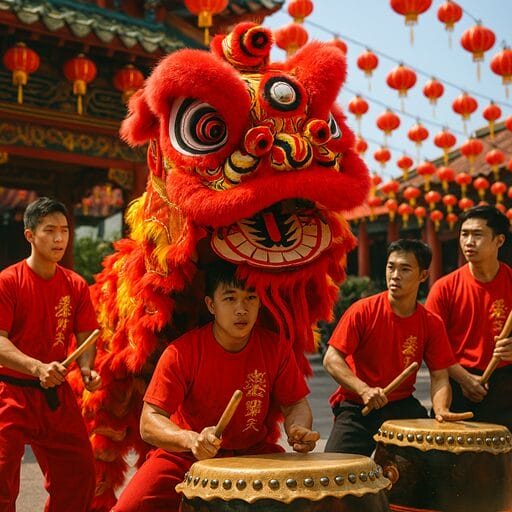
There was a time when Chinese New Year did not arrive by calendar notification, shopping mall banners, or WhatsApp greetings with animated gold ingots bouncing across the screen. It arrived on the wind — carried by the unmistakable tong-tong-tong of distant drums.
That sound alone was enough to send us scrambling.
In those days, we lived in a kampung where festivals did not belong to management committees or marketing teams. They belonged to people. To neighbours. To shopkeepers. To families who saw celebration not as an event to be scheduled, but as an expression of life itself.
The lion dance would appear almost without warning. One moment you would be playing marbles or cycling lazily under the afternoon sun; the next, a thunder of drums would erupt somewhere beyond the coconut trees or behind the row of shophouses. Someone would shout, “Lion dance!” and that was all it took.
We would run.
Barefoot sometimes. Slippers forgotten. Hearts racing faster than the drumbeats themselves.
The lions were never quiet, never polite, never confined by safety regulations. They leapt from second-floor balconies, climbed bamboo poles, squeezed through narrow shop entrances, and occasionally startled unsuspecting aunties hanging laundry. Their eyes blinked wildly, their mouths snapped, and their bodies moved with a mix of grace and mischief that felt almost alive.
Most magical of all was the ritual of “eating” the offerings. Vegetables hung high above shop entrances, oranges tied with red ribbons, and ang pows tucked cleverly among the leaves. The lion would stretch, wobble, and sometimes pretend to struggle before triumphantly snatching the offering — scattering lettuce leaves dramatically to symbolise prosperity flowing everywhere.
We children, did not fully understand the symbolism. But we understood the excitement.
We understood that this was joy.
Today, living in a condominium, Chinese New Year feels… organised.
Too organised.
The lion dance still comes, of course. But now it arrives according to a printed schedule circulated via resident WhatsApp groups:
“Saturday, 10:00 AM — Main Lobby.”
“Sunday, 2:00 PM — Retail Entrance.”
No surprises. No running across muddy paths. No spontaneous gatherings.
Instead, the drumbeats echo faintly through corridors, sounding less like a call to celebration and more like background music for commerce. The performance is orchestrated not by homeowners seeking blessings, but by building management eager to attract shoppers to retail outlets below.
Even the lions seem aware of this shift. They perform efficiently, pose obligingly for selfies, and leave promptly once the schedule demands.
Blessings, it appears, now come with time slots.
Of course, change is inevitable. Kampungs become townships. Open spaces become gated communities. Festivals evolve alongside urban life. There is nothing inherently wrong with this — after all, modern living offers comforts our younger selves could never imagine.
Yet, as Chinese New Year approaches each year, I find myself listening — not for the scheduled drums, but for the memory of unscripted ones.
I miss the unpredictability. The communal excitement. The sense that celebrations emerged organically from the heartbeat of a neighbourhood rather than from a management calendar.
Most of all, I miss how the festival once belonged entirely to the people — not to branding strategies or event coordination.
Perhaps that is the true nostalgia of ageing: not merely longing for the past, but recognising how ownership of joy quietly shifts over time.
Today, the drumbeats still echo in the distance.
But now, instead of running toward them, I stand by the condo balcony and listen.
And for a brief moment, in the rhythm of those fading tong-tong-tong sounds, I can almost hear the kampung calling me back.
WE