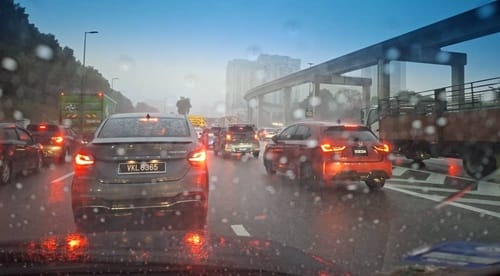
Hanging on there in the heavy rain at nightfall
By Jeff Yong
“When the skies decide otherwise, even the best-laid plans must yield.” That quote aptly describes my experience on Nov 17, 2026, when I found myself around Rimbayu, a new township in Teluk Panglima Garang of the Kuala Langat district.
Some people often associate it with Klang because of its proximity to the more established township. Or nearby Kota Kemuning, which is in Shah Alam. They are, I must confess, alien places to me, being mostly ensconced in Wangsa Maju, Kuala Lumpur, hemmed in by another corner of Selangor.
I had arrived almost punctually for an important meeting at a café. Unfortunately, I discovered that my umbrella was in the boot of my car. Given the wet weather we have experienced in recent weeks, that was a rather foolish oversight on my part.
With the rain falling heavily, I had little choice but to remain in the car until the downpour eased enough for me to make a dash to the café.
After about 90 minutes of productive discussion, I began the journey home to Wangsa Maju, roughly 50 kilometres away as the crow flies. As I drove off, a radio bulletin reported flooding in nearby Kota Kemuning.
By then, the rain had stopped, and I asked my GPS application to guide me to the nearest petrol station before commencing the long drive home.
I faithfully followed the suggested route and continued listening to the radio. My heart sank when the rain returned. Looking up at the sky, I saw nothing but thick grey clouds with little sign of clearing.
As rain pelted the windscreen, I had no idea that I was about to endure a journey lasting more than two hours. Much of the route would be spent crawling through traffic amid relentless rain and worsening road conditions.
Progress was painfully slow. I crept through Subang Jaya, where the heavy rain obscured even familiar landmarks. Eventually, I found myself in the Sunway area before heading towards Jalan Kuchai Lama along the New Pantai Expressway (NPE). Upon reaching NPE, I thought I had found salvation from the inch-by-inch crawl. No such relief, but I encountered strong winds, heavy showers and seemingly endless congestion.
The sole respite came when I entered the Setiawangsa-Pantai Expressway (SPE), where traffic was noticeably lighter. Even then, the weather remained unforgiving. The rainy traffic odyssey was made slightly bearable when a radio station was actively discussing the choice and merits of the new James Bond in Robert Pattinson, who used to be Batman (2022) and starred in Twilight (2008) and Harry Potter and the Goblet of Fire (2005). His varied roles made the discussion more intriguing!
When I finally arrived home, I felt immensely grateful. The drive had been exhausting, but I was fortunate that my vehicle had not stalled in floodwaters or slid into a drain or canal.
Later that evening, as I read news reports of flooded roads and stranded motorists across the Klang Valley, I counted my blessings. Apart from fatigue and a sore right leg from the prolonged drive, I had escaped relatively unscathed. I subsequently shared my ordeal with several close friends and associates who were relieved that I was all right.
Coincidentally, my cousin, Joseph Ong See Sung, who lives in Batu Belah, Klang, was equally exasperated by the watery situation. He texted me the next day to share his experiences with the effects of the flooding and jokingly remarked that the Klang Valley had become “the Venice of Selangor and Kuala Lumpur”. Viola, another Klang resident I know, had her car inundated by floodwaters.
Joseph wondered aloud whether our drains were simply too small, too shallow, or inadequately maintained. He questioned whether local councils were doing enough to clear clogged drains and waterways.
I admitted that I did not have definitive answers. However, I pointed out that the recent rainfall had been unusually intense. We must also acknowledge that our own actions contribute to the problem.
More homeowners today pave over gardens with tiles or concrete, reducing the amount of rainwater that can be absorbed into the ground. As a result, water runs off more quickly into public drains.
Development often comes at the expense of vegetation and trees, further reducing the landscape’s ability to absorb and retain rainfall.
Yet there is one issue that continues to puzzle me.
On numerous occasions, I have observed contractors clearing undergrowth and ground cover, including on slopes adjacent to major highways. One stretch along the Duta-Ulu Kelang Expressway (DUKE), near the Tun Hussein Onn military residential enclave, particularly caught my attention. A large section of slope had been stripped of vegetation and left exposed.
I struggle to understand the rationale for such extensive clearing. Vegetation plays an important role in stabilising slopes, reducing erosion and slowing water runoff. Removing it unnecessarily seems to invite trouble, especially during periods of persistent heavy rain.
Perhaps there are technical reasons that are not immediately apparent to the public. If so, they should be explained. Otherwise, these practices deserve closer scrutiny before they contribute to a preventable landslide or other disaster.
As recent events have reminded us, we may boast ever-improving infrastructure and increasingly sophisticated technology, but nature still has the final say. When the skies decide otherwise, even the best-laid plans must yield.
WE