By Dr Rahim Said
We landed on our favourite holiday island on Friday, February 6, 2026, just as The Jakarta Post ran a report on a massive beach cleanup across Bali. What timing.
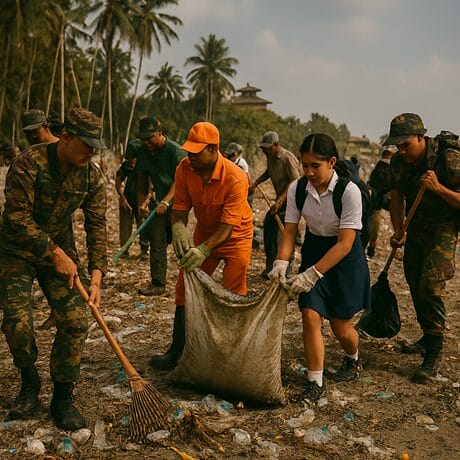
It felt almost theatrical: wheels touched down, phones buzzed, and there it was — news of soldiers, police, students and volunteers fanning out across Kuta, Kedonganan, Gianyar and Jembrana, hauling away tonnes of rubbish that had long overstayed its welcome.
Coincidence, perhaps. But also symbolism.
We have been coming to Bali for over 20 years, at least three times a year. Long enough to notice patterns. Long enough to know that beach cleanups here are not new, but often episodic — like festive spring cleaning before an important guest arrives.
Occasionally, someone would tidy up our regular stretch of Seminyak Beach, just across from Villa Kalimaya. A few trucks, a few workers, a few polite smiles. Necessary, appreciated, but modest.
What we saw — and what Bali is now witnessing — is something else entirely.
This time, the mobilisation feels serious. Hundreds of Bali Police personnel, TNI soldiers, students and volunteers were deployed across multiple beaches.
Tonnes of waste removed in a single sweep. A special task force promised by Governor Wayan Koster to ensure that when marine debris washes ashore at Kuta, the beach is restored within an hour. An hour. In Bali time, that is almost revolutionary.
And all this, because President Prabowo Subianto dared to say the quiet part out loud: Bali is dirty.
More precisely, he relayed what foreign leaders told him after visiting the island. “Bali is no longer as beautiful. The beaches are so dirty now.”
Words that probably stung, especially for an island that has been marketed for decades as the “Island of the Gods” — a place of purity, harmony and balance.
But sometimes, blessings come disguised as embarrassment.
Bali’s waste problem is not anecdotal. It is arithmetic. In 2024 alone, the island generated 1.2 million tonnes of waste, much of it concentrated in tourist hubs like Denpasar, Gianyar and Badung.
Nearly all landfills are full. Single-use plastics dominate the rubbish stream. Only about 48 per cent of waste is properly managed. An estimated 33,000 tonnes of plastic leak into rivers and waterways every year, eventually returning—ironically — to the beaches tourists pay good money to enjoy.
This is not a Bali-only story. It is a Southeast Asian story. But Bali, because of its global profile, does not have the luxury of pretending otherwise.
To his credit, Prabowo did not wrap the issue in euphemisms or bureaucratic poetry. He treated the criticism as “constructive feedback” and challenged the system to respond.
And respond it did. Suddenly, environmental concern found boots, gloves, garbage bags, and authority.
Governor Koster’s policies were already pointing in the right direction: bans on single-use plastics, restrictions on small bottled water, mandatory waste sorting, composting and recycling, and the long-awaited waste-to-energy facility set to begin construction.
But policies, like prayers, only work when practised regularly, not recited occasionally.
What Prabowo’s intervention did was inject urgency. A sense that this was no longer just an environmental issue, or a local governance headache, but a matter of national pride.
Cleanliness, after all, has always carried moral weight in this part of the world. In many traditions, cleanliness is next to godliness — not just metaphorically, but spiritually.
For an island defined by ritual offerings, sacred waters and daily acts of devotion, allowing beaches to be drowned in plastic is not just an environmental failure; it is a theological contradiction.
Tourism Minister Widiyanti Putri Wardhani’s announcement that the Clean Tourism Movement will now be expanded nationwide is another encouraging sign.
Bali, as usual, becomes the testing ground—and the warning sign—for the rest of Indonesia.
Will this momentum last once the headlines fade and the beaches look presentable again? That remains the real test. Sustained cleanliness is harder than dramatic cleanups. It requires discipline, enforcement, community buy-in and the political courage to inconvenience businesses and tourists alike.
But for once, credit where it is due.
If it took a president bluntly saying “this is dirty” to remind us that paradise requires maintenance, so be it. The gods, one suspects, prefer honesty to flattery.
And perhaps, just perhaps, Bali will emerge not only more beautiful — but more blessed — for it.