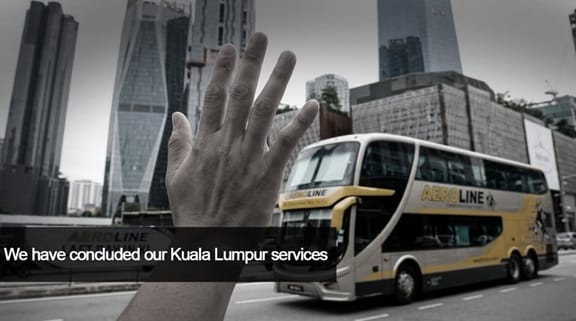
Image Credit: Aeroline FB
By Leslie Lim
The abrupt exit of Aeroline from Kuala Lumpur after two decades is a sobering case study in what appears to be a “decide, announce, and defend” approach to policymaking.
While APAD has valid regulatory reasons to channel express buses into designated terminals to manage urban traffic, the execution reveals an apparent absence of stakeholder empathy.
Finding a win-win middle ground does not require complex transport or traffic expertise – it simply requires a willingness for more engagement with various stakeholders.
Of course, the whole scenario would be completely different today if DBKL, as the city planner, had possessed the foresight back in the 2010s to convert the former Hentian Putra bus station and the car park, located right next to the World Trade Centre Kuala Lumpur, into a purpose-built complex rather than sacrificing it for another commercial development. In an overbuilt city like KL, we don’t need another mall and office building, do we?
The capital is already saturated with vacant commercial square footage and underutilised retail lots.
Had DBKL retained this critical node specifically as a dedicated, integrated complex with a hub for premium transport, wouldn’t there be far more “life”, economic foot traffic, and vibrant excitement brought to Jalan Putra and the surrounding Chow Kit today?
It could have served as a bustling, high-value gateway seamlessly linked to the WTC LRT and Putra KTM lines, rejuvenating local businesses instead of leaving the vicinity to contend with prolonged real estate stagnation.
In essence, a regulator, together with the local council, must act as a market enabler, not just an enforcement body. Resolving this requires shifting from rigid administrative templates to flexible tiering, such as allowing off-street, private commercial hubs that pass traffic impact assessments.
Different commuter segments demand different service levels; forcing premium, point-to-point business class coaches to conform to the same operational framework as budget interstate stages stifles market innovation and drives affluent travellers back into private cars.
Until regulatory frameworks learn to accommodate diversity in service delivery, well-intentioned policies will continue to produce lose-lose outcomes for operators and the public alike.
For Kuala Lumpur city planners, what are your thoughts on reviving Plaza Rakyat?