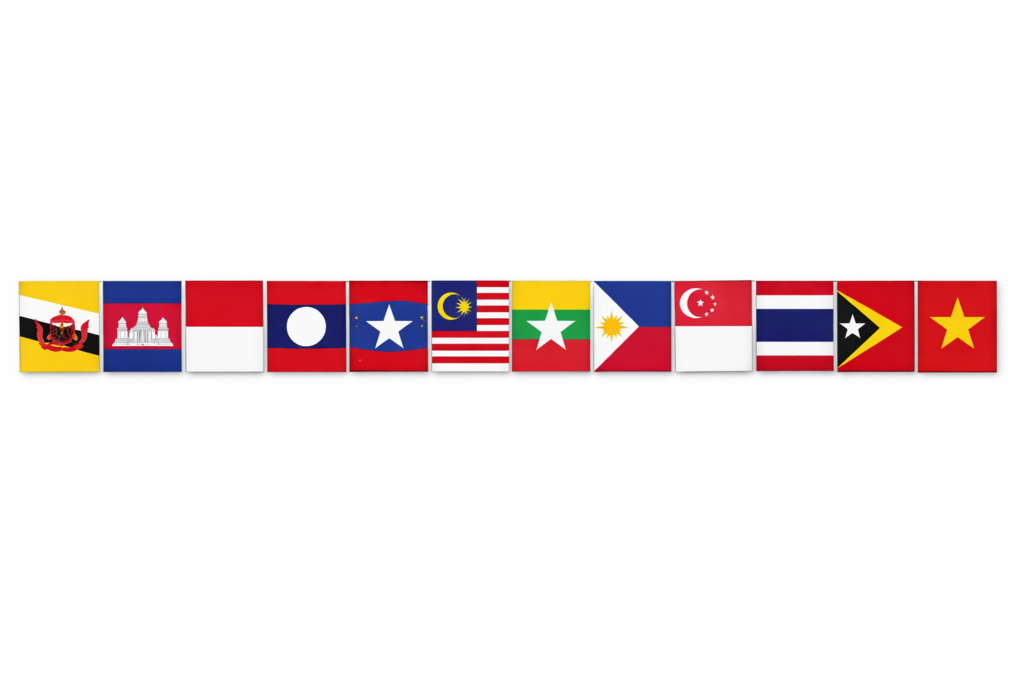
A business analysis by Harris Hakim
For years, the rule of thumb seemed clear: Southeast Asia’s manufacturing future would belong to whichever country offered the lowest costs, the fastest approvals, and the most-free trade agreements. Vietnam was rising. Indonesia was reforming. Thailand was muddling through. Malaysia was stagnating.
That era is over.
Two recent events have shattered the old framework.
First, the China Chamber of Commerce in Indonesia issued an unusually blunt letter to President Prabowo, warning that “law enforcement standards…are opaque and grant excessive discretionary power.” The chamber listed grievances ranging from sharp tax hikes and foreign exchange retention rules to reduced nickel quotas and inconsistent enforcement. Chinese media added specifics: Tsingshan Group and Huayou Cobalt saw their mining quotas cut by 70 per cent, while Huafei Nickel Cobalt had to shut half its production in May.
Second, Bloomberg data showed Singapore overtaking Indonesia as Southeast Asia’s largest stock market. By May 2026, Singapore’s market cap had climbed to US$645 billion, while Indonesia’s had fallen more than 30 per cent from its January peak to US$618 billion. The Edge Malaysia called it a “market verdict” — investors endorsing Singapore’s reforms while losing confidence in Jakarta’s economic management.
These are not isolated datapoints. They are signals of a deeper shift: Chinese investors are no longer comparing efficiency. They are comparing types of risk.
Three Types of Risk
- Indonesia: Discretionary Centralisation Rules change overnight, quotas are cut arbitrarily, and contracts can be reviewed retroactively. This unpredictability is hard to model.
- Vietnam: Nationalist and Geopolitical Volatility Factories can be burned because of a flag. The 2014 anti‑China riots and the memory of the 1979 war linger. Sentiment cannot be controlled.
- Malaysia: Administrative Friction Slow approvals, overlapping agencies, endless stamps. Frustrating, yes — but manageable. You can hire consultants to navigate the bureaucracy.
Administrative risk delays profits. Nationalist or discretionary risk threatens assets, staff safety, and the very existence of the investment. That distinction is everything.
Indonesia’s Problem: Centralisation Without Rules
Jakarta’s nickel policies and downstreaming mandates may make sense domestically, but investors ask: “If rules can change this quickly once, what stops it from happening again?”
The China Chamber’s public warning broke an unwritten rule. Foreign chambers usually complain quietly. Going public signalled that private lobbying had failed, and confidence erosion was becoming structural.
Recent moves — such as giving a Danantara‑linked entity control over key export channels — reinforced fears of creeping state centralisation. Economists warned that unclear implementation and discretionary authority could unsettle planning. Ratings agencies echoed the concern: pricing uncertainty and distorted market mechanisms could weaken sentiment.
This is not ordinary policy risk. It is a discretionary intervention after capital is deployed. That is what investors fear most.
Vietnam’s Problem: The 2014 Memory
On paper, Vietnam looks extraordinary: low costs, fast approvals, strong export manufacturing. But the shadow of 2014 looms large.
When China deployed an oil rig in disputed waters, riots erupted. Factories were burned, workers killed, and thousands of businesses forced to shut down. Nationalism spilt into the streets, targeting any company with Chinese characters on its sign.
For Chinese manufacturers, the lesson was brutal: efficiency means nothing if a mob can torch your factory overnight. Add the memory of the 1979 Sino‑Vietnamese War and unresolved South China Sea disputes, and the risk is existential.
Malaysia’s Quiet Advantage
Malaysia’s risk is bureaucracy. Slow approvals, overlapping agencies, endless paperwork. But unlike Indonesia or Vietnam, Malaysia lacks deep‑rooted anti‑China hostility.
- No war history with Beijing
- No unresolved territorial disputes at Vietnam’s intensity
- No 2014‑style riots
- A large ethnic Chinese business community acting as a cultural and commercial bridge
This matters. Chinese investors may grumble about stamps and signatures, but they do fear nationalist mobs or geopolitical retaliation. For family‑owned groups from Guangdong, Fujian, and Zhejiang — who think in generational terms — stability outweighs speed.
Malaysia’s ethnic Chinese ecosystem reduces language friction, trust barriers, and political anxiety. In a fragmented world, that is a hidden advantage.
The “China + 1 + 1” Strategy
Chinese companies are no longer searching for one perfect ASEAN location. They are spreading risk:
- China: Core R&D and headquarters
- Vietnam: Low‑cost assembly, but not the only leg
- Malaysia/Thailand: Second‑tier assembly, slower but safer
- Singapore: Finance and treasury, expensive but stable
Not perfection — survivability.
The ASEAN Risk Matrix
- Indonesia: Discretionary centralisation; resource‑rich but trust‑poor
- Vietnam: Nationalist volatility; efficient but fragile
- Malaysia: Bureaucratic friction; slow but stable
- Thailand: Political instability, coups, and unpredictability
- Singapore: High cost; safe harbour for finance
The Irony
Indonesia’s problem — centralisation — is hard to manage. Vietnam’s problem — nationalism — is uncontrollable. Malaysia’s problem — bureaucracy — is negotiable.
You can hire runners. You can navigate the stamps. You can learn to love the paperwork.
But you cannot negotiate with a mob. And you cannot predict when a state body will seize control of your contracts.
Closing Line
In ASEAN today, investors are not searching for the perfect country. They are searching for a country where they can survive.
Indonesia’s risk is centralisation. Vietnam’s risk is nationalism. Thailand’s risk is instability. Singapore’s risk is cost. Malaysia’s risk is bureaucracy.
Of all these, bureaucracy may be the most survivable. It is not fast. It is not cheap. It is not glamorous. But it is stable. It is predictable. And it does not burn your factory down.
In a world of fragmentation, that is not a compromise. That is a competitive advantage.
This analysis is based on publicly available sources, including the South China Morning Post (May 2026), Bloomberg, The Edge Malaysia (May 2026), Sina Finance, Netease, Channel NewsAsia (May 2026), Reuters (May 2026), BBC News (May 2014), and Xinhua (May 2014). All claims are attributable to the sources cited. The views expressed are the author’s own analytical conclusions based on the available evidence.