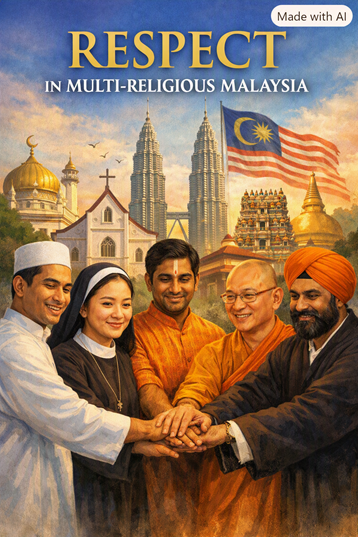
Image by Copilot
By Phillip Das
The words were meant to be a joke. At least, that was how they were presented. A politician had made a remark about another religion. Some laughed. Others applauded. A few shook their heads.
By the end of the day, the words had travelled far beyond the room in which they were spoken. To some, it was just politics.
To others, it was an insult to something they held sacred.
And to many Malaysians, it was another reminder of how easily religion can be turned into a weapon.
When a joke is no longer a joke
There is a difference between laughing with people and laughing at what they believe. A joke may seem harmless to the person telling it. But when it involves a religious figure, a sacred tradition, or a symbol of faith, the person hearing it may not experience it as humour.
They may hear disrespect. They may hear a message that their faith, and perhaps the people who practise it, are somehow less worthy of dignity. That is why words matter.
Not because every disagreement should be silenced, but because freedom of expression does not remove our responsibility for the harm we may cause.
A politician may believe that a religious joke will win applause from supporters. But applause is not always approval of wisdom. Sometimes it is simply the sound of people enjoying someone else being made smaller. And when the subject is religion, the consequences can be much larger than the joke.
The person behind the faith
A Catholic may see a priest or nun not merely as a public figure, but as someone who represents a sacred calling. A Muslim, Buddhist or Hindu may feel the same when a figure or tradition central to their religion is mocked.
Anyone of another faith may feel that same sense of hurt when something deeply respected is treated with contempt. We do not have to share another person’s beliefs to understand that those beliefs matter to them.
That is the beginning of respect.
We can disagree with a politician without insulting his religion. We can challenge a policy without ridiculing a sacred tradition. We can question a statement without turning an entire community into the target of a joke. These are not signs of weakness.
They are signs that we understand the difference between winning an argument and preserving a society.
What are we teaching the young?
There is another question we should ask. When young Malaysians hear leaders using religion as a political weapon, what do they learn? Do they learn that faith is something to be respected? Or do they learn that religion can be used to humiliate another person whenever it is politically convenient?
A young person who hears such remarks may not understand the history, the sensitivities, or the pain behind them. They may simply believe that this is how public life is conducted.
That is where the real danger lies.
Hatred does not always begin with a violent act. Sometimes it begins with a careless word, repeated often enough until people stop noticing its cruelty. And sometimes division begins with a joke that everyone is expected to laugh at.
Malaysia is bigger than our differences
Our country was not built by people who all believed the same things. People built it by learning to live together despite their differences.
Our languages are different. Our customs are different. Our festivals are different. Our places of worship are different. But the country we share is one.
A Malaysian does not become less Malaysian because he is Muslim, Christian, Hindu, Buddhist, Sikh, or follows another faith. Nor does one person’s devotion give him the right to belittle another person’s. Our diversity is not an inconvenience to be managed during elections. It is part of who we are. That is why unity must remain more important than the applause of a political gathering.
The responsibility of leaders
Political leaders have every right to criticise one another. They have every right to debate policies, question decisions, and demand accountability. But leadership carries another responsibility: to understand the power of words.
A remark made from a stage can reach thousands of people. A joke that seems amusing to one group can deepen the hurt of another. And when the subject is religion, the wound may remain long after the laughter has ended.
The measure of a leader is not only how strongly he can speak. It is also how carefully he chooses what should be said. A wise leader knows that there are some things one can say, but should not say. A humble leader knows that being powerful does not make him infallible.
And a responsible leader understands that the people he represents include those who may not share his faith, his language, or his political beliefs.
We can choose a better way
The answer is not to demand that everyone agree. It is to ask that everyone learn to disagree without losing respect for one another. Let our political debates be about the future of Malaysia.
Or our arguments be about the economy, education, healthcare, corruption, jobs, and the welfare of our people. We should challenge ideas, not sacred beliefs. Let us question leaders, not humiliate communities. And let us remember that a person does not have to surrender his faith to show respect for another’s.
Make every effort to keep unity through the bond of peace. That is not merely a reminder for a certain religious group of people. It is a reminder for all of us who share this country.
The choice before us
We cannot control every word spoken by a politician. But we can decide what we will applaud, what we will repeat, and what we will refuse to pass on. Let’s choose not to turn another person’s faith into entertainment.
We can choose to correct our children when they mock what others hold sacred. Defend the dignity of a neighbour even when we disagree with his politics.
Let’s choose to remind our leaders that Malaysia does not need more reasons to distrust one another. It needs more reasons to stand together.
Religion should never be used to make Malaysians enemies of one another. It should remind us of the values we share: humility, compassion, responsibility, and respect for human dignity.
The strength of our nation will not be measured by how loudly one group can mock another. It will be measured by whether, despite our differences, we can still look at one another and say: You are different from me, but you are still my fellow Malaysian.
That is a choice worth making.
The views expressed here are entirely those of the writer
WE