Remove the bottleneck & we’ll be world-class!
By Jeff Yong
When Bahrain bowed out of hosting this year’s Formula One Grand Prix due to hostilities in the Middle East, few expected Malaysia to roar back into the spotlight. Yet here we are — Sepang International Circuit, once written off as a relic of dwindling crowds, is again the centre of global motor racing attention.
For Malaysia, this is more than a sporting revival. It is a statement of resilience and relevance. After nine years in the shadows, the return of F1 to Sepang has reignited national pride and injected fresh energy into the economy. Hotels are full, restaurants are buzzing, and a sell‑out crowd of 100,000 is expected on Sunday. Even Friday’s practice sessions drew throngs of fans eager to feel the thunder of engines once more.
A Race That Means Business
For Petronas, the nation’s oil giant, the timing could not be better. Its Mercedes‑AMG Petronas team leads the constructors’ championship, with Italy’s Kimi Antonelli topping the drivers’ standings and teammate George Russell close behind. The team’s dominance has given Petronas global prestige — a powerful reminder that Malaysia’s name still resonates in the highest echelons of motorsport.
Behind them, the grid brims with talent and rivalry:
- Charles Leclerc and Lewis Hamilton for Ferrari, chasing podiums with renewed aggression.
- Lando Norris and Oscar Piastri for McLaren, both hungry for more wins.
- Max Verstappen and Isack Hadjar for Red Bull, still formidable despite mid‑season inconsistencies.
- Fernando Alonso for Aston Martin, proving experience still counts. His teammate is Lance Stroll.
- Pierre Gasly and Franco Colapinto for Alpine, fighting to stay relevant.
The other teams are Haas (Esteban Ocon and Oliver Bearman), Racing Bulls (Liam Lawson and Arvid Lindblad), Williams (Carlos Sainz and Alexander Albon), Audi (Nico Hülkenberg and Gabriel Bortoleto) and Cadillac (Sergio Pérez and Valtteri Bottas).
Each team brings its own story — ambition, redemption, and rivalry — but none as symbolic as Malaysia’s own comeback this weekend.
Lessons from the Region
When Sepang dropped off the F1 calendar in 2017, officials cited declining spectatorship. Yet Singapore, China, and Japan have since recorded record attendances. The difference lies not in passion but in promotion and management. Singapore turned its night race into a global spectacle, blending sport, entertainment, and tourism into one seamless experience. China leveraged its domestic market and infrastructure. Japan built on decades of fan loyalty.
Malaysia, by contrast, let its crown jewel gather dust. The return of F1 proves that the circuit was never the problem — the vision was. With sharper marketing, better logistics, and stronger partnerships, Sepang can reclaim its place as one of Asia’s premier racing venues.
The Economic Ripple
The numbers speak for themselves. Every hotel room from Putrajaya to Subang is booked. Ride‑hailing apps are surging. Merchandisers, food vendors, and transport operators are seeing brisk business. For a weekend, Malaysia is not just hosting a race — it is hosting the world.
The Nagging Gridlock
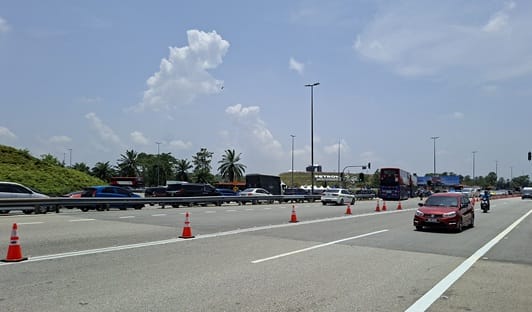
And yet, amid the roar of engines and the cheers of fans, one familiar frustration returned: traffic chaos. Today (Friday) it took nearly an hour to crawl a few kilometres from the highway roundabout near the airport to the circuit. The same bottlenecks that plagued the event nine years ago resurfaced, as if nothing had been learned. Buses ferrying fans were trapped in the same lanes as lorries and private cars under the punishing midday heat.
To be fair, today’s organisers introduced a contra lane for later buses — a small mercy that eased congestion for some. But for earlier arrivals, the experience was miserable.
This cannot be the norm. Malaysians must stop accepting traffic jams as part of the “festive mood” during sporting events. They are not. They are a symptom of poor planning and coordination. Two months ago, I warned that this very scenario could repeat itself — and it has.
A Call for Smarter Management
If Malaysia wants to host world‑class events, it must deliver world‑class logistics. The Royal Malaysian Police (PDRM) and event organisers must treat traffic management as seriously as race safety. My own view of the French Grand Prix at Magny‑Cours some years back remains a model: narrow provincial roads, yet thousands of cars cleared within an hour. Discipline and coordination made the difference.
Sepang deserves that same precision. Fans should remember the thrill of the race, not the agony of the jam.
The Final Lap
The return of F1 to Sepang is a triumph — of timing, opportunity, and national pride. It shows that Malaysia can still host global spectacles with flair. But if we want this revival to last, we must fix the basics.
Let the roar of engines be the only jam we hear this weekend.
WE