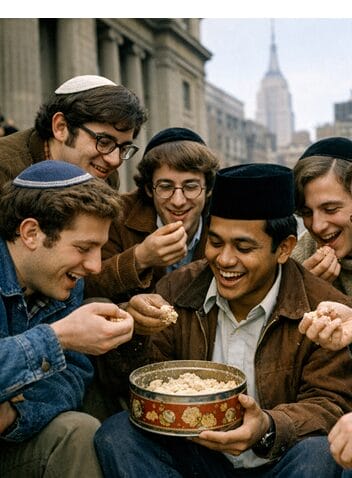
Illustration by Copilot
By Dr Rahim Said
In the mid-1960s, when I first arrived in New York as a wide-eyed young student, I discovered something rather remarkable: on a campus full of what my Muslim upbringing would call “People of the Book,” I was the only Muslim anyone seemed to have met.
My suite mates were among the best and brightest young men that the state of New York had produced that year. Each of them had been carefully selected by the Board of Regents — the top 10 per cent of their high school classes, armed with full scholarships, and the quiet confidence of boys who knew they were expected to become something impressive.
Two were pre-med students who could already pronounce Latin medical terms with the ease of veteran surgeons. Another was a psychology prodigy who would eventually go on to become a professor at Columbia University.
The fifth member of our suite — my roommate from Queens — was a brilliant chemistry major with a mind that sees med wired for discovery. At least that was the expectation.
But university life is a laboratory not just for science, but for human frailty. My roommate would eventually fall into drug addiction, much to the heartbreak of his tightly knit Jewish community and the deep anxiety of his mother. Every morning without fail, she called our room phone from Queens. I was always up early.
“Is he awake? Is he going to class?” Her voice carried the universal tone of motherhood: love mixed with fear.
To my parents back home, New York was not the intellectual capital of the Western world. It was something else entirely. My father had christened it “Kojak City,” after the bald television detective played by Telly Savalas in the wildly popular show Kojak.
My mother and father wrote to me regularly with two consistent reminders. First: study hard. Second: stay away from the Mafia.
It was sound parental advice, though somewhat difficult to operationalise on a campus several miles out on Long Island, where the greatest danger most evenings was burnt cafeteria meatloaf.
Hari Raya came not long after I had settled into dormitory life. It was my first Aidilfitri away from home, and there were no mosques nearby, no Muslim community, and certainly no kampung festivities waiting for me.
But something unexpected happened.
One evening, my Jewish suite mate invited me home to Queens for Passover. I found myself sitting at a long dining table surrounded by a large, warm Jewish family who regarded me with both curiosity and hospitality.
At the head of the table sat the rabbi.
He wore long black robes and possessed a magnificent white beard that could have qualified him for part-time work as Moses in a biblical epic. The rabbi studied me with the intense curiosity of a scholar encountering a rare manuscript.
“You are Muslim?” he asked.
“Yes.”
He leaned forward slightly. “I have never met a Muslim before.”
What followed was less a dinner conversation than a gentle theological interrogation. He wanted to know everything — about Islam, fasting, prayer, the Prophet, and Ramadan.
For a moment in Queens, two traditions that shared the same ancient Abrahamic roots were meeting not through politics or headlines, but over dinner.
Back on campus a few days later, a package arrived from home. It was from my mother.
Inside was a carefully packed assortment of Hari Raya cookies meant to comfort a homesick son thousands of miles away.
Unfortunately, the American postal system had other plans.
The cookies had not survived the journey from Southeast Asia to Long Island. By the time the box reached me, the entire contents had been pulverised into a fine golden powder.
But Malaysians are nothing if not adaptable.
What remained in the large round tin can looked suspiciously like sagon kelapa, that Kedah delicacy made from roasted rice flour mixed with coconut and sugar, usually served in a cone of paper like an edible snowdrift.
So, the five of us gathered around the table in our fully carpeted living room of a suite, courtesy of New York State University.
Five young men from different backgrounds — Jewish boys from New York and one slightly homesick Muslim from Kedah — each took a spoonful of what used to be Hari Raya cookies.
We tasted it together. “This,” I told them with great authority, “is traditional.”
And just like that, on a quiet campus a few miles from the bright chaos of Manhattan, we shared a very improvised Hari Raya. Decades have passed since then.
I do not know where all those brilliant Jewish boys are today. The psychology prodigy undoubtedly continued shaping young minds. Life took my roommate down a more difficult path than anyone had hoped.
As for the devout Jewish friend who brought me home for Passover, he eventually married a Catholic woman and raised their children to become free thinkers — perhaps the most New York ending imaginable.
But every Aidilfitri, when I think back to that first one far away from home, I remember five students standing around a large round tin can fully covered in newspaper wrappings, of crumbled cookies, discovering that even powdered crumbs can carry the taste of home.