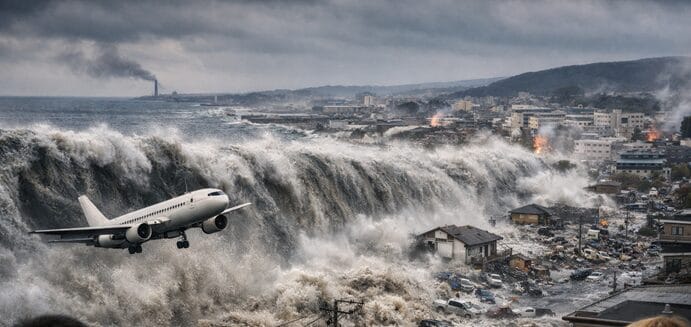
Image Credit: Copilot on Sendai’s Devastation through the March 11, 2011 Tsunami
A Personal Account by Yong Soo Heong
Fifteen years ago, on March 11, 2011, I might have been snuffed out — if not for the sturdy skyscrapers of Tokyo, engineered to withstand earthquakes. That was the day the great earthquake and tsunami struck Japan’s northeast coast, devastating Fukushima and Miyagi, and shaking Tokyo to its core.
It was just after 2 p.m. when the tremors began. I was in a bookshop in the Aoyama district, idly browsing before a 5 p.m. appointment at the Malaysian Embassy in Shibuya. Suddenly, through the large windowpane, I saw construction cranes swaying like palm trees. The building itself trembled like a leaf. The surreal sight left me stunned.
My minder, Junko Tazawa from the Japan External Trade Organisation (JETRO), stammered, “I think so,” when I asked if it was an earthquake — her uncertainty revealing how unprecedented the moment was.
We decided to leave. Instead of calmly walking down the stairs, I leapt to the sidewalk — one of the rare times I jumped without a badminton racket in hand.
On the main thoroughfare, scores of people gathered on road dividers, later increasing to hundreds and thousands, which I was told were considered the safest place should buildings collapse. To me, it seemed futile; if skyscrapers fell, no divider could protect us. Still, I followed, dazed by my first earthquake.
Thanks to Tokyo’s resilient architecture, the towers of Aoyama stood firm. I managed to trek through the cold to the Malaysian Embassy, one of the longest walks of my life, uncertain of what lay ahead.
I exchanged a few words with the ambassador about the quake and the embassy’s work in trade and diplomacy, though his name escapes me now.
Afterwards, I tried to return to my hotel in Ikebukuro. The subway was closed for safety inspections, leaving the city eerily quiet — no rumbling trains beneath, no taxis, no sirens.
Buses became the only option, and I was struck by the orderliness of the queues and the dignity with which drivers ushered passengers, especially the elderly.
The cold winter air pressed in as we searched for food. A restaurant offered brief respite, until closing time forced us back into the silent streets. Hours later, the familiar rush of a subway train finally returned. That sound was music to my ears. We boarded quickly, grateful for the chance to reach Ikebukuro.
Throughout, I was cut off from information, having left my Blackberry behind in Kuala Lumpur. Only later did I learn of the devastation in Sendai, Miyagi’s capital, one of the worst-hit cities.
I shuddered, recalling my earlier plan to visit its mayor, whom I had met in Kuala Lumpur two years before. Fate, and JETRO’s polite refusal to alter my schedule, had kept me in Tokyo instead. If I had gone ahead, you wouldn’t be reading this now!
The next 48 hours were eerie. Tokyo felt lifeless — no cars, police patrol vehicles or ambulances. No movement. My departure on Saturday morning was delayed as airports were closed. I was mostly in the dark. Thanks to the mobile phone I had, sanity was still preserved and also to reassure my loved ones that I was still in one piece!
Eventually, with help from contacts at Malaysia Airlines, I secured a flight home on Sunday morning. The taxi fare to Narita was staggering — RM1,000 — but necessity outweighed frugality. I had plotted taking a train and pondered for four hours or more, but decided against it as the arrival time of 7.45 am at Narita station, and the flight at 9.00 am were too dicey to take such a big life gamble.
Arriving at the airport near midnight, I rested against a pillar at the departure hall, ignoring the makeshift mattresses offered to stranded travellers in the arrival hall, using my bags as my pillows instead. News of Fukushima’s nuclear leak haunted me, conjuring images of Hiroshima and Nagasaki, making me uneasy throughout the night.
Climbing on board the Malaysia Airlines aircraft that morning was one of the sweetest moments for me. On the flight home, the Malaysia Airlines pilot offered weary passengers a gift: a low pass over Mount Fuji. Too drained to look, I simply longed for home. Relief washed over me when I landed at KLIA, embraced by my loved ones later at KL Sentral.
That day remains etched in memory — a reminder of fragility, resilience, and the quiet strength of human order amid chaos. Tokyo’s skyscrapers saved lives, but it was the dignity of its people that left the deepest impression.
WE