By Phillip Das
There is a conversation taking place around the world that Malaysia cannot afford to ignore. It is not a conversation about whether artificial intelligence will arrive, because it has already arrived. The real question is what we are going to do with it and, more importantly, what kind of society we want it to create.
Recently, I listened to Senator Bernie Sanders speaking about the extraordinary speed at which artificial intelligence and robotics are developing. His concern is not that AI itself is evil. In fact, he recognises that it could transform our lives for the better.
His concern is what happens when technology becomes so powerful that its primary purpose becomes replacing people rather than helping people.
That is a very different question.
Imagine a young Malaysian leaving school at eighteen, full of hope. He wants to work, earn a living, marry, raise a family and contribute to society. For generations, that has been the simple contract between a person and the country he lives in: you work hard, you learn, you earn, you build a home, you raise your children and you become part of a community.
Now imagine that one day the job he was preparing himself for no longer exists, not because he was lazy, not because he was incapable and not because he did something wrong, but because a machine can now do the work faster and cheaper. Then imagine millions of people facing the same reality.
That is when AI stops being merely a technology story. It becomes a human story.
We should absolutely embrace AI. Let it help our doctors detect diseases earlier, our farmers increase productivity, our teachers educate children, our businesses become more efficient, and our government deliver services faster while reducing corruption and waste. Let AI take away dangerous, repetitive and exhausting work. There is nothing wrong with that. In fact, it is progress.
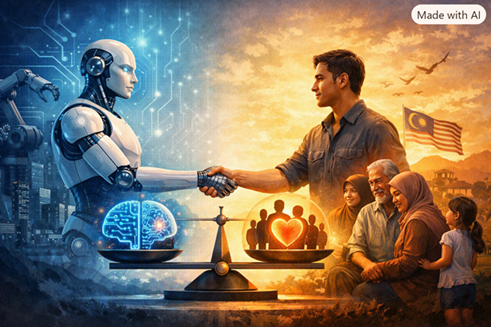
But there is a line we must never cross: technology must serve humanity; humanity must not become the servant of technology.
The danger is that we may begin to measure progress only in terms of productivity. A company replaces a thousand workers with technology, its costs come down, its profits go up, and its productivity rises. On a spreadsheet, that looks like progress. But what happens to the thousand families? What happens to their income, their dignity and the children who depend on those salaries? What happens to the communities where those people live?
And there is an even more important question: what happens to the human connection between us?
We are already seeing how technology can bring two people sitting next to each other into completely different worlds. A family can sit around the same dining table while everyone is looking at a different screen. Friends can be together without actually talking. Children can have hundreds of online contacts but fewer meaningful relationships. Now we are developing machines that can talk to us, listen to us and even appear to understand us.
There is a danger that we begin to prefer the convenience of a machine to the complexity of another human being.
But human beings were never designed simply to be productive. We need companionship, friendship, family and neighbours. We need conversation. We need to laugh together, argue together, forgive one another and sit together when someone is hurting. These things cannot be measured in productivity, and they should not be replaced by it.
This is where I believe Malaysia has an opportunity. We do not have to choose between technology and humanity. We can choose both.
Malaysia can become a country that uses AI to improve the quality of life rather than simply reducing the cost of living for corporations. If AI makes a company twice as productive, the question should not simply be, “How many people can we now remove?” The question should also be, “How can we use this increased productivity to give our people a better life?”
People can work fewer hours. They can be retrained for better occupations. Companies can share more of the gains created by technology with the people who helped create that wealth. AI can allow parents to spend more time with their children, give older people better healthcare and help young Malaysians learn skills that were previously unavailable to them.
That is the AI future I would like to see: a future where technology gives us more time to be human, not less opportunity to be human.
Malaysia therefore needs an AI policy that protects three things: work, dignity and community.
We must ensure that the introduction of AI does not quietly take away the rights and privileges that Malaysians have worked generations to build. If a machine replaces a job, there should be a responsibility to help the person whose livelihood has been displaced. If AI increases corporate profits enormously, society should have a legitimate conversation about how some of that wealth is shared. If AI is used in government, people must retain the right to know when decisions affecting their lives are being made by machines, and there must always be a human being accountable for important decisions.
Because a machine may make a decision, but a machine cannot carry moral responsibility for that decision. That belongs to us.
We should also be careful about allowing AI to become a substitute for human relationships. Let technology connect us, but let it never convince us that connection is the same thing as companionship.
There is a difference between receiving a message and hearing someone’s voice. There is a difference between seeing a photograph and sitting beside someone. There is a difference between talking to an AI and talking to a person who knows your history, understands your pain and remembers the laughter you shared twenty years ago.
Technology can imitate many things, but it cannot replace a lifetime of shared memories.
This is the greatest lesson Malaysia should remember as we enter this new age. We should not fear AI, but neither should we worship it. We should use it, regulate it and benefit from it, but most importantly, we should remain in control of what it is allowed to change about our society.
The richest companies in the world may have the money to build the most powerful machines, but that does not mean they should be allowed to decide what the future of ordinary people looks like. That decision belongs to society. It belongs to governments. It belongs to communities. And ultimately, it belongs to the people.
The purpose of progress should never be to make machines more valuable than human beings. The purpose of progress should be to make human life more valuable.
If AI can do that, Malaysia should embrace it wholeheartedly.
But if the price of progress is a country where people have no work, no income, no purpose and increasingly no need for one another, then we must stop and ask ourselves:
Is that really progress?
The greatest achievement of artificial intelligence will not be that machines eventually become more like human beings. It will be that human beings finally use machines intelligently enough to give themselves more time to be human.
WE