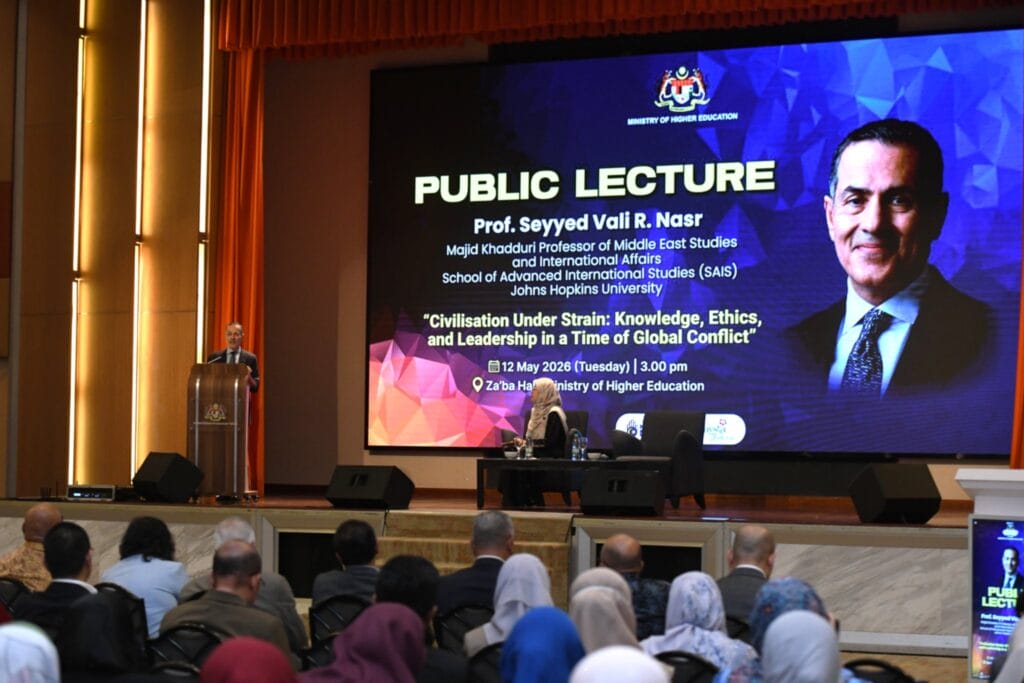
PUTRAJAYA, May 12 (Bernama) — Southeast Asian countries have a direct stake in ensuring stability in West Asia as any escalation of conflict would have serious implications for regional economies and global trade, said prominent Iranian-American scholar Prof Seyyed Vali R. Nasr.
Nasr, who is the Majid Khadduri Professor of Middle East Studies and International Affairs at the Johns Hopkins School of Advanced International Studies, said countries in the region, including Malaysia, could not isolate themselves from instability arising in the Persian Gulf, particularly involving critical maritime trade routes.
“The self-interest of Southeast Asia is that there be no war in the Persian Gulf. It is in the interest of Asia that there be no war in the Bab el-Mandeb and the Red Sea, that it stays open,” he said during a public lecture hosted by the Higher Education Ministry here today.
Speaking on the topic “Civilisation Under Strain: Knowledge, Ethics, and Leadership in a Time of Global Conflict”, Nasr said economic instability arising from tensions linked to the Iran-Israel conflict was already affecting regions far beyond West Asia, including Asia, Africa and Latin America.
He also cautioned that the current ceasefire remained fragile and could collapse if diplomatic efforts failed to progress.
Nasr stressed that any future stability in the region would require a gradual process of de-escalation and coexistence among rival powers, including Iran and Israel.
“You cannot force Iran and Israel to make peace tomorrow. There might be a 10-year period, but you could think there’s a way in which you gradually get into certain live-and-let-live situations where you don’t have active war happen,” he stressed.
Meanwhile, speaking to reporters after the lecture, Nasr said Malaysia’s longstanding ties with Iran were expected to continue despite ongoing tensions in the region.
“Malaysia is not a party to the conflict. However, it’s obviously being impacted by it greatly.
“But I think as things move forward, Iran will look to all of its friends and countries with which it has relationships in terms of finding solutions going forward,” he said.
Commenting on the lecture, Higher Education Minister Datuk Seri Dr Zambry Abd Kadir said Nasr’s presence in the country enabled the government to gain a clearer and more objective understanding of the ongoing conflict involving Iran, Israel and the United States.
He said Nasr had challenged simplistic views of the Muslim world and encouraged a deeper understanding of complex geopolitical realities amid growing global uncertainty, wars and geopolitical rivalries.
“At a time when public discourse is often reduced to slogans and binaries, his work reminds us that history, identity, nationalism, religion and power are deeply intertwined realities that require intellectual honesty and strategic understanding,” he said.
— BERNAMA