By Husna Kassim
We are often told that ageing is a linear decline, a gradual narrowing of what is physically possible. Try telling that to a man opting for competitive riding, clearing over 160 kilometres of punishing terrain on horseback during two gruelling marathons, the World Endurance championships in 1998 (in Dubai) and in 2002 (in Jerez, Spain) at 45 and 50 years old!
Dr Nik started endurance riding at 42 years old, embarking on an athletic career that defied every stereotype of senior life. At 49, he was selected to represent Malaysia at the SEA Games to win a silver medal, despite being relatively new to the sport.
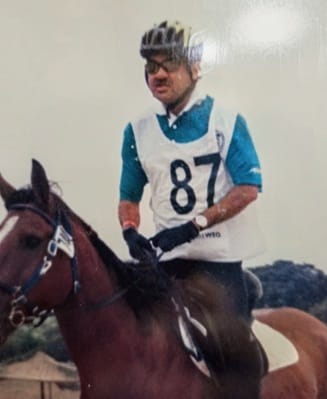
Dr Nik…never too old to ride & still with plenty of determination in him
At 69, after many falls and broken bones, he opted for an operation to install six screws pin and plates in his lumbar spine, and at 73, he is still considering taking up riding again.
He is currently a practising consultant cardiologist at a private hospital in Kuala Lumpur. His persistence to carry on the practice, even after 73, is admirable. He was determined to bring decades of invaluable clinical wisdom to patient care as well as to mentor the next generation. In the end, it is all about his desire to retain mental stimulation.
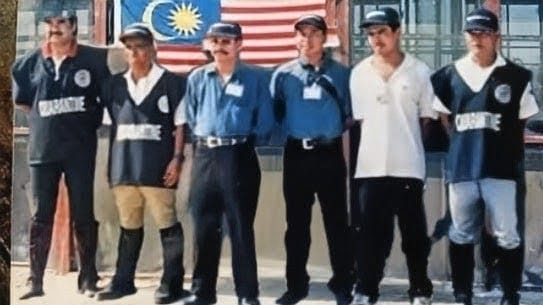
Dr Nik (left) with the Malaysian team at the World Endurance Championship in Dubai, 1998
Unlike Dr Nik, Kay (another old friend who loved leisure riding) and I are happily retired. We used to be researchers in our individual areas for over 32 years, me in oil & gas and Kay in agriculture. All three of us studied at the same university back in the 1970s.
Kay grew up wanting to be a disc-jockey because music was her passion since primary school. She used to love listening to renditions by Nat King Cole, “Rambling Rose,” and then the 60s pop music era took over her daily life. She religiously listened weekly to Top Hits on the radio and watched Beat Club pop music programme on black & white television. (In the 1960s, television was still black & white).
Kay had a rather interesting introduction to horse riding. She was drawn to horse riding following her fascination with some beautiful fairy tale breeds she saw galloping in the movies.
She imagined that riding was for the rich and famous because owning a horse, a stable and following the riding lessons would be expensive. She thought riding was beyond her dreams.
This probably explained why many of those who turned to horse riding, like Kay, entered the hobby at a late age of 40-something, when horse riding, once requiring deep pockets, became more affordable. Most recreational riders, however, rely on commercial clubs located in the Klang Valley, where horse riding is mostly pursued for specialised competitive sports such as polo or dressage.
The beginning of her proper riding classes started at the Bukit Kiara Equestrian Club. Kay rode in the club until one day, the horse suddenly stumbled, and she was flipped over and fell flat on her back ending in a hairline fracture on her tailbone. Kay then decided that it was time to give up riding altogether. But not before she rode in the freezing snow of the pine forests, the mountains and open meadows in Austria. She decided to hang up her riding boots at 53 after that fall.
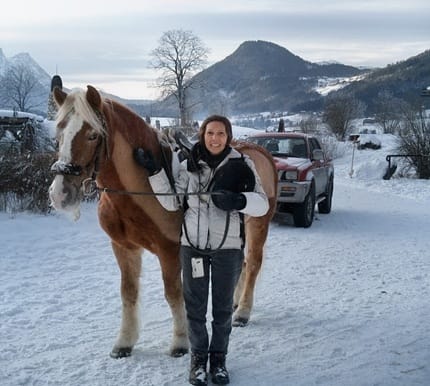
Kay, feeling elated and happy, in snowy Austria
Kay learned that the horses she rode at the Kiara Club and those in Austria reacted differently to the rider’s handling of the reins. Kay also learned, the hard way, that horses are prey species and by nature more prone to flight than fight when something scary happens. I experienced this on my own first riding lesson with Dr Nik when a lorry nearby blew its horn suddenly. The horse just bolted and was up and running at top speed, nearly throwing me off before I reined him in.
Horses could be unexpectedly transformed into a raving lunatic at the start of a ride, such as in a line-up at a race. The horse would get an adrenaline rush when seeing other horses off and running. Dr Nik witnessed this behaviour at the World Equestrian Game in Jerez, Spain, in 2002, where some 200 or so riders from 50 countries were hardly able to hold back their super-fit Arabian horses, known for their superior stamina and endurance, all raring to go (From Hero to Zero essay in People & Places, Walk My Journey, 2022).
He saw his friend, a woman rider, got dismounted during the start of the race. He, too, nearly got dismounted by his horse, Floyd, a half-breed Arabian from Montpellier, France. Floyd was huge and powerful for an Arabian, a cross between a smaller but tougher Arabian and the bigger, faster and taller French national horse, a Selle Francais or a show-jumping horse.
But Dr Nik’s strong legs and control of Floyd’s reins managed to ensure he remained seated in the saddle to start the race.
Unlike Kay, Dr Nik started his fascination for horses while he was just eight years old. Growing up in a village in Kelantan, he was introduced early to pony and horse riding as a deeply rooted tradition where village-style riding and local pony races had been a favourite pastime.
Kelantan’s deep-rooted horse-riding culture stems from close historical trade and cultural ties with the Patani kingdom and Southern Thailand. Horse breeding and bareback racing evolved as a homegrown coastal village tradition. But coming from a poor family, it remained a dream until he was working and the sport became more affordable.
Dr Nik’s first horse was a thoroughbred meant for racing. Boss, originally named K’din, was owned by the late Yang DiPertuan Besar of Negri Sembilan, Tuanku Jaafar. The stall handlers often found the horse difficult to handle as he refused to enter the starting gate or box for the race. Dr Nik bought him from the turf club for just RM800. Dr Nik overhauled Boss from a one-kilometre horse into an endurance horse. How he did it so well is commendable.
Transitioning an Off-Track thoroughbred racing horse into an endurance horse requires shifting the horse’s mindset from short, explosive sprinting to long, relaxed pacing. This transformation focuses on building slow-twitch muscle fibres, cardiovascular base miles and teaching Boss emotional control and relaxation on the trail. Dr Nik became the horse-whisperer!
Asked how he managed to transform Boss into a marathoner, Dr Nik said: “When I bring up an endurance prospect, I not only condition the sinews, muscles and the tendon but I also have to condition the mind of the horse. Race horses are built for a one- kilometre race, at most two kilometres.
“In endurance, we have to condition the mind of the horse to be a marathoner. Progressive long rides over the months and years to bring up the mind of the prospect to ride long and hard, faster and longer, was the strategy in their training.
“At the same time, I must not injure the endurance prospect. Getting the right balance is a fine line between permanent injury to the tendon and sinews and building strength.”
Throughout his riding life, Dr Nik learnt to understand the intricacies of horse control to win races. He put science into the art of riding. The difference between Dr Nik, an endurance rider and Kay, a leisure rider, was the level of passion.
The level of passion and the mindset determine the extent to which one rider will go. There is no age limit to quit a physically demanding passion like riding, especially endurance riding. Many riders continue riding into their 70s.
But when riding transitions from an enjoyable activity to a source of injury or physical limitations prevent you from safe riding, then it is time to quit.
In life, winning is knowing when to quit. Ultimately, it is not the age but the mindset and the physical limits that dictate! And Dr Nik still dreams of competitive riding!
WE