By Leslie Lim
As Budget 2027 approaches, the conversation is dominated by two words: minimum wage. Rising living costs have made this a pressing issue, but the truth is simple — one number cannot possibly capture the realities of Malaysia’s diverse economy.
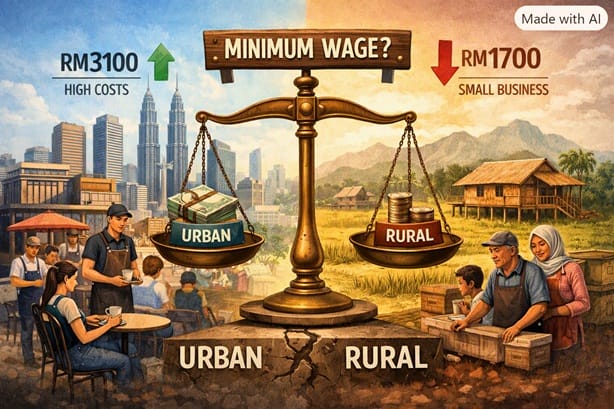
Take MTUC’s proposal of RM3,100. On paper, it matches living‑wage benchmarks. In practice, it risks jolting the economy. A universal jump from RM1,700 to RM3,100 would push the statutory floor above the national median wage, flattening pay scales and leaving half the workforce clustered at the baseline.
The Urban–Rural Divide
Walk into a café in Kuala Lumpur or Petaling Jaya, and you’ll see part‑timers earning RM11–12 an hour. Employers in high‑traffic malls are already paying premiums where demand is strong. Contrast that with a family‑run shop in rural Kelantan or Perlis, where margins are thin and a sudden wage hike could be crippling.
Living costs tell the same story. EPF’s Belanjawanku shows a single adult in the Klang Valley needs RM1,970 a month with public transport, but RM2,800 if owning a car. Lifestyle, infrastructure, and location all shape the numbers.
Why Flexibility Matters
Malaysia’s statutory framework requires reviews every two years, often producing sharp jumps — RM1,500 to RM1,700 in 2022, for example. Even a modest rise to RM2,000 in 2027 would strain micro‑enterprises. Smaller, annual increments would ease the transition while keeping wages responsive.
Regional differences are becoming more pronounced. Southern Johor, with the RTS Link and the Johor–Singapore Special Economic Zone, is evolving rapidly. Expecting one rate set in Putrajaya to suit Johor Bahru and rural Sabah alike is increasingly unrealistic.
Lessons from Abroad
Indonesia and Thailand already use provincial minimum wages. Vietnam applies a regional system, with clear schedules announced months in advance. Singapore’s Progressive Wage Model links pay to skills and productivity, mapped over several years to give employers certainty.
Malaysia has dipped its toes into progressive wages with a pilot in 2024. The next step is to weave these approaches together: regional floors, annual increments, and sector‑specific ladders.
The Way Forward
The principle is straightforward: different communities face different realities. A rigid national baseline cannot reflect them all.
By moving towards a flexible framework, Malaysia can protect workers, support businesses, and build a wage system that grows with the economy rather than against it.
WE