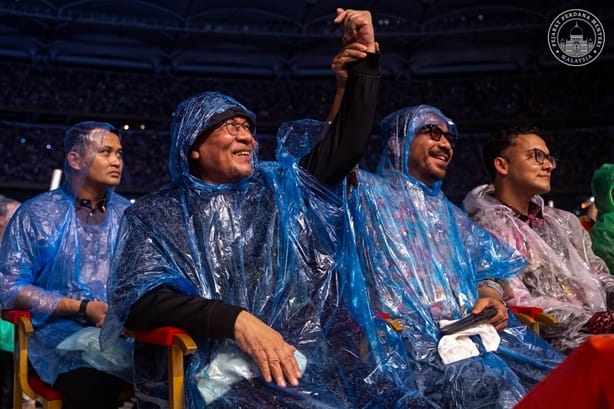
Image Credit Anwar Ibrahim FB: Prime Minister Datuk Seri Anwar Ibrahim (2nd from left) at the concert
By Dr Rahim Said
Malaysia has many national obsessions — shopping malls, grand launches, colourful slogans and the irresistible urge to declare success before the bills arrive. But one passion deserves special recognition: our enduring love affair with rain.
Most countries treat rain as a meteorological inconvenience. Malaysians treat it as an invitation. Why complain when you can turn it into a festival?
Years ago, we had the Monsoon Cup in Terengganu, a sailing competition that brought international attention to the east coast of Peninsular Malaysia during the season when the northeast monsoon made its presence felt. Millions were spent turning a period of rough seas and unpredictable weather into a sporting spectacle.
The logic was admirable. When nature throws buckets of water at you, why not invite the world to watch?
Then there was the Rainforest World Music Festival in Sarawak, where music lovers gathered amid the greenery of Borneo to enjoy music, culture and the natural environment. It was a clever way to showcase our rainforests and attract tourists.
Strictly speaking, the festival celebrates music in a rainforest setting, not rain itself. But never mind. In Malaysia, even a passing shower can be recruited into the tourism industry.
And recently we had Rain Rave in Bukit Bintang, where the prospect of getting drenched is apparently no obstacle to having a good time. Somewhere along the way, we seem to have concluded that if an event is not wet, it is not sufficiently Malaysian.
Perhaps the Tourism Ministry should consider a new slogan: Malaysia, Truly Asia. Occasionally, Truly Soaked. Then came Saturday night at the National Stadium in Bukit Jalil.
On October 17, 2026, some 63,000 fans gathered to watch local celebrity songstress Datuk Seri Siti Nurhaliza perform at Gema Bumantara, her celebration of traditional music and the shared cultural heritage of the Nusantara.

Image: Anwar Ibrahim FB
It was a spectacular gathering, featuring more than 30 classic songs, traditional dances, wayang kulit, heritage costumes and an impressive line-up of guest performers.
The heavens, however, decided to provide an additional production number. Rain fell persistently, but the audience stayed. They were not going to let a little water spoil a long-awaited musical dream.
And there, among the faithful, was Prime Minister Datuk Seri Anwar Ibrahim, wearing a raincoat and enjoying the performance beside Siti’s husband, Datuk Seri Khalid Mohamad Jiwa.
It was a heartwarming sight. The Prime Minister, who spends much of his working life dealing with the nation’s problems, was apparently prepared to deal with one more: getting wet.
Perhaps it was the most democratic moment of the evening. In Malaysia, rain does not discriminate between the prime minister, the ordinary rakyat and the unfortunate fellow who forgot to bring an umbrella.
Everyone gets the same treatment. The only difference is that the Prime Minister’s raincoat is likely to attract more photographers.
Siti thanked him for attending despite his demanding official schedule. One wonders whether the Cabinet had been informed that the Prime Minister was going to inspect the nation’s musical weatherproofing capabilities.
After all, we have had ministers inspect flood-prone areas, visit disaster victims and announce measures to deal with climate-related problems. Now we have a Prime Minister demonstrating solidarity with the people under a different kind of water pressure.
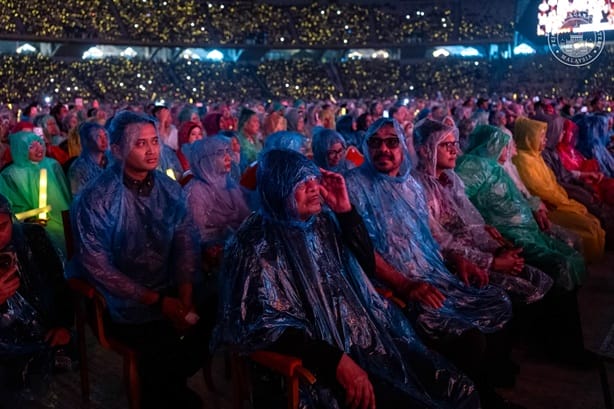
At least nobody could accuse him of governing from a dry office that night. But let us be fair. Gema Bumantara was not a rain festival. It was a major cultural concert, and the audience’s determination to remain despite the weather was a tribute to Siti’s popularity and the emotional connection Malaysians have with her music.
The rain was an unwelcome guest, not the headline act. Nevertheless, the episode raises an amusing question: Why does Malaysia seem so determined to turn every encounter with nature into an event?
We have monsoon sailing, rainforest music and rain-themed entertainment. We have gathered thousands of people in stadiums, parks and open spaces, hoping that the weather will cooperate. Sometimes it does. Sometimes it does not. And sometimes, as with Saturday night’s concert, the show goes on regardless.
Of course, no Malaysian rain story would be complete without mentioning the haze. We have endured periods when the air was so polluted that the sky looked as if it had been wrapped in a dirty bedsheet. Schools closed, outdoor activities were curtailed and Malaysians searched for air purifiers, face masks and explanations.
During such episodes, rain becomes more than entertainment. It becomes a blessing.
A good downpour can help clear airborne haze particles from the atmosphere, although it cannot eliminate the underlying sources of pollution. The real solutions still require enforcement, prevention of open burning and cooperation across borders.
Unfortunately, rain cannot attend diplomatic meetings, sign memorandums of understanding or summon plantation owners to explain themselves. If it could, perhaps it would have delivered a more convincing performance than some of our official statements.
And that is where our national love affair with rain becomes rather revealing. We celebrate it when it arrives at a festival, tolerate it when it interrupts a concert and pray for it when the haze becomes unbearable.
Yet we can spend considerable energy organising spectacles around the weather. At the same time, the less glamorous business of preventing floods, improving drainage, protecting forests and tackling pollution continues to demand sustained attention.
There is nothing wrong with festivals. They generate economic activity, promote tourism and bring people together. Nor should we begrudge 63,000 fans their evening with Siti Nurhaliza, even if they had to wring out their clothes afterwards.
But a festival is not climate policy, and a raincoat is not an environmental strategy. Malaysia’s gift is our cheerfulness when the skies refuse to cooperate. We dance, we sing, and sometimes watch our leaders do the same.
It’s a charming trait — provided we remember resilience is not preparedness. So before anyone proposes another million‑ringgit rain festival, here’s a modest suggestion: make sure the toilets work, the drains don’t overflow, the roads don’t flood and the emergency plans hold. Then turn on the music. And if the rain comes, let it.
After all, we are Malaysians. We’ve lived with the weather, the haze and the occasional government announcement. A little rain is nothing. But if we’re going to celebrate the heavens opening, let’s also ensure the roof above us doesn’t leak.
WE