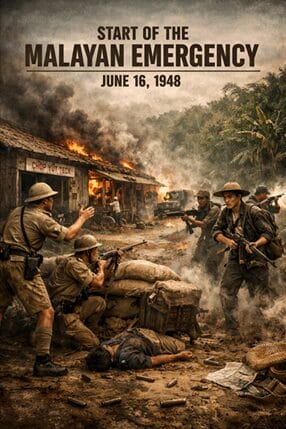
Image Credit: Copilot
By Abdul Mutalib Razak
Every nation has dates etched into its collective memory. For Malaysians, two dates immediately come to mind: August 31, 1957, when the Federation of Malaya gained independence, and September 16, 1963, when Malaysia was formed. They are celebrated, commemorated and taught to every schoolchild.
Yet there is another date that profoundly shaped the country’s journey towards nationhood. It passes almost unnoticed each year. June 16, 1948.
It was on that day that three European estate managers were murdered in Sungai Siput, Perak. Among them was A.E. Walker of Elphin Estate. The killings triggered a chain of events that would lead to the declaration of the Emergency, first in Perak and then throughout Malaya.
A war had begun, although nobody officially called it one.
The British administration chose the term “Emergency” for practical reasons. Insurance companies in London were reluctant to cover losses arising from a war, and Malaya’s plantation and mining industries depended heavily on such protection. Thus, a conflict that would claim thousands of lives and consume 12 years of the nation’s history was reduced to an administrative label.
But make no mistake. The Emergency was a war.
The Communist Party of Malaya sought to overthrow the government and establish a communist state. What followed was a brutal struggle fought in jungles, villages, plantations and towns. It came only three years after the Japanese surrender, when the country was still recovering from occupation and devastation.
For many Malaysians today, it is difficult to imagine the atmosphere of those years. Curfews were commonplace. Roads became dangerous after dark. Buses and lorries were ambushed and burned. Trains were derailed. Entire communities lived under the constant fear of violence. Economic recovery was threatened at every turn.
The Emergency shook Malaya to its foundations. Yet it was also during this difficult period that the foundations of modern Malaysia were strengthened.
Unlike many anti-insurgency campaigns elsewhere, Malaya was never placed under full martial law. Civilian administration remained intact. Elections continued. Political development proceeded. The struggle against communist insurgency was fought alongside a growing movement for self-government and independence.
General Sir Harold Briggs introduced what became known as the Briggs Plan, severing links between communist guerrillas and their rural support networks. This led to the creation of the New Villages, a policy that remains one of the most significant social engineering exercises in Malaysian history.
His successor, General Sir Gerald Templer, added another dimension. He understood that military victories alone would not defeat an ideology. His famous “hearts and minds” campaign sought to win the confidence of ordinary citizens and make them stakeholders in the country’s future.
At the same time, local political leaders were building a new nation. The cry of “Merdeka” was growing louder. The promise of independence offered a political alternative to revolutionary violence.
Templer himself once remarked in a BBC interview that if Malaya could defeat militant communism, then independence could be considered. History would prove him correct.
The Emergency officially ended on July 31, 1960, but communist insurgency lingered for decades. The conflict finally concluded with the signing of the Hatyai Peace Agreement in 1989, bringing a formal end to hostilities after more than 40 years of struggle.
Today, however, public memory of the Emergency has faded. Many younger Malaysians know little about it beyond a few paragraphs in a history textbook. They recognise the names of some political leaders but not the sacrifices of police constables, soldiers, estate workers, planters, villagers and ordinary civilians who lived through those uncertain years. Perhaps the most poignant annual remembrance takes place not in Kuala Lumpur but in a quiet cemetery in Batu Gajah, Perak.
Known as God’s Little Acre, it is meticulously maintained and serves as the resting place of many who lost their lives during the conflict. Each year, veterans and families gather there to honour the fallen, keeping alive a tradition that owes much to the dedication of individuals such as Datuk Thambipillay Rajasingham, who chronicled its history in his book God’s Little Acre.
Yet one cannot help but wonder why the nation itself pays so little attention to June 16. Other countries understand the power of remembrance. Australia and New Zealand commemorate Anzac Day every April 25. The world remembers D-Day on June 6. These dates are not merely about military history; they are reminders of sacrifice, resilience and national identity.
June 16 deserves similar recognition. Not because we should glorify war, but because we should remember the cost of peace.
The Emergency was more than a conflict between government forces and communist insurgents. It was the crucible in which modern Malaya was forged. It tested institutions, communities and political leadership. It shaped policies that continue to influence the nation today. Above all, it helped clear the path to independence.
Former Prime Minister Tun Abdullah Ahmad Badawi once observed that the Emergency remains relevant because it demonstrates a timeless lesson: violence can never be justified as a means to achieve political ends. That message is as important today as it was in 1948.
History is not only about celebrating triumphs. It is also about remembering trials. And if August 31 marks the destination, then June 16 marks one of the most difficult roads that led us there.
A nation that forgets such a date risks forgetting how hard-won its peace and freedom truly were. This version reads as a commemorative news column rather than a historical memorandum, while preserving the key facts and argument that June 16, 1948, deserves greater national recognition.
The views expressed here are entirely those of the writer, Dato’ Seri Abdul Mutalib Razak, a lawyer by training and formerly Chairman of Media Prima