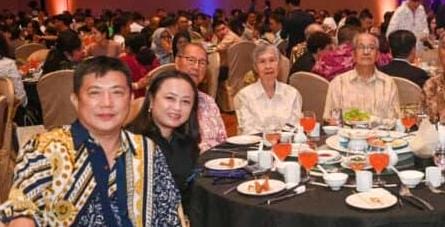
(From right to left) Datuk Teh Kew San, Datin Ng Me Ling, Datuk Yew Cheng Hoe, Mrs Ong Ewe Chye and Ong Ewe Chye) at the Penang Badminton Association’s 100th anniversary dinner in November last year
By Yong Soo Heong
KUALA LUMPUR, May 14: “Kew San recognised me and called my name in a video call yesterday,” said ex-Thomas Cupper Datuk Yew Cheng Hoe, when describing his timely call to his team captain, the late Datuk Teh Kew San, 91, before he passed away in Penang at 10 am today. (Cheng Hoe had asked someone at Kew San’s home to facilitate the call).
As one of Kew San’s closest friends and team-mates, Cheng Hoe had visited Kew San at the Penang General Hospital some weeks back.
A few days ago, he told me that Kew San’s condition was deteriorating and that we should offer prayers to the badminton maestro.
“I’ve kept in touch with the family for the past two weeks. I’m so glad we had a conversation via video yesterday, and he was able to call my name,” said Cheng Hoe, 83.
Kew San was always a highly respected sports personality in Penang, especially at his place of work, the Penang City Council. He not only excelled in badminton, but also in other sports that put his skilful hands to good use, like hockey, cricket and basketball. He even took part in football at the school and inter-department competition levels.
Always calm, soft-spoken and unassuming in his disposition, he was well-liked by many in the sporting fraternity, especially in badminton, where he was the Thomas Cup captain in 1967.
Kew San’s international breakthrough came in 1959 when he and partner Lim Say Hup captured the prestigious All England Men’s Doubles title, defeating top European contenders in a display of agility and tactical brilliance. This victory marked Malaysia’s early dominance on the world stage and inspired a generation of players to pursue global success.
His versatility was rare — he excelled in all formats, earning medals at the Asian Championships (1962) and Asian Games (1962 and 1966), where he won gold in mixed doubles with his wife and partner, Ng Mei Ling.
Throughout his career, Kew San represented Malaysia in four Thomas Cup campaigns (1958, 1961, 1964, and 1967), consistently delivering crucial wins in singles and doubles. His contributions extended beyond competition; he mentored younger players, promoted grassroots development, and served as a bridge between the sport’s amateur beginnings and its professional future.
His popularity would often see his friends, team-mates, supporters and “students” celebrating Kew San’s birthday in late January. The organisers would usually have a tough time choosing the date, which was either on his exact birthday on Jan 26 or somewhere near it, and they would also ensure that the event did not “clash” with the Chinese or Lunar New Year, which usually falls around that time!
Ex-national player Ho Khim Soon and another badminton enthusiast, Albert Goh Teong Hoe, would usually be the convenors with calls to friends and acquaintances, near and far, with the usual question in Hokkien: ”Lu eh lai, bo?” (Can you come?). And the turnout would usually be more than decent – some six to eight tables with 10 diners each, and sometimes even reaching 10 tables for Kew San, who was affectionately known as “Ah Pek” by those close to him.
Equally adept at playing the singles and doubles, he was from the amateur era of the 1960s and 1970s, where sportsmen indulged in the game not because of big money but interest and passion. And because of that, he sacrificed a lot in terms of time and effort for his employers, state and country.
“I can safely say he was humble and helpful. To me, he is ‘Mr Badminton’. He quietly trained many players to become champions, though many people may not recognise this. He had done so much for badminton,” Cheng Hoe told KH Ong of Bulletin Mutiara, an official publication of the Penang state government.
Cheng Hoe recalled admiring Kew San as a schoolboy, watching him play at practice sessions. “I’m so glad I eventually joined him on the same team. We were teammates and partnered to win the Penang Open in 1964. When I spoke with Kew San, he would often recall that we beat a formidable Indonesian pair 15-0, 15-0 in that final match — a feat that had never been achieved before,” he told Ong.
After his competitive badminton-playing days, Kew San continued to help provide a place for teenage or twenty-something aspirants to receive tips and guidance at the Lee Kongsi or Long Say Building along Jalan Burma before he moved his base to the Yong Men’s Christian Association in Jalan Macalister and the Chinese Recreation Club in Jalan Victoria Green.
I remember watching Kew San play during his heyday. A peculiar characteristic of his was seeing him rubbing his racquet face against his hair on the head whenever a mistake was made, as if to remind him to buck up. Or when the shuttle had not been hit properly earlier in a move to “smoothen” the natural guts of his racquet and preserve the longevity of those expensive strings, then!
In the later years, Kew San slowed down and described his court rental sessions as providing an avenue for “social badminton”, especially for veterans keen to sweat it out.
And sometimes, for the fun of it, some of these “social badminton” encounters would revert to the old format of 15 points, service overs, and even second serves for the doubles matches!
WE