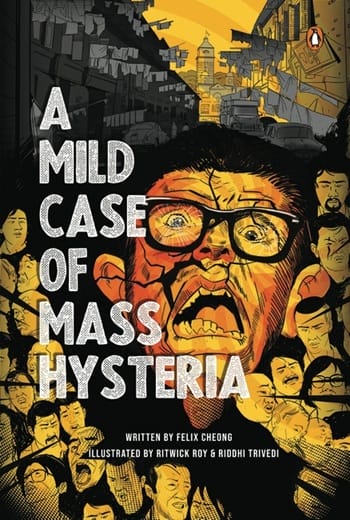
Review by Cyril Pereira
Written by Singaporean author Felix Cheong, it’s a satirical graphic novel illustrated by Ritwick Roy and Riddhi Trivedi. The book cleverly uses a bizarre slice of Singapore’s history as a metaphor to explore deeper social themes like class, sexuality, national identity, and the fragile nature of a newly independent country, some two years after Aug 9, 1965.
The story takes place in October 1967 during Singapore’s real-life “Koro” epidemic. (Koro is a form of mass psychogenic illness or mass hysteria where hundreds of men suddenly panicked because they believed their genitals were shrinking into their bodies and that they would die if they let go — hence the phrase “hold it or lose it”). Sufferers went to extreme lengths, using clothespins, clamps, or a firm physical grip to prevent it.
Against this chaotic and comedic backdrop, the novel follows three young men from different walks of life — Su Tang, a rookie gangster operating out of Chinatown who falls for a woman in an all-female gang; Wee Tiong, a closeted young doctor who just returned from his studies in the UK, struggling with his sexuality and his dying mother’s traditional wishes; and James Yang, a resentful young man conscripted into the army who unexpectedly finds a sense of purpose in military machismo.
The book cleverly uses their intersecting lives to show how personal insecurities mirror the grander, collective anxieties of a young Singapore finding its footing.
The graphic novel opens with a string trailing down to a cryptic statement: “Tie it quick before it slips away.” The October 1967 landscape saw an existential panic of imperilled manhood that gripped Singapore. The nation suffered a mass delusion of penis shrinkage, “Suo Yang” in Mandarin – boys and men were string-tying, clothes-peg clamping, or holding on to their members in life-and-death fright, as they were raced to hospitals.
The medical advice was “There is nothing wrong with you. It is all in your mind.“ Doctors classify this mass delusion contagion as psychogenesis.
Being a peculiarly Chinese-male trauma, Koro left Malay and Indian fellow-citizens alarmed, puzzled, curious. Traditional Chinese medicine referred to the penis-retraction syndrome as yin-yang imbalance, which could lead to death. That triggered the Koro hallucinations and terrified 24/7 dick vigilance.
Through an intense public education campaign, the Health Minister and Medical Association officers addressed citizens across all media channels. Nobody died from the hysteria; the madness subsided within a fortnight. Normalcy was restored to gender relations. The panic was contained.
Some social analysts placed Koro within the larger anxiety of the island’s abrupt August 1965 separation from the Malaysian federation. The forced-independence gloom was compounded by high unemployment, the withdrawal of British military forces, zero national security capacity, and no road map for survival. Was that collective depression ripe for the Koro freakout?
The point man destined to lead Singapore had his back to the wall. He had no time to waste — and no patience for those unable to see the mission urgency. Singapore’s nightmare allowed no space for complacency. Its leaders and flock were uptight about nation-building. By contrast, people in Malaysia seemed cavalier about the muddles of political leaders, laughing off their vanities and failures.
Using the Koro story as an anchor, Felix Cheong plumbs sexual anxiety, cultural superstitions, and the broader Singapore social fabric.
His scenarios include an anxious mother prompting her doctor-son to marry, a father scolding an alcoholic late-night partying boy, a teen finding the rules-driven regime of national service just right, an Alpha-female moll saving a guy from gang violence, and a mousy stenographer marrying a closeted gay man for respectability. Locals can recognise these as familiar.
The graphic novel format allows tales to be conveyed with action and emotion beyond text. It enables future development into animated short movies. This collaboration between a Singaporean writer and two Indian illustrators maps the possibility for more regional integration of talent, across borders of geography and culture.
Malaysian Cyril Pereira has been living in Hong Kong since 1985. He was the former Publisher of the Asia Magazine and Ops Director of the South China Morning Post