(The Formula One roar has returned to Sepang — but so has the chaos)
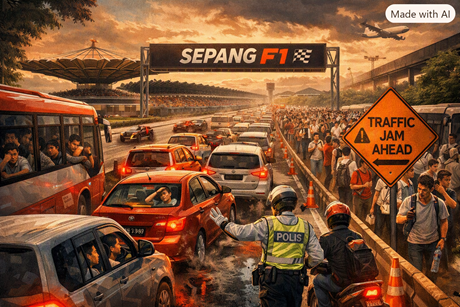
Image created by Copilot
By Jeff Yong
On Friday, the first day of practice for the Bahrain Grand Prix relocated to Malaysia, the Sepang International Circuit was once again engulfed in scenes that Malaysians know all too well: gridlocked traffic, endless queues, and parched spectators under the punishing sun.
It was supposed to be a triumphant comeback. Instead, it became a sobering reminder that Malaysia’s organisational reflexes for large‑scale events remain stuck in the past.
Déjà Vu in the Fast Lane
I wrote on the matter two months ago about traffic management at Sepang. Sadly, the warnings have materialised again — and this time, not even on race day. Friday’s fiasco unfolded before the weekend crowd arrived in full force.
Visitors complained of disorganised transport, long waits for shuttle buses, and even longer waits for water. Social media brimmed with frustration: fans walking along highway emergency lanes, fainting under the heat, and waiting hours for buses that never came.
One fan wrote, “I’ve been to Grand Prixs all over the world and not experienced chaos like this. And it’s only Friday.” Another lamented, “No signs. No lines. Just a complete free‑for‑all.”
These are not isolated gripes. They are symptoms of a deeper malaise — a complacency that has crept into our event culture, the “biasa je” attitude that accepts mediocrity as inevitable.
The Human and Reputational Cost
The organisers may have been focused on ensuring the FIA was satisfied and that the race itself ran smoothly. But Formula One is not just about the cars and the track. It is about people — spectators, volunteers, vendors, and transport workers — whose experience defines the success of the event.
When thousands of fans are stranded for hours, dehydrated, and frustrated, the reputational damage extends far beyond Sepang. It reflects on Malaysia’s preparedness for international tourism and our ability to host world‑class events.
We cannot afford to treat visitors as afterthoughts. Every queue, every delay, every missing water station chips away at the image of Malaysia as a capable, welcoming host.
Lessons Ignored
Nine years ago, when Sepang last hosted F1, similar complaints surfaced. Traffic snarls, poor signage, and inadequate crowd control were all part of the post‑race chatter. The organisers promised lessons had been learned. Yet here we are again, watching history repeat itself — only this time amplified by social media.
Reports of spectators taking three hours to reach KLIA2 from SIC and then waiting for the train to take them back to Kuala Lumpur are pure agony. And don’t forget the hassle of reaching SIC earlier in the day! What have we done or not done to create this mess?
The irony is painful. Malaysia fought hard to reclaim its place on the F1 calendar after Bahrain’s withdrawal. The spotlight is back on us, but instead of showcasing efficiency and hospitality, we are once again making headlines for the wrong reasons.
The “People‑Movement” Problem
Crowd management is not rocket science. It is logistics, planning, and empathy. It requires anticipating bottlenecks, coordinating transport schedules, and ensuring basic amenities like water and shade.
The Royal Malaysian Police (PDRM), Prasarana, and the Sepang International Circuit management must work in concert — not in silos. Contra lanes for buses are a good start, but they must be properly timed and communicated. Shuttle frequencies must match crowd surges. Water stations must be operational, not ornamental.
If Singapore can move 300,000 spectators through its night race with precision, surely Malaysia can manage 100,000 without chaos.
Abandoning the “Biasa Je” Mindset
We must stop normalising disorder. Traffic jams are not part of the festival mood. Long queues are not proof of popularity. They are failures of planning.
Malaysia’s hosting of the Bahrain Grand Prix should have been a showcase of competence — a chance to prove that we can rise above the mistakes of the past. Instead, Friday’s scenes have reminded us how far we still have to go.
The Final Lap
There is still time to salvage the weekend. The organisers must act swiftly: deploy more buses, open dedicated lanes, improve signage, and ensure water stations are fully stocked.
But beyond this weekend, Malaysia must confront a larger truth. We cannot aspire to host world‑class events while clinging to third‑class management habits.
The roar of Formula One has returned to Sepang. Let it not be drowned out by the groans of stranded fans.
WE