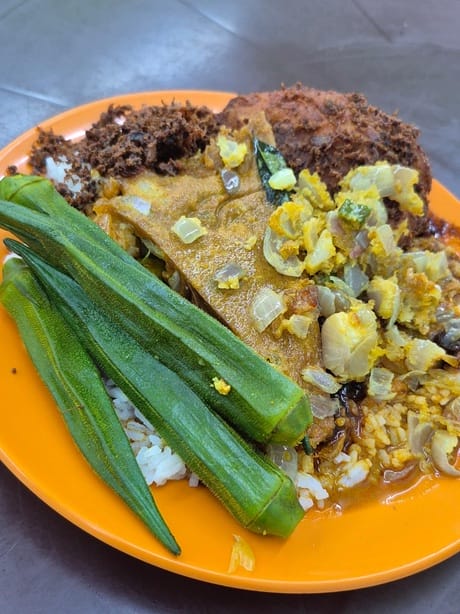
Leslie Lim Takes a Serious Look at the Revered Dish
AAsk five people where to find the best nasi kandar (or curried rice, for the uninitiated), and you will not merely receive five different answers. You may well ignite a spirited debate over spice profiles, generational loyalty and the delicate chemistry of kuah campur (mixed gravy).
Like nasi lemak and char koay teow, nasi kandar can spark surprisingly passionate arguments over which stall does it best. Where you go for a hearty meal depends entirely on whom you ask.
When a popular outlet gets picked up by the Michelin Guide, the queue can suddenly stretch out to the main road. But recognition often brings a bump in prices, leaving regulars wondering whether they are paying for the food or simply for the overnight fame.
A Google reviewer might award a single star because parking proved elusive on a Saturday, while another may have genuine reservations about the balance of spices or find the daging masak hitam (beef in dark gravy) too tough.
Social media enthusiasts, meanwhile, are drawn to dramatic slow-motion pouring or “flooding” of the gravy or banjir, although some diners would argue that a glossy, oil-rich gravy is precisely what makes the experience worthwhile. Others prefer greater depth, nuance and a more harmonious blend of spices.
Then there is the kaki nasi kandar or aficionado who demands old-school authenticity. If an outlet cannot consistently serve a fine kari bawal hitam (black pomfret curry), perfectly tender ladyfingers and, above all, a seasoned veteran behind the glass counter, it holds little interest.
And let’s not forget the regular who swears by a neighbourhood stall simply because the person behind the counter routinely throws in a little extra gravy and a handful of crispy batter bits.
I’m often asked where to find the best nasi kandar. My standard reply? It isn’t necessarily a chain outlet or the one with the longest queue in town. Some kaki nasi kandar prefer the old-school experience: familiar flavours, traditional cooking and, above all, consistency. Popularity and quality do not always go hand in hand.
The Jockey: Architect of the Perfect Plate
In most culinary traditions, the chef in the kitchen determines the outcome of a dish long before it arrives at the table.
But Nasi kandar turns this idea around. The kitchen may prepare the individual curries and dishes, but the jockey, or person behind the food counter, as he is popularly known among kaki nasi kandar, is the real architect, or even conductor, of the meal, shaping the gravies towards their final taste.
He is not merely taking orders or scooping food; he is exercising culinary judgement, tailoring each plate to the diner. Two people can select exactly the same piece of fish, ladyfingers and salted egg from the display counter, yet walk away with entirely different meals depending on whose hand tilts the ladle.
For regular patrons, this counter-side interaction becomes a familiar, unscripted ritual. You step up to the display, and before a word is spoken, the jockey offers a familiar nod: “Hari ni nak makan apa, boss?” (What would you like to eat today, boss?). He knows your usual order, but he is also gauging whether you intend to stick to the routine.
More often than not, he will gesture with his ladle towards a particular dish before you have even decided: “Sotong hari ni banyak segar, boss” (Today’s cuttlefish is especially fresh) or “Daging masak hitam baru angkat, lembut betul” (The dark-gravy beef has just come off the stove and is wonderfully tender), thereby steering your plate towards whatever is at its best that day.
And if he sees you eyeing the ever-popular fried chicken section, he might quietly pause his ladle, lean over the counter and advise, “Boss, tunggu kejap, I goreng chicken thigh baru” (Boss, hold on a minute, I’ll fry a fresh chicken thigh for you). That little moment of consideration is something no menu description or reservation app can ever buy.
Then comes the real artistry. The jockey knows that a rich, dark daging masak hitam needs to be handled differently from a sharper, more fragrant fish curry. When you choose a delicate bawal hitam, he applies a lighter splash so that the natural flavour of the fish is not overwhelmed.
He also reads your preferences, gauging your tolerance for pedas (spiciness), how much gravy you like and which combinations work best. Three or four distinct curries must complement one another rather than compete for attention, with just enough kuah to coat the rice without turning it into mush.
This is where experience counts. A good jockey understands that kuah campur is not merely banjir (a flood), or the act of pouring everything over the rice. It is about proportion, restraint and instinct. The difference between an ordinary plate and an exceptional one can come down to a few carefully judged ladles.
Substance Over Style: The Real Ambience
When the nasi kandar is truly exceptional, one cares surprisingly little for trendy interior design, sleek aesthetics or a curated atmosphere. A stylish modern café counts for nothing if the curry lacks soul.
All that genuinely matters is basic hygiene, proper ventilation to keep the afternoon heat at bay and sufficient lighting to appreciate the colours of the gravies. Give us a clean table, a humming wall fan, bright fluorescent lighting and an outstanding jockey, and the rest is merely background noise.
After all, the real attraction is the food: the aroma of freshly cooked curries, the fragrance of toasted spices, the crispness of fried chicken and the unmistakable richness of kuah campur soaking into a mound of steaming rice.
The Ultimate Plot Twist
Herein lies the enduring charm: nasi kandar remains a matter of personal, subjective taste.
No international guide, viral video or online rating can replicate that fleeting interaction across the glass counter. One person’s idea of perfection is a heavy, dark deluge of gravy; another’s is a carefully measured three-curry splash that allows the fresh fish and ladyfingers to remain the focus.
Ultimately, the “best” nasi kandar is never determined by stars, awards or public consensus. It is the plate assembled by the jockey who understands your palate, knows which pots have turned out best that day and prepares the kuah campur exactly to your liking.
Because the best nasi kandar isn’t necessarily the one everyone talks about. It’s the one where the jockey remembers how you like your rice, knows just how much kuah you need and, without being asked, throws in that extra spoonful of gravy.
That’s not Michelin-starred service. That’s nasi kandar loyalty.
WE