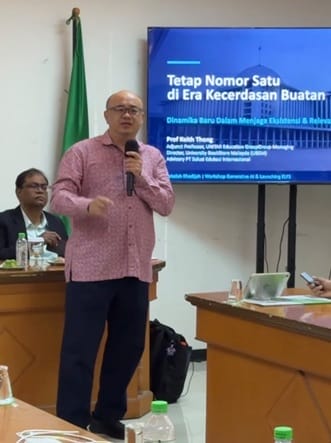
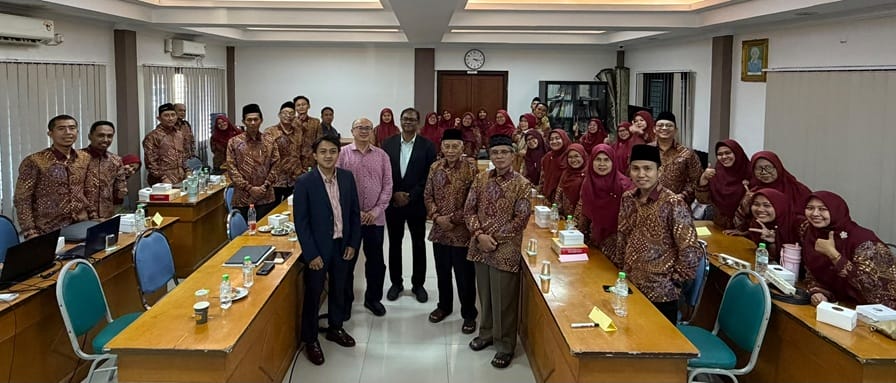
SURABAYA, July 25: In a world where attention spans are shrinking and information is consumed in bite‑sized clips, schools must embrace artificial intelligence (AI) to remain relevant and competitive. That was the central message delivered by Keith Thong, Adjunct Professor at UNITAR Education Group and Group Managing Director of University Book Store Malaysia (UBSM), during a recent workshop at Sekolah Khadijah in Surabaya, Indonesia.
Speaking at the Generative AI Workshop and Launching of ELFS, Thong painted a vivid picture of the new educational landscape. “We live in an instant era,” he said. “Students expect speed, clarity, and engagement. Books now have trailers, news is condensed into short paragraphs, and even conference speakers are limited to ten minutes. This is not a passing trend — it is the new standard.”
He cited examples of how content is being compressed worldwide: Singapore’s STEM comics reduced from 30 pages to six, English Premier League highlights cut from nine minutes to two, and thousands of short learning clips produced on demand. “Students and parents often make 60 to 70 per cent of their decisions before they even approach a school,” he noted. “They watch videos, compare fees, and check alumni outcomes. Schools must influence them before they ask.”
Thong argued that AI is the defining tool of today’s classrooms. Far from replacing teachers, he said, it empowers them — enabling faster preparation of lesson plans, adaptive assessments with instant feedback, and multimedia materials tailored to each learner. “If the world is already embracing autonomous mobility, smart buildings, and personalised retail, our classrooms cannot afford to be left behind,” he stressed.
The workshop also highlighted the growing importance of English as a global passport. By 2027–2028, English will become a compulsory subject in Indonesia, and schools must prepare now.
Thong emphasised employability, confidence in speaking, and authentic video‑based learning as key to producing graduates ready for the global stage. “It’s not just about theory,” he said. “It’s about preparing a generation that can compete internationally.”
To support adaptation, he outlined an ecosystem of tools: AI‑powered reading libraries that turn children into storytellers, video‑based English learning from thousands of real‑world clips, and AI‑proctored assessments accessible anywhere. “It’s not about the tools themselves,” he concluded, “but about schools daring to adapt.”
The Surabaya event underscored a broader challenge facing education worldwide: how to stay relevant in a digital age where students learn, search, and decide differently.
Thong’s message was clear — schools must evolve from chasing numbers to cultivating interest, from traditional methods to embracing technology. “To stay ahead,” he said, “we must adapt.”
WE