By Leslie Lim
For many migrants from Kelantan and Terengganu living in Greater KL, ordering Nasi Dagang is a recurring cycle of eager anticipation and inevitable disappointment.
You crave the rich, aromatic gulai ikan tongkol, only to be served a sweet, diluted curry that barely captures the essence of authentic East Coast cooking.
Food taste preferences aside, the disappointment doubles when the Ayam Percik arrives. KL’s version differs noticeably from Kelantan’s traditional preparation styles and flavour profiles.
It is a familiar heartbreak for Penangites hunting for authentic northern street food, such as Assam Laksa or Prawn Mee, in PJ. You can take people out of their hometowns, but try as you might, you cannot fool their palates with anything less than authentic.
Perhaps this is one of the most relatable ways to understand why national connectivity matters. For decades, the East and West coasts of Peninsular Malaysia have operated in two very different economic — and culinary — spheres.
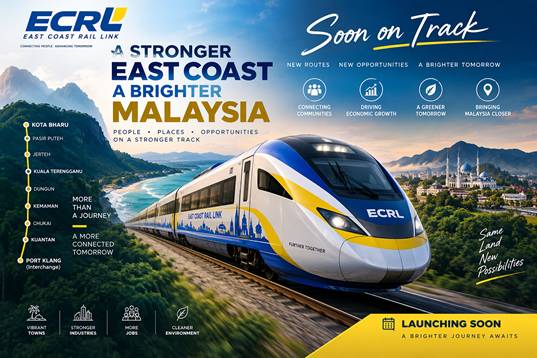
Stretching 665km from Kota Bharu to Port Klang, the RM52.43 billion construction of the East Coast Rail Link (ECRL) promises to bridge that divide. With just a month left before the targeted launch on Dec 12, nine years of anticipation are finally turning into reality.
When passenger fares were announced, starting at RM125 for the Gombak–Kota Bharu journey, lively public debate was inevitable. For some, the price seemed a little steep; others found it reasonable enough, while seasoned travellers raised an eyebrow at the dynamic pricing structure.
While the fares may compare favourably with some international intercity rail services, many Malaysians will naturally judge every Ringgit against their own balik kampung budgets.
The train certainly has the advantage of speed. Driving from KL to Kota Bharu can easily take seven to eight hours, whereas the ECRL Express promises to complete the journey in about four. For students and young workers travelling alone, however, standard express bus fares, starting from RM44, remain hard to beat.
For families heading home during Hari Raya and long weekends, packing the car may still work out cheaper, thanks to BUDI95 and the irreplaceable convenience of having their own wheels when visiting friends and relatives.
Let us be realistic. The ECRL will not empty our highways every Raya, nor will it replace the humble express bus. And perhaps that is the point: we should not judge a major infrastructure project by passenger headcounts alone.
The bigger opportunity actually lies in freight. By linking Kuantan Port with Port Klang, the ECRL could offer businesses another way to move goods, taking heavy lorries and container trucks off our congested highways while improving connections between ports, factories, and industrial centres along the East Coast.
For manufacturers and traders in Pahang, Terengganu, and Kelantan, smoother logistics could open up new markets and create opportunities to grow beyond their traditional customer base.
Then there is domestic tourism. For Malaysians who have never ventured beyond Kuantan, the ECRL could turn what was once a daunting long-distance drive into a more accessible weekend getaway.
Kota Bharu’s bustling Pasar Siti Khadijah and Wakaf Che Yeh offer an endless feast for the senses, while Terengganu’s master batik weavers, Kelantan’s gold jewellers, and traditional artisans deserve a much wider audience.
And let us not forget the everyday delights. From Nasi Kerabu, Nasi Tumbang, Serunding, Jala Mas, and Lompat Tikam to premium but loose (beras timbang) Beras Siam and semi-dried ikan bekok, the East Coast has so much more to offer than beaches and holiday photos. More visitors mean a welcome boost for local roadside stalls, eateries, homestays, and small traders.
The ECRL’s true value will not be measured by ticket sales or highway traffic alone. By helping local businesses reach new markets and giving Malaysians a compelling reason to explore beyond their usual haunts, it achieves something far more meaningful than simply shaving hours off a journey.
And who knows? Perhaps one day, ordering Nasi Dagang in Greater KL will no longer trigger a wave of homesickness. With better logistics and distribution networks, authentic East Coast delicacies might find their way to our neighbourhoods, fresher, faster, and with their traditional flavours intact.
That may not be written in the ECRL’s official master plan, but for Kelantanese and Terengganu folk on the West Coast craving a true taste of home, it would certainly be a delicious bonus.
WE