By Leslie Lim
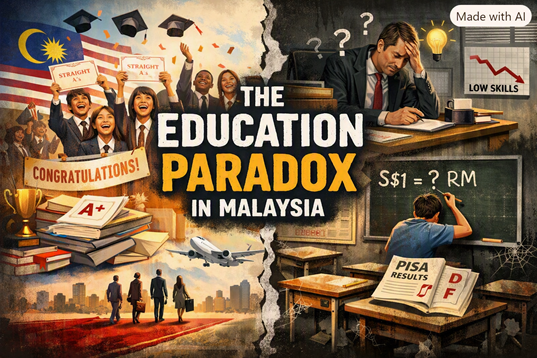
Every year, like clockwork, family WhatsApp groups explode with celebratory banners, and Facebook feeds fill with proud parents celebrating more than 13,000 SPM candidates who achieved straight As.
Yet beyond the celebrations, along office corridors and over lunch breaks, employers tell a very different story — of fresh graduates struggling with basic critical thinking, independent problem-solving and workplace communication skills.
How does a public education system that receives the largest allocation among ministries produce so many straight-A students, yet still leave some of our anak-anak poorly prepared for the real world?
On paper, we are thriving. Yet international assessments paint a sobering picture.
The World Bank’s report on Malaysia’s education system released in April 2024 laid bare our deep-seated deficit: while Malaysian students spend an average of 12.5 years in school, they achieve a learning attainment equivalent to only 8.9 years. Even more alarming, many local 10-year-olds struggle to read or comprehend a simple, age-appropriate sentence.
Looking back, our system has weathered decades of abrupt policy U-turns without fixing its core foundations. One of the true elephants in the room — rarely discussed in official circles — is the limited transparency in how our children are actually assessed.
When Mathematics and Science were taught in English under PPSMI, introduced in 2003 and phased out from 2012, the policy faced implementation problems, including teacher language proficiency and concerns over a widening urban-rural divide.
Yet a deeper issue remains: the limited transparency over SPM marking schemes and grade boundaries. Despite repeated calls from advocacy groups like the Parent Action Group for Education (PAGE) for greater clarity, these grading metrics are not fully disclosed to the public.
Without transparent cut-off marks, parents and students are left in the dark, fuelling concerns that rising grades may not necessarily reflect stronger learning outcomes.
International benchmarks like PISA show our students can struggle when asked to apply logic rather than memorise formulas. In the latest PISA assessment, Malaysia’s mathematics performance painted a concerning picture, with only about a third of 15-year-olds reaching basic proficiency.
A recent episode of a minister’s podcast revealed that over 60 per cent of local students could not solve a basic money conversion question between Singapore dollars and Malaysian ringgit — not due to the arithmetic, but because they could not figure out whether to multiply or divide. Our schools can train children to spot exam patterns, yet some may still struggle when faced with basic everyday logic.
This regression has drawn sharp warnings. As recently as May, former Bank Negara Governor Tan Sri Muhammad Ibrahim noted that while Malaysia successfully opened school doors to almost every child, the quality of learning has steadily regressed. He called for an urgent pivot away from exam-driven cramming towards critical reasoning, practical thinking and elevated vocational education (TVET).
Why does this persist? As Bersama politician Rafizi Ramli has argued on his podcast, there is a deeply ingrained cultural trait in our public institutions and society: a systemic lack of transparency paired with a comfortable “everything is okay” or “everything is fine” mindset.
Instead of confronting structural weaknesses early, we sweep them under the rug and hide behind rising counts of straight-A students to give the impression that everything is running smoothly.
If we become complacent while neighbouring countries like Cambodia and Myanmar accelerate their education reforms, today’s lead cannot be taken for granted.
The real test is not simply where Malaysia ranks in the next PISA table, but whether our children are gaining the knowledge and skills needed to compete in a changing economy.
Worse still, Malaysia faces a severe double-whammy: a weakening baseline at home and an escalating brain drain. Some of our strongest professional talent continues to move abroad for better salaries and opportunities.
We are left hollowed out at both ends, losing some of our sharpest minds overseas while relying on an exam-drilled domestic workforce to drive a high-income economy.
Until we confront this complacency, align our classrooms with global standards and retain our top talent, Malaysia risks becoming a nation of paper qualifications in a world that demands actual capability.
The views expressed here are entirely those of the writer
WE