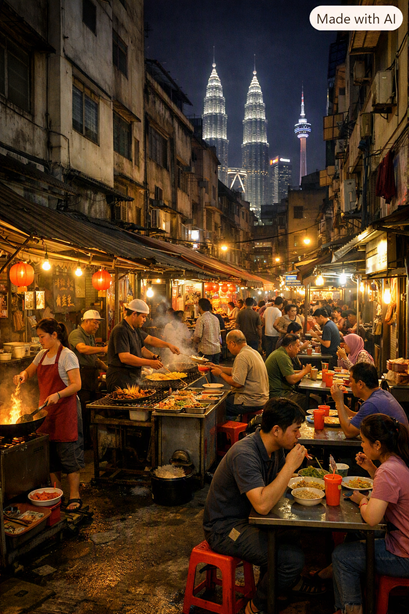
Image Credit: Copilot
By Leslie Lim
Federal Territories Minister Hannah Yeoh’s move to streamline outdoor seating permits – introducing an RM30 monthly fee for each set of tables and chairs on five-foot ways – has understandably struck a chord.
On paper, it is a pragmatic nod to our ingrained lepak & teh tarik culture. After dark, Malaysians naturally prefer open-air dining over air-conditioned enclosures.
Legitimising what was previously a legal grey area seems a sensible, win-win policy shift. It also aims to reduce red tape and cut operating costs for eateries, a practical consideration in an industry already under considerable cost pressure.
Yet, licensing the five-foot way without solving the spatial reality risks creating a safety and public health hazard.
Outdoor dining is not the issue, nor is the attempt to formalise it. The question is whether five-foot ways are the right place to expand it.
The immediate friction lies in boundary control. Long before any new permit was announced, many restaurants were already routinely colonising street parking bays after dusk.
Local precedent shows that once an operator is granted a few feet of official leeway, boundary creep is inevitable. Without consistent enforcement, tables can spill past the curb, coming dangerously close to moving traffic.
One only has to visit Chinatown KL or Chow Kit to see the many chaotic examples of the “abuse” of outdoor seating, where tables and chairs spill into pedestrian and parking spaces with little regard for boundaries.
More critically, frontage dining poses a physical risk. Sitting mere metres from moving traffic is a gamble. A driver’s gearing error – amplified by the instant torque of EVs – can turn an evening outing into a fatality in seconds.
It is a grim echo of past tragedies, such as the fatal Jalan Semangat (renamed Jalan Prof Khoo Kay Kim) incident two decades ago that initially prompted outdoor dining bans.
Five-foot ways were designed to safeguard pedestrians from scorching heat and road traffic; cluttering them can force foot traffic onto roadways.
Continuous, unobstructed pedestrian access should therefore be an explicit condition of any permit, including adequate space for wheelchairs, prams and those with mobility difficulties.
And next is second-hand smoke. Under Ministry of Health regulations, open-air eateries are gazetted smoke-free zones, yet the absence of regular monitoring allows irresponsible diners to light up openly, with little regard for non-smoking patrons.
A new permit system is only as good as its enforcement. Enforcement must therefore be strictly reinforced – not just for the permitted footprint, but especially for the smoking ban.
As it is, we already hear many grouses about street-level sidewalks across the city: poor maintenance, missing links and safety hazards. Adding more commercial activity without first addressing these basic problems risks making an already difficult pedestrian environment worse.
Perhaps another approach lies hidden behind the shops: our underutilised backlanes and alleys.
Redirecting outdoor dining into selected, properly transformed backlanes could separate patrons from traffic hazards. With proper lighting, repaving and security, neglected service corridors could become vibrant cultural destinations.
It echoes Melbourne’s laneway charm, such as Degraves Street, or Tokyo’s yokocho. The closest local equivalent in Petaling Jaya is Nasi Lemak Bumbung, the legendary back-alley supper spot in SEA Park, alongside the popular but rather haphazard and chaotic Jalan Alor Food Street.
Admittedly, the backlane strategy requires more effort from local councils and won’t work everywhere – location is everything.
Backlanes house grease traps, refuse bins and kitchen exhausts. DBKL and MBPJ must enforce strict waste management, pest control and Bomba emergency access before these spaces can function safely.
Simply monetising main road sidewalks is the easy route. True urban planning requires foresight.
If authorities want a safe, pleasant and lasting outdoor dining culture, the focus should shift from commercialising high-risk road frontages to revitalising suitable backlanes for both tourists and locals. It will also encourage the local authorities to spruce up backlanes.
WE