By Dr Rahim Said
There is a peculiar interrogation reserved for writers like us — those who think, feel, and write in English, yet carry histories that do not belong to England.
I have heard versions of it in Kuala Lumpur, in London, and, as Tash Aw recounts, in faraway literary halls where earnestness often masquerades as curiosity. The question is always delivered with politeness, sometimes even admiration, but beneath it lies a quiet accusation: Why do you write in the language of the coloniser? And worse, can you ever be authentic if you do?
It is a question that reveals more about the asker than the writer.
For those of us raised in Malaysia, language was never a singular inheritance. It was a marketplace. A negotiation. A daily improvisation. We moved between Bahasa Melayu, English, Mandarin, Tamil, and dialects not with ideological intent but with instinctive ease. Language was not a badge of loyalty; it was a tool of survival — and sometimes, of mischief.
To demand that authenticity must reside in a “native tongue” is to misunderstand what a native reality looks like in places like ours. There is no single tongue to return to.
The irony, of course, is that this demand for authenticity is itself a Western construct—tidy, categorical, and deeply suspicious of hybridity. It echoes, albeit in more liberal clothing, the anxieties articulated by Frantz Fanon in The Wretched of the Earth, where the “native intellectual” is accused of betrayal simply by virtue of linguistic migration.
But Fanon wrote in a time of sharper binaries — coloniser and colonised, oppressor and oppressed. Today’s world is less obliging. It is cluttered with contradictions: postcolonial nations that educate their elites in English, writers who traverse continents, identities that refuse to sit still. To insist on authenticity now is not just naïve; it is exclusionary.
It suggests that a Malaysian who writes in English is somehow less Malaysian than one who writes in Malay. That education dilutes experience. That exposure contaminates truth. By this logic, the more one sees of the world, the less one is permitted to speak of it. It is a peculiar punishment for curiosity.
I have always found this anxiety about authenticity to be less about language and more about control. Who gets to tell stories? Who gets to be believed? And perhaps most importantly, who gets to decide what is “real” enough?
The answer, too often, lies in the invisible centre of cultural power — still, inconveniently, somewhere in the West.
So, the writer from Kuala Lumpur or Lagos is summoned, gently but firmly, to explain himself. To justify his medium. To prove that he has not strayed too far from whatever pastoral, unspoiled version of his homeland exists in the imagination of his audience. It is not a question. It is a test. And like all tests, it is rigged.
The most elegant response I have witnessed — and one that Tash Aw captures beautifully — is refusal. Not confrontation, not indignation, but a quiet disengagement. A joke, perhaps. A deflection. A decision not to dignify the premise with a serious answer. Because to answer is to accept the terms of the question. And those terms are flawed.
Authenticity, as it is often framed, demands purity. But purity is a fiction, especially in a country like Malaysia, where even our most intimate thoughts are shaped by borrowed words, shared histories, and accidental encounters. We are not less authentic because we write in English.
We are more honest. Honest about the fact that our realities are layered. That our identities are negotiated. That our stories cannot be contained within the neat borders of language or nation.
The real ruse is not that we are inauthentic. It is that authenticity itself has been so narrowly defined.
In the end, the task of the writer is not to satisfy the expectations of authenticity, but to expand its meaning — to write in whatever language best captures the truth of a moment, a memory, a life.
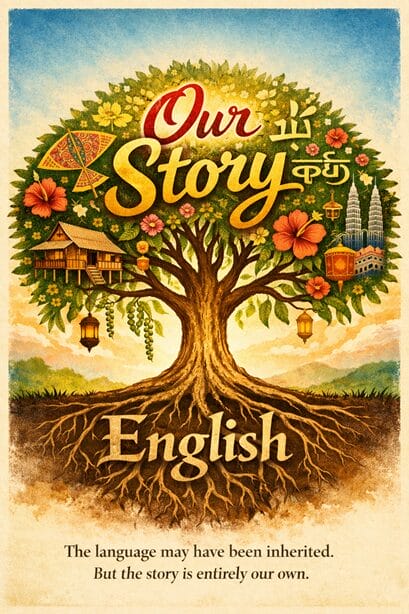
And if that language happens to be English, then so be it. After all, the language may have been inherited. But the story is entirely our own.
WE