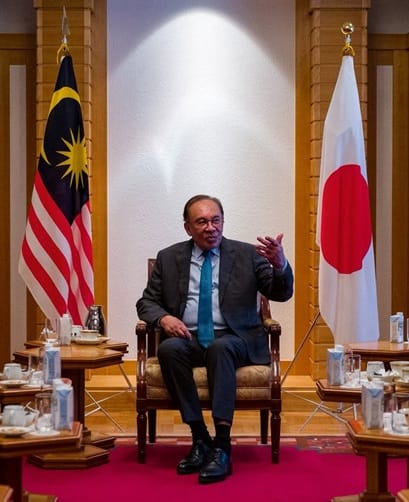
TOKYO, June 9: Prime Minister Datuk Seri Anwar Ibrahim once again revealed his fondness for drawing on the wisdom of poets and philosophers as he addressed the University of Tokyo’s Research Centre for Advanced Science and Technology.
Opening his lecture on “Humanity in a Human-Machine Civilisation”, Anwar invoked Masaoka Shiki’s belief that poetry must remain faithful to real life, before weaving in Shakespeare’s admonition from King Lear to “speak what we feel, not what we ought to say.”
These literary touchstones set the tone for a speech that questioned whether artificial intelligence, despite its dazzling fluency, can ever carry the moral weight of human experience.
“Moral philosopher Watsuji Tetsurō throws light on the word ningen and postulates the imperative for ‘human relationality.” The two characters carry a suggestion: the person, and the space between persons. A human being is never a solitary figure standing apart from the world. We are born into relation. We are shaped by family, by community, by history, and by the affections that pass between one life and another.
“Nevertheless, in today’s discourse, our focus is that space is now being entered by systems that can mimic human interaction with extraordinary ease and fluency. But that fluency can be a dangerous disguise. A machine may produce words of comfort without knowing grief, or draft an apology without having wronged another. It may conjure an image of beauty without having stood before the sea and witnessed the golden hour of twilight. But it will never watch a parent grow old, or feel the silence after loss,” Anwar cautioned, underscoring the limits of imitation in a world increasingly mediated by algorithms.
The Prime Minister warned that the march of AI risks eroding compassion, dignity and critical thought, particularly in the realm of work. While past technological revolutions displaced manual labour, he noted, today’s paradigm shift threatens cognitive and decision-making roles, reducing humans from originators to mere curators.
“Truth be told, the ruthless pursuit of efficiency, without more, may well strip away our very humanity,” he said, invoking the Japanese value of omoiyari — empathy and consideration for others.
Anwar also pressed the urgency of confronting AI’s entanglement with power. He pointed to widening digital divides and the concentration of influence among a handful of corporations and states. “A platform offered as a tool may begin to carry the deeper logic of dominion: who sees, who decides, who sets the terms, and who must live within them,” he warned, urging nations to resist turning every standard into a flag and every dependency into alignment.
For Malaysia, he stressed, AI must serve development — supporting teachers, doctors, farmers and civil servants — rather than becoming a race for speed and scale.
“Artificial intelligence will continue to advance. But it does not arrive with its purposes already written. Those purposes will be shaped by human beings, by our laws, our institutions, our markets, our universities and our moral courage,” he declared.
Closing his lecture, Anwar struck a balance between pragmatism and principle: “We must build systems that serve human beings to enrich our humanity, not debase it, institutions that remain answerable to them, and societies that remember what no machine can inherit on our behalf: conscience, responsibility, integrity, and care for one another.”
WE