By Dr Chai Ming Hock, Universiti Sains Malaysia
The reported warning that Iranian airlines could face severe disruption to their international operations from Sept 23 raises a question that extends far beyond Iran: how much influence should one country be able to exercise over other sovereign states’ economic activities?
The United States possesses enormous financial and economic power, particularly through the international role of the US dollar and the global reach of its banking system. Yet that power increasingly raises concerns about whether the international financial system has become excessively dependent on the decisions of a single government.
Rather than accepting this arrangement as inevitable, other countries should consider cooperating to build alternative mechanisms that allow legitimate international trade and transportation to continue without depending entirely on US financial infrastructure.
The issue is not simply whether one agrees with Iran or its government. It is about the broader principle of economic sovereignty. If a foreign airline can potentially lose access to international services because companies fear punishment from Washington, countries that have no direct involvement in the underlying dispute may find their own economic decisions constrained.
Airports, banks, fuel suppliers, insurance companies and ticketing platforms may have to consider not only the laws of their own countries but also the possibility of sanctions from the United States. This creates a form of economic influence that extends beyond US territory.
The dominance of the dollar is central to this influence. The dollar remains the world’s principal reserve and international transaction currency, while US financial institutions occupy an important position in global payments.
Consequently, access to the US financial system can be extremely valuable to companies operating anywhere in the world. The threat of losing that access can therefore influence the behaviour of businesses and governments that are not themselves American.
This does not mean that the United States literally controls the world economy. Nor does it mean that every US sanction is illegitimate. States have always used economic measures to pursue foreign-policy objectives, and governments have legitimate interests in protecting national security.
The problem arises when the financial power of one country becomes sufficiently dominant that other sovereign states feel compelled to follow its policies even when they have chosen a different position.
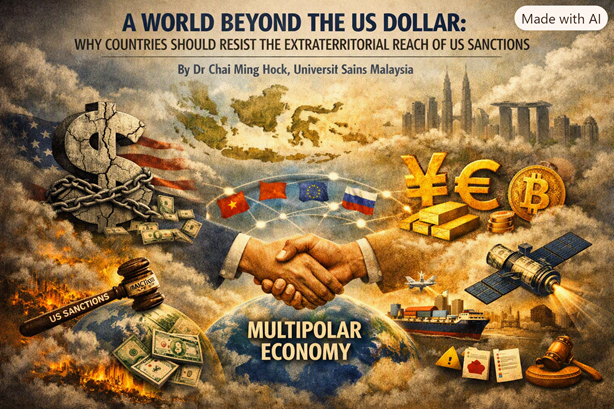
The appropriate response should therefore not necessarily be confrontation with the United States, but diversification. Countries should develop alternative payment systems, strengthen bilateral and regional financial arrangements, increase the use of national currencies where practical, and establish mechanisms for trade that are less vulnerable to unilateral sanctions. Such initiatives could involve existing regional institutions as well as new multilateral arrangements.
A similar principle applies to aviation. If an airline is subject to restrictions by one country, other states should be able to decide independently whether they wish to provide airport services, fuel, maintenance or passenger services, subject to their own laws and applicable international obligations.
Countries could explore mechanisms for settling legitimate aviation transactions through currencies and financial institutions that do not depend exclusively on the US banking system.
However, countries should be realistic about the difficulties. Replacing the dollar is not as simple as announcing that international trade will henceforth be conducted in alternative currencies. The dollar’s importance is supported by deep financial markets, liquidity, convertibility, established payment infrastructure and international confidence.
Alternative systems would therefore need to demonstrate reliability, transparency and efficiency rather than merely political opposition to Washington. There is also a danger in replacing one form of dependence with another. A genuinely multipolar financial system should not simply shift power from Washington to Beijing, Moscow or another centre. The objective should be greater choice, not a new financial hegemon.
Countries should have multiple avenues for conducting lawful international commerce without being forced to align themselves with the geopolitical preferences of any single power.
The Iranian aviation case therefore provides a useful opportunity for the international community to reconsider the architecture of global economic power. If countries believe that unilateral sanctions are being applied beyond the territory of the country imposing them, they have legitimate reasons to strengthen their collective economic resilience.
Cooperation among Asian, Middle Eastern, African, Latin American and European states could gradually create a more diversified financial and commercial environment.
Ultimately, the question is not whether the United States should have influence. Given the size of its economy and its role in global finance, American influence is inevitable. The more important question is whether that influence should be so structurally powerful that businesses around the world must constantly calculate the consequences of displeasing Washington.
A healthier international economy would offer alternatives. Countries should be able to trade, fly, invest and conduct legitimate commercial activity through multiple financial and institutional channels. Building such alternatives would not require abandoning the dollar or isolating the United States. It would simply mean ensuring that the global economy does not depend excessively on one country’s currency, banks and foreign-policy decisions.
A multipolar financial system would ultimately give countries greater economic sovereignty. It would also force every major power—including the United States — to exercise its economic influence with greater awareness of the consequences for the wider international system.
That is not an attack on America. It is an argument for a world economy in which no single country can make the rest of the world feel that it must comply.
The views expressed here are entirely those of the author
WE