By Leslie Lim
Some grim numbers to digest: 18 lives lost daily to road crashes in Malaysia. Yes, Malaysia. Rear-seat belt compliance below 15 per cent.
And before the import ban took effect on Dec 31 last year, nearly 30 per cent of traffic offenders reportedly relied on dummy buckles to avoid the “irritating” dashboard chime.
Based on the latest data from the Malaysian Institute of Road Safety Research (MIROS) and other authorities, these figures point to a troubling attitude – buat tak kisah – towards road safety among motorists.
Many know that basic precautions matter, but knowledge does not always translate into behaviour. Complacency, convenience and the perception that safety measures are optional remain difficult barriers.
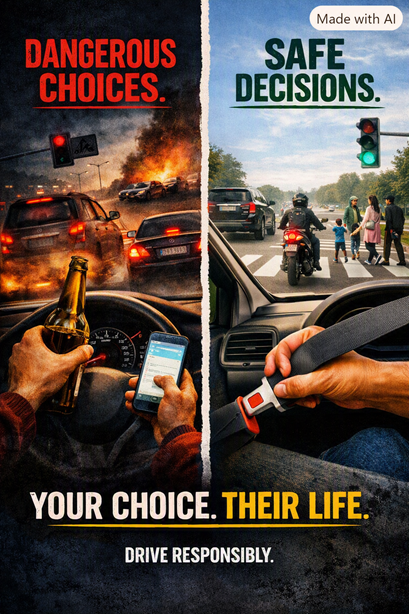
For years, road-safety campaigns have relied on familiar messages and reminders. They remain necessary, but persistent unsafe behaviour suggests that awareness alone is insufficient.
Malaysia’s target of halving road deaths by 2030, against 6,537 road-crash fatalities last year, will require a broader approach.
Human behaviour remains central. MIROS has reported that human factors account for 80.6 per cent of crashes. Among motorcyclists, four in 10 exceed speed limits, while significant proportions run red lights or fail to stop at intersections.
Our increasingly car-dependent urban environment adds another dimension. Greater Kuala Lumpur has nearly nine million people operating within a highly car-centric ecosystem.
Despite higher public-transport usage, more than 1.1 million vehicles enter Kuala Lumpur daily through major corridors. Such dependence places considerable pressure on the road network.
Congestion should never excuse reckless driving or riding. Motorists remain responsible for their decisions. But we should also ask whether prolonged exposure to traffic, frustration and fatigue can influence behaviour behind the wheel.
We all see it. Frustrated by the daily traffic crawl, some motorists speed to make up for lost time. Tailgating, dangerous lane changes and aggressive overtaking are risks that deserve attention.
The recent Jalan Dutamas Raya episode highlighted another part of the equation. In a Facebook post, Federal Territories Minister Hannah Yeoh drew attention to a traffic bottleneck linked to the coordination of traffic lights. Once the operational issue was addressed, traffic flow improved.
The lesson is not that congestion causes dangerous driving, nor that every traffic problem can be solved by adjusting a signal.
It is that relatively small operational failures can create unnecessary delays and frustration. Better traffic management can therefore form part of a wider road-safety strategy.
The same principle applies to enforcement. Higher fines and longer suspensions have a role, but deterrence also depends on the likelihood that violations will be detected.
Technology-driven enforcement, better traffic monitoring and targeted action at high-risk locations can make enforcement more consistent and effective.
As Deputy Prime Minister Ahmad Zahid Hamidi has acknowledged, conventional road-safety campaigns need a rethink.
The answer is not to abandon campaigns or enforcement, but to strengthen them with more persuasive messaging, meaningful engagement and greater relevance to how people actually behave on the road.
This should be complemented by lifelong road-safety education, beginning in schools, safer road design, better traffic management, stronger motorcycle protection and credible public-transport alternatives.
Halving road deaths by 2030 will require shared responsibility. Drivers must make safer choices, while governments and agencies must create systems that support those choices.
Road safety cannot remain a seasonal campaign followed by business as usual. We need to build an environment where safe behaviour is not merely encouraged, but made easier and more likely every day.
WE