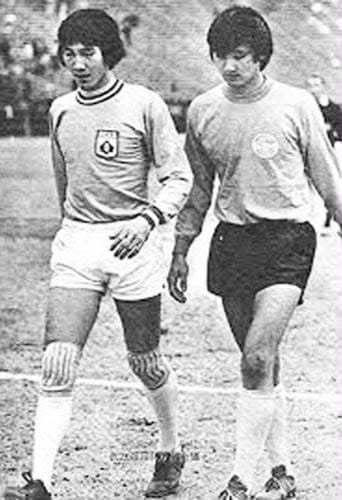
Lim Fung Kee (right) with Chow Chee Keong (both Malaysian star goalkeepers played for Hong Kong professional clubs in the 1970s)
By George Das
Lim Fung Kee has called on FIFA to take a closer look at player safety following the recent death of Jesus de Miguel on the football pitch.
“It’s a tragic loss of life,” said Lim, a former Malaysian goalkeeper in the 1970s.
Miguel, 25, a striker with CD Tenerife in Spain’s Second Division, died on Nov 3, 2026, following a collision with FC Andorra goalkeeper Jesus Owono during a match the previous day.
Owono, 25, an Equatorial Guinea international, had sprinted out towards midfield when the fatal collision occurred.
“Having been a goalkeeper myself, I look at the mechanics of the incident. It was a split-second miscalculation that resulted in a catastrophe,” Lim observed.
He added: “Owono’s intention will inevitably come under scrutiny. Did he raise his knees to protect himself, gain height or inflict injury?”
According to Lim, when goalkeepers accelerate at such speed, a collision can become almost inevitable.
“Was Owono reckless, or was it simply an instinctive reaction from a goalkeeper?” he asked.
Lim, 74, believes the modern game has evolved, with teams adopting increasingly advanced defensive strategies that demand more from their goalkeepers.
“Watch football today and you will see goalkeepers leaving the safety of their penalty areas more frequently. They are sprinting out to intercept balls and increasingly finding themselves in collisions with opposing forwards,” said Lim, who turned professional and later guarded the goal for Hong Kong’s Seiko FC.
He described this as the goalkeeper taking on a “sweeper” role outside the penalty area.
Lim is calling on FIFA to review player safety measures to ensure that such a tragedy does not happen again.
“It’s a real shame that a life has been lost. But Owono will be carrying a heavy burden. The guilt he may be experiencing could be overwhelming. He needs psychological help too,” said Lim.
His concerns go beyond the physical safety of players. He believes FIFA must also examine the emotional consequences of fatal on-field accidents and provide support for everyone affected.
“One player has died, don’t kill another,” was his powerful message to FIFA.
Lim rightly points out that there is another player whose life may have been profoundly affected by this tragedy.
Owono survived the collision, but the psychological consequences of being involved in an incident that claimed another player’s life could be devastating.
Lim speaks with considerable authority. With 20 years of experience as a goalkeeper, he understands the pressures and responsibilities of being the last line of defence.
He also understands the physical risks involved. He broke his nose during the 1971 Kuala Lumpur Merdeka Tournament and was sidelined for nine months in 1975 after suffering a wrist fracture while playing in Hong Kong.
While nobody can say with certainty what Owono is experiencing, he could face feelings of guilt, shock, anxiety and depression. He may also suffer recurring memories of the incident, nightmares, flashbacks, emotional withdrawal or even a loss of confidence and fear of returning to the football pitch.
The psychological impact may not be confined to Owono. Players from both teams, match officials and even those who witnessed the incident could also experience emotional trauma.
This makes it increasingly important for football clubs to have dedicated sports psychologists and trauma counsellors available to support players and officials following serious on-field incidents.
FIFA must recognise that psychological recovery deserves as much attention as physical rehabilitation. Support should not end when the injured player leaves hospital or when the match officials blow the final whistle.
Owono should not be condemned before the circumstances of the collision have been properly examined. As Lim suggests, what happened may have been an instinctive reaction in a split-second situation.
What he needs now is understanding, professional psychological support and time to come to terms with the tragedy.
FIFA and Football Clubs must protect the lives of those who play the game. But it must also care for those who are left in limbo due to the consequences of a tragedy.
One player has lost his life. Let us not allow another to be destroyed by the emotional scars of the same incident.
WE