By Dr Mohd Safar Hasim
When the tragic death of Zara Qairina Mahathir shook the nation in July 2025, it was supposed to be the definitive line in the sand. For weeks, national discourse was dominated by solemn pledges from authorities, promises of rigorous overhauls, and impassioned calls to safeguard our children within the sanctuaries meant to nurture them.
Yet, as the months rolled on, headlines across Malaysia continued to deliver heartbreaking reminders that our learning institutions remain vulnerable. The heartbreak did not end with Zara; at least two more tragic deaths of students occurred in school settings shortly after — including the loss of student G. Sarvina and the tragic incident involving 16-year-old Irene Sofiya — keeping public anxiety at an all-time high.
From dorm-room fatalities to severe altercations on school grounds and cyberbullying, systemic vulnerabilities clearly persist. In the wake of every tragedy, a familiar ritual unfolds. The blame game begins.
Finger-pointing cascades from the corridors of the Ministry of Education (MOE) to overburdened school administrators, exhausted teachers, distracted parents, and the ungoverned wilderness of social media platforms.
Some argue that tighter control over digital platforms — censoring online content and penalising tech giants—is the panacea. Others insist the fault lies squarely at home, where smartphones serve as unsupervised digital babysitters.
Meanwhile, frontline educators are caught in the middle, expected to serve as academic instructors, disciplinarians, overnight hostel wardens, and mental health counsellors simultaneously.
Assigning blame to a single entity is intellectually lazy and misdiagnoses the disease. The failure of school safety in Malaysia is systemic. It stems from administrative silos, bureaucratic self-preservation, and a reliance on paper SOPs that break down against the complex realities of teenage life.
Under the traditional framework, when an incident occurs within a school or hostel, administrative machinery prioritises containment and reputation management. Key performance indicators (KPIs) often inadvertently reward schools for keeping disciplinary records “clean”, creating a subtle disincentive to log incidents into official central portals like Aduan Buli or SISPAA (Sistem Pengurusan Aduan Awam).
By the time an escalation brings in external agencies or law enforcement, valuable time has been lost, evidence tampered with or deleted, and young lives irreversibly harmed.
The Rise of Mini-Dramas: Algorithmic Desensitisation and Mimetic Bullying
To understand why adolescent violence persists despite strict rules, we must look at what students digest daily on their mobile screens. A growing factor in shaping youth behaviour is the explosive rise of micro-dramas (vertical short dramas) proliferating across TikTok, Facebook, Instagram Reels, and dedicated drama applications.
Unlike traditional television series operating under broadcast censorship, these bite-sized mini-dramas rely on extreme, exaggerated emotional hooks to drive viral engagement.
A significant portion relies heavily on themes of overt physical violence, slap fights, domestic abuse, workplace harassment, extreme social humiliation, and revenge tropes.
For adult audiences, these clips are easily dismissed as sensationalised fiction. For impressionable adolescents whose cognitive discernment is still developing, the psychological impact is profound. Repeated exposure to algorithmic feeds depicting conflicts resolved through physical dominance, verbal humiliation, or mobbing leads to desensitisation.
Bullying stops being perceived as cruelty; it becomes normalised as a tool for status or justified retribution. Students do not merely watch these scenes — they copy them. Tactics of intimidation, group isolation, physical confrontation, and recording victims on mobile phones for online humiliation often mirror the exact narrative beats of viral mini-dramas.
Enforcement Deficits and the MCMC Mandate: Why Leadership Must Act
This is where regulatory intervention must move from reactive content takedowns to decisive enforcement. Under the Ministry of Communications, Deputy Minister Teo Nie Ching and the Malaysian Communications and Multimedia Commission (MCMC) have repeatedly highlighted the thousands of cyberbullying-linked postings removed from platforms annually.
Yet, deleting toxic posts after they accumulate millions of views is like extinguishing a forest fire with a cup of water. MCMC cannot restrict digital oversight to political speech, financial scams, or explicit adult material. Under the Online Safety Act (ONSA) and mandatory Class Licensing, MCMC holds statutory leverage to enforce strict content standards directly on platform operators.
Deputy Minister Teo and MCMC must take firm steps to require major platforms like TikTok and Meta (Facebook/Instagram) to halt the airing and algorithmic promotion of mini-dramas glorifying violence and harassment.
Platforms operating in Malaysia must apply broadcast-level moderation tools to vertical series and paid ads, removing hyper-violent short-form content before it reaches minor feeds.
Simultaneously, educational commentators like Prof. Emeritus Datuk Dr. Teo Kok Seong have long pointed out that discipline, administrative rigour, and institutional standards are the bedrock of student development.
When school environments suffer from weak oversight and reactive administration, students look outside school walls — into the unmonitored digital space — for behavioural cues. Re-establishing safety requires aligning strict internal school discipline with uncompromising external digital enforcement.
What Really Needs to Be Done
While tackling digital triggers is essential, relying solely on social media control remains an incomplete remedy if we ignore physical school safety protocols. Real reform requires moving toward four concrete structural shifts:
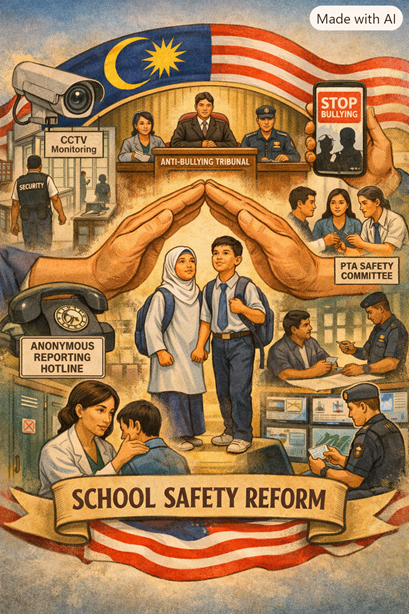
First, dismantle the institutional conflict of interest. Disciplinary and safety reporting must be decoupled from administrative performance metrics. Reporting an incident of bullying or distress should be viewed as a sign of institutional health, not a failure that threatens a principal’s career or a school’s ranking.
Direct, encrypted, and anonymous reporting channels must be maintained so students and staff can flag threats without fear of retaliation.
Second, professionalise school and hostel security. It is unreasonable to expect academic teachers, after a full day of instruction, to pull overnight warden duties at dormitories — where unsupervised hazing and peer intimidation historically peak.
The government must invest in dedicated, professionally trained residential management staff whose sole mandate is student welfare and physical oversight.
Third, bridge the gap between home and school through active oversight. Safety cannot be outsourced entirely to the state or school administration. Parent-Teacher Associations (PIBG) must evolve into proactive safety committees conducting regular, transparent audits of school facilities, CCTV coverage in high-risk zones, and mental health resources. At home, parents must take active responsibility for their children’s digital footprints and emotional shifts.
Fourth, enforce swift, independent accountability. Legislative milestones such as the Anti-Bullying Act 2026, with its independent tribunal framework, provide a crucial mechanism for victims to seek justice outside prolonged bureaucratic channels.
However, statutory power is only as effective as its execution. Tribunals, police liaison officers, and guidance counsellors must act with urgency, treating early warning signs with the seriousness they deserve before they escalate into national tragedies.
Every child who enters a school gate carries the hopes and trust of their family. Protecting them requires the courage to tear down silos of silence, curb algorithmic exposure to violence, invest real resources into frontline safety, and build an educational ecosystem where no student’s cry for help is ever ignored.
WE