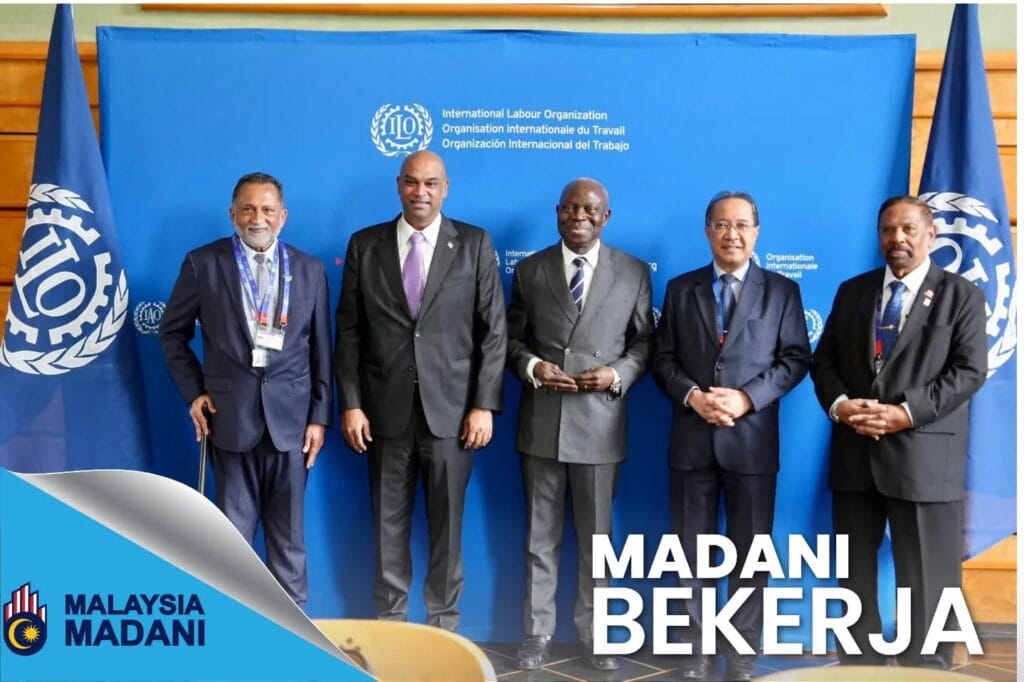
KUALA LUMPUR, June 9 (Bernama) — Malaysia has reaffirmed its commitment to a human-centred future of work at the 114th International Labour Conference (ILC), as Artificial Intelligence (AI) rapidly transforms the world of work and raises concerns over rights, equality, and inclusion.
Speaking at the Plenary Session of the conference in Geneva, Switzerland, today, Human Resources Minister Datuk Seri R. Ramanan stressed that technology only progresses when it advances decent work and human dignity.
“The question is no longer whether AI will transform our societies, because it already has. The real challenge is whether we can shape this transformation in a way that remains fair, inclusive, and centred on human dignity, while ensuring that no one is left behind,” he said in his speech posted on Facebook today.
Ramanan said Malaysia’s approach was guided by the Malaysia MADANI framework, which emphasises compassion, justice and humanity in development.
“Our Prime Minister Datuk Seri Anwar Ibrahim has reminded us that technology without values will only widen inequality and deepen division,” he said, adding that the future must remain people-centred rather than driven solely by algorithms, machines or markets.
Ramanan said Malaysia, with a workforce of more than 17 million, remained focused on ensuring every worker is equipped and protected to thrive in an AI-driven economy.
He highlighted several national initiatives, including AI and digital technology training programmes under the Centre for Instructor and Advanced Skill Training, aimed at strengthening workforce readiness.
In parallel with these efforts, he said the Occupational Safety and Health Master Plan 2026-2030, which integrates emerging technologies to address new workplace risks arising from AI, automation and digitalisation.
“Through these efforts, Malaysia’s Digital Risk Assessment System has already benefited nearly 270,000 users nationwide, reflecting our commitment to building safer and future-ready workplaces,” he said.
To strengthen industrial justice, Ramanan said the Malaysian Industrial Court has modernised its operations through AI-supported technologies and real-time digital recording systems, replacing manual note-taking.
Ramanan added that Labour Courts are also being upgraded with digital recording systems in phases, with full implementation expected by 2030 in Peninsular Malaysia to enhance efficiency and fairness in industrial justice.
To support industry adaptation, he said the AI and Cybersecurity Training Tax Deduction under the MyMahir-National AI Council for Industry ecosystem would help employers, particularly small and medium enterprises, invest in upskilling and reskilling workers.
“Through this initiative, employers can receive an additional 50 per cent tax deduction for eligible AI and cybersecurity training expenses,” he said.
Ramanan said Malaysia’s labour market platform MYFutureJobs has also facilitated 1.49 million job placements since 2020, connecting 3.3 million jobseekers with 13.4 million vacancies through AI-powered job matching.
On social protection, Ramanan said nearly 10 million formal sector workers are now covered under the Social Security Organisation (PERKESO)’s 24-hour injury protection scheme as of June 1, 2026, extending coverage beyond the workplace for the first time since 1969.
— BERNAMA