Image Credit: Copilot
By Les.lie Lim
Datuk Seri Johari Abdul Ghani has raised a valid concern about Malaysia’s electric vehicle (EV) charging infrastructure.
His openness to Cabinet ministers adopting EVs reflects a pragmatic response to the global oil crisis and the mounting cost of fuel subsidies. Yet, as the Minister of Investment, Trade and Industry rightly noted, this transition must rest on a robust nationwide charging network. For Malaysians, chargers must not only come first — they must be everywhere.
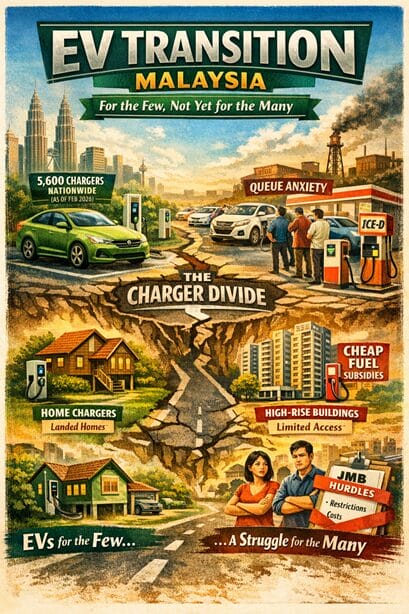
As of early February 2026, Malaysia had just over 5,600 public charging units nationwide. Availability in the Klang Valley — particularly Kuala Lumpur and Petaling Jaya — is acceptable, but still far from sufficient for a population as car-dependent as ours.
For many, “range anxiety” has evolved into “queue anxiety.” We’ve all heard the stories: long waits at R&R stops, malfunctioning chargers, and the persistent problem of “ICE-ing,” where petrol cars — and increasingly, idle EVs — occupy charging bays with impunity.
While the local market has seen encouraging uptake of Proton and various Chinese EV brands, a significant gap remains before EVs can truly go mainstream. Subsidised RON95 fuel is one deterrent, but the more formidable obstacle is the widening gap in charger availability.
The privilege of a home charger — made more affordable by Tenaga Nasional’s Time of Use (ToU) scheme — remains largely confined to landed homeowners. For high-rise residents, especially those in serviced apartments paying commercial utility rates, the reality is far less convenient. They must rely on public chargers, which, quite frankly, are not cheap. In many cases, the cost per kilometre rivals that of driving a subsidised petrol car.
Although “EV-readiness” has become a selling point for newly launched condominiums, most existing high-rise developments remain stuck in the dark ages. The ultimate gatekeeper is often the Joint Management Body (JMB). Residents seeking to install private chargers frequently face resistance — typically over concerns about electrical load capacity, fire safety, and the thorny question of who pays for common-area electricity.
Until these barriers are addressed, EV ownership will remain far more practical for landed homeowners than dwellers in high-rise buildings.
Singapore, by contrast, has largely solved the high-rise charging challenge by treating EV charging as a public utility, not a private luxury. About 90% of parking facilities in HDB developments are equipped with chargers, removing the “permission barrier” that continues to frustrate Malaysian residents.
Johari’s suggestion that companies importing CBU vehicles should help deploy charging facilities is commendable. But whether the industry will absorb the high installation costs without stronger regulatory pressure or incentives remains uncertain.
Ultimately, until Malaysia resolves the JMB stalemate and truly democratises charging access for high-rise residents, the EV transition will remain stratified — efficient for the few, but a logistical headache for the many.