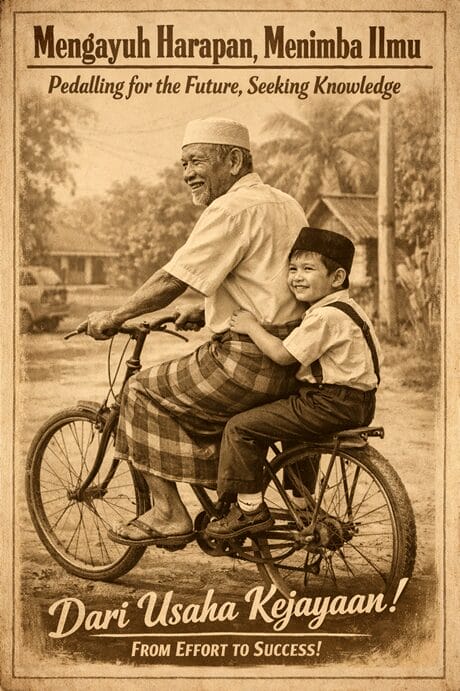
Image Credit: Copilot
By Dr Rahim Said
You hear stories about fathers driving their children to school, taking them on holidays, and buying toys to show their love. Those are lovely things, of course. Love often arrives in shiny packaging — in cars, in beach trips, in boxes wrapped for birthdays.
But my father belonged to another time.
In the 1950s, very few people owned cars. In fact, many homes didn’t even have running water. Ours certainly didn’t.
We lived in a ramshackle wooden house near a swamp where the ground stayed damp, and the mosquitoes ruled the evenings.
Toys were not bought in shops because there was no money for such luxuries. We made our own from bits of wood and bamboo, carved and tied together with imagination.
Holidays during school breaks were unheard of. The idea of “vacations” belonged to people in magazines.
But my father had something more valuable than all that.
He had a bicycle.
It was a sturdy old thing with a large metal carrier at the back. Every morning, I would climb onto that carrier and sit behind him as he pedalled the seven long miles to my school. The road was rough, sometimes muddy, sometimes dusty, but he rode steadily, never once complaining.
But before that journey even began, there was another task waiting.
There was no water in our house.
So, before dawn, my father would take a large bucket, tie it carefully to the bicycle, and ride half a kilometre to the roadside standpipe. There he would fill it, balancing the sloshing weight carefully on the bicycle as he rode back.
One trip was never enough. He would make several journeys in the cool darkness of early morning, ensuring there was enough water for everyone in the family — water to drink, to cook, to wash, to start the day with dignity.
It was simply what he did.
When I was old enough to ride a bicycle myself, I joined him. I would wobble along with a bucket tied to my tiny bike, trying not to spill half the water along the road.
Looking back, I think that balancing act made me quite a cyclist. I sometimes joke that if a circus had come through town, I might have been good enough to ride a bicycle on a tightrope.
But that dream would have to wait.
After we had bathed and dressed, my father would place me on the carrier again and begin the seven-mile ride to school. In the afternoon, he would return to fetch me and pedal the whole distance home.
He did this day after day.
Not once do I remember him raising his voice, losing his temper, or complaining about the effort.
Eventually a bus service began running along the route. Most fathers might have felt relieved to hand over the responsibility.
But mine did not simply send me off alone. For the first couple of weeks, he travelled with me, quietly observing the route, the driver, the stops — making sure everything was safe before trusting the system with his son.
That was his way.
No speeches. No grand declarations of love. Just quiet acts of devotion repeated every single day.
When my father passed away at the ripe old age of ninety, I found myself crying in a way I hadn’t since childhood. Not just from grief, but from the overwhelming realisation that I could never repay what he had given.
Because love like that cannot be measured in money, holidays, or toys.
It is measured in miles pedalled before sunrise. In buckets of water carried through the dark.
And in a lifetime of sacrifices made without ever asking for thanks.
No father could love more.