By Dr Rahim Said
When world leaders land at foreign airports, what they choose to talk about often tells us more than what they sign. Some arrive clutching term sheets and tariff schedules. Others arrive carrying stories, songs, and a careful nod to memory and belonging.
The contrast between Donald Trump’s transactional diplomacy and Narendra Modi’s people-first approach could not be starker — and Malaysia recently found itself an instructive stage for this difference.
Trump’s worldview, well-documented and unapologetic, is rooted in deal-making. Nations, in his lexicon, are corporate entities. Relationships are evaluated by trade surpluses, defence purchases and whether someone is, in his favourite phrase, “ripping off” the United States.
People-to-people ties, culture, history, or diaspora sentiment rarely feature unless they can be leveraged. Affection is secondary; advantage is everything.
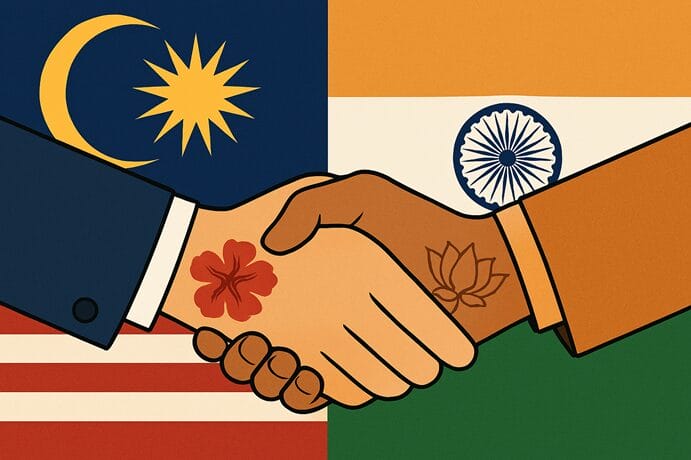
Modi, by contrast, plays a longer and subtler game. When he stood before more than 10,000 people at the Selamat Datang Modi Ji event in Seri Kembangan recently, he was not pitching a trade agreement. He was courting hearts — specifically those of the Indian diaspora, which he described as a “living bridge” between India and Malaysia.
In doing so, he reminded both countries that diplomacy is not only conducted between governments but sustained by communities.
His message was layered. Malaysia was praised as a “close and trusted partner”, but equal emphasis was placed on the Indian-origin community as custodians of shared history and aspirations.
Scholarships for Malaysian students of Indian origin, the extension of OCI card eligibility up to the sixth generation, a proposed new Indian consulate, youth exchanges and the establishment of a Thiruvalluvar Centre were not mere announcements. They were signals — that identity, culture and memory matter in foreign policy.
This is soft power deployed with intent. Modi understands that diaspora communities are not relics of colonial migration, but strategic assets. They vote, invest, influence narratives and humanise bilateral ties in ways no memorandum of understanding ever could.
By celebrating Tamil schools, cultural performances and linguistic preservation, he was not indulging nostalgia. He was reinforcing loyalty — not just to India, but to the idea of India as a civilisational anchor.
Trump’s approach, in comparison, treats diaspora communities as largely irrelevant unless they threaten or advance domestic political outcomes. His rallies abroad, when they occur, are less about cultural communion and more about projecting strength.
The message is simple: America will trade with you, defend you — at a price. Emotional connection is optional, often inconvenient.
There is no denying that trade matters. Malaysia, like any middle power, must care about market access, investment flows and economic growth.
But Modi’s visit subtly reframed the question: what sustains a relationship when trade cycles dip or geopolitics shift? Tariffs can be renegotiated. Trust, once eroded, is harder to rebuild.
Prime Minister Anwar Ibrahim’s personal reception of Modi was noted and reciprocated with public warmth. That gesture, too, matters. It signals a recognition that Malaysia’s plural society — where the world’s second-largest Indian-origin community resides — is not a liability to be managed, but a strength to be acknowledged.
The cultural showcase involving over 800 performers was not diplomatic theatre for its own sake. It was a reminder that unity and harmony are political assets in an increasingly fractured world.
Modi called it a moment that would be remembered for years — and he is likely right.
In the end, Trump asks: What can you do for me today?
Modi asks: Who are we to each other, and who can we become together?
Both approaches yield results. But only one invests in the human infrastructure that outlasts presidencies, populism and quarterly trade figures.
In a region where identity and memory still shape politics, hearts, it seems, may be the better long-term currency than deals alone.