NAIROBI, Dec 4: The United Nations today recognized three new World Restoration Flagships in Australia, Canada and South Africa, anchored in Indigenous Peoples and local knowledge. Announced ahead of the seventh session of the UN Environment Assembly (UNEA-7), the new initiatives support agrifood systems, biodiversity and climate goals.
Jointly led by the UN Environment Programme (UNEP) and the Food and Agriculture Organization of the United Nations (FAO), the awards are announced under the UN Decade on Ecosystem Restoration (2021–2030), a statement issued by UNEP said today.
The World Restoration Flagships represent some of the most ambitious, science-based, and inclusive examples of restoration in action.
“One hectare at a time, governments, communities and partners are restoring forests, grasslands, shrublands, coastlines and marine environments,” said Inger Andersen, Executive Director of UNEP. “By combining lessons from Indigenous Peoples with modern science, we are restoring damaged ecosystems. One hectare at a time.”
“Real ecosystem restoration is accomplished from the ground up,” said FAO Director-General QU Dongyu. “With Indigenous Peoples and local communities at the center, these new Flagships demonstrate the power of partnerships that bridge ancient wisdom with modern innovation, while strengthening agrifood systems, biodiversity and food diversity, and climate resilience.”
Shellfish Reef Building Program – Australia
Australia’s once-abundant shellfish reefs – comprising oysters and mussels– have become critically endangered by overharvesting, sedimentation and pollution, among others. Between 2021and 2023, The Nature Conservancy and the Australian Government embarked on the Reef Builder programme to rebuild these vital coastal ecosystems at 13 locations around the southern coastline, in partnership with local communities. The Nature Conservancy continues this partnership-based work to restore native shellfish reefs across 30 percent of their original locations around Australia’s expansive coast by 2030.
“Shellfish reefs are natural solutions to some of our greatest conservation challenges, and Reef Builder has shown that restoring them at a national scale is not only possible—it’s transformative,” said Australia’s Minister for the Environment and Water, Senator the Hon. Murray Watt. “This recognition as a UN World Restoration Flagship highlights Australia’s leadership in marine ecosystem recovery. Reef Builder is delivering real benefits for nature and communities alike; supporting local jobs, strengthening coastal resilience, and revitalising biodiversity along our shorelines.”
Shellfish reefs serve as natural ecosystem engineers, purifying water and providing habitat for hundreds of marine species. Since the initiative’s launch, it has helped remove nearly 15 tonnes of nutrient pollution, boost fish stocks, and has achieved significant biodiversity gains. The restoration project has generated over 425 jobs and USD 10 million by supporting over 50 small and medium sized businesses, which helps to reconnect coastal communities with nature and promote stewardship of the marine environment. This project involves the deep collaboration of many different groups, including Indigenous Traditional owners, fishers, restaurants, scientists and local communities.
Respectful Returns: Restoring Resilience to Salmon Ecosystems – Canada
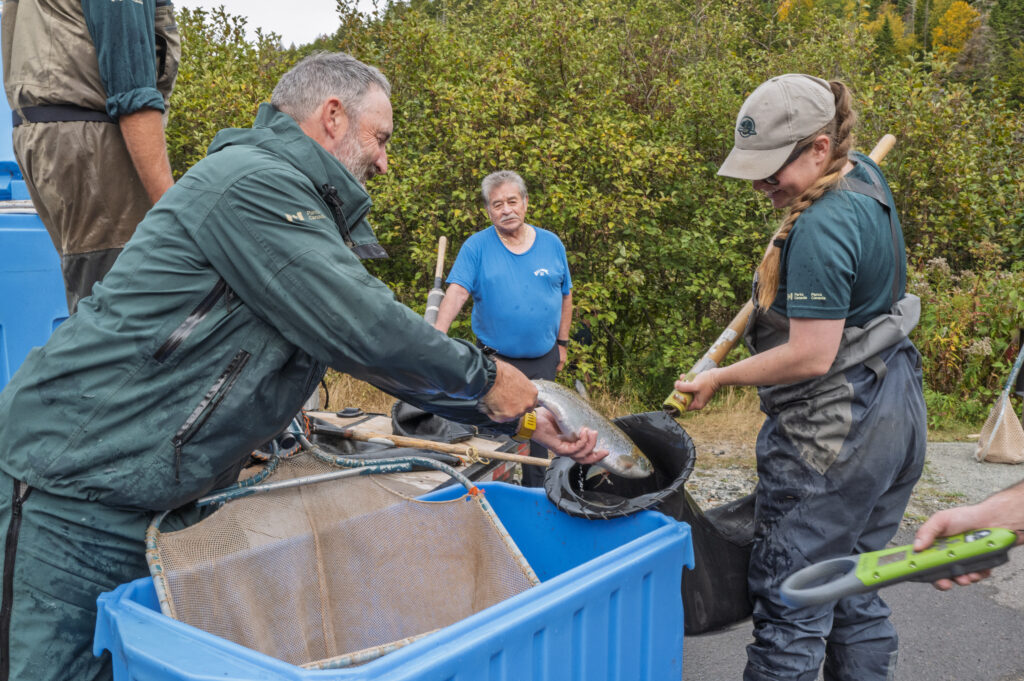
Many salmon populations are in peril in Canada, with significant economic and cultural consequences – salmon hold profound spiritual value in the country, particularly for Indigenous communities. Since 2010, Parks Canada has collaborated with Indigenous Peoples and local communities on the Respectful Returns initiative, which focuses on restoring damaged rivers and streams in seven national parks along Canada’s Pacific and Atlantic coasts.
“Canada is honoured that Parks Canada’s salmon restoration initiative has been named a World Restoration Flagship by the United Nations Environment Programme. This global recognition shows what’s possible when we act boldly and work together,” said the Honourable Julie Dabrusin, Minister of the Environment, Climate Change and Nature. “Guided by Indigenous knowledge and science, Respectful Returns demonstrates the power of collaboration to restore ecosystems and renew relationships with Indigenous communities whose cultures and livelihoods are tied to salmon. More than a project, it is a blueprint for restoration worldwide – where reconciliation with Indigenous Peoples through shared stewardship and conservation go hand in hand to protect biodiversity and strengthen communities.”
By using new tools, sharing knowledge, and working together, the project has helped restore over 65,000 hectares of land and 228 kilometers of waterways. Respectful Returns has also created more than 100 jobs, supported research at three universities, and built strong partnerships with 32 organizations and communities. The goal is to protect salmon and their habitats while strengthening the connection between people and nature. This work is helping both the environment and communities heal and grow together. In six out of the seven sites, salmon numbers have already increased.
Thicket Restoration Movement – South Africa
One of South Africa’s most biodiverse yet neglected ecosystems is the native subtropical thicket. Thicket Restoration in South Africa unites over 60 initiatives across Eastern and Western Cape. The initiative aims to restore 800,000 ha by 2030.
Restoring thicket makes the soil more resilient, stores carbon and serves as fodder storage for large livestock and other large mammals during droughts, a high priority for a region that has experienced its worst drought in 100 years in 2023/24. It also provides a safe habitat for various native browser species, including black rhinos and African elephants, responding to long-term threats. Planting native species, clearing invasive plants and training communities in restoration is expected to create more than 1,000 rural jobs, improving the livelihoods of around two million people. The thicket’s revival also sequesters up to eight million tonnes of CO₂ annually, offsetting emissions equivalent to about 20 gas-fired power plants.
“The efforts that have been put into spekboom restoration will benefit future generations. We are banking for the long term,” said Luyanda Luthuli, a landscape practitioner of Living Lands, one of the organizations forming the initiative. “I am excited and hopeful for the future and for seeing the fruits of our labor towards restoring ecosystems, restoring resilience.”
Restoring ecosystems – restoring resilience
These three new World Restoration Flagships add to a growing portfolio of already 27 recognized flagships, collectively restoring over 18 million ha of diverse ecosystems worldwide, with plans to restore a total of more than 68 million ha.
The success of multiple ecosystem restoration initiatives highlights a central message of UNEA-7: restoring ecosystems is an essential pathway to strengthen resilience for people and nature, ensuring they thrive in tandem.
About the UN World Restoration Flagships
Countries have already promised to restore 1 billion hectares – an area larger than China – as part of their commitments to the Paris climate agreement, the targets of the Kunming-Montreal Global Biodiversity Framework, the Land Degradation Neutrality targets and the Bonn Challenge. However, little is known about the progress or quality of this restoration. With the World Restoration Flagships, the UN Decade on Ecosystem Restoration is honouring the best examples of large-scale and long-term ecosystem restoration in any country or region, embodying the 10 Restoration Principles of the UN Decade. Progress of all World Restoration Flagships will be transparently monitored through the Framework for Ecosystem Restoration Monitoring, the UN Decade’s platform for keeping track of global restoration efforts.
–WE