By Dr Rahim Said
Every year, when the final stretch of Ramadan arrives — the mysterious, sacred stretch the Malays call tujuh likor — something in the air of memories that refuse to fade.
Not the sort of memories that arrive politely. No. These come barging in like childhood friends who know they don’t need an invitation.
And somehow, my mind always returns to a place with an unlikely name — Pekan China, by the gentle brown flow of the Kedah River.
Strange perhaps, that a Malay boy’s Hari Raya nostalgia should begin in a Chinese quarter.
But that was kampung life.
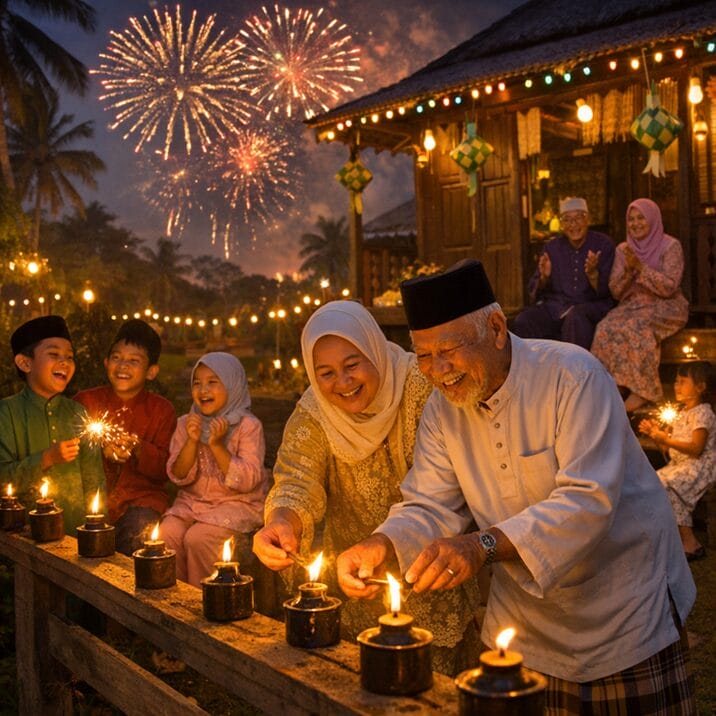
In those final seven nights of Ramadan, my brothers and I would begin our nightly expedition with the seriousness of pilgrims. Our mission: to hunt for pelita — kerosene lamps handmade by Chinese tinsmiths who, for reasons only small towns understand, had become indispensable suppliers of Malay festive tradition.
They were not the bamboo pelita panjut we made at home.
Those were our DIY village versions — bamboo tubes filled with kerosene, often tilted at alarming angles, occasionally setting fire to the grass if handled by overenthusiastic boys such as ourselves.
The ones from Pekan China had class.
Fashioned from recycled tin cans with little handles and neat spouts, they could be hung easily along fences, trees, and verandahs. They were elegant in their own humble way — the Mercedes-Benz of kerosene lamps.
And most importantly, they burned all night. Until dawn. Or until the kerosene surrendered.
We would buy the fuel from our neighbourhood Chinese grocer — a tall, kindly man we called Uncle Panjang, whose shop smelled permanently of kerosene, dried anchovies, and the faint promise of boiled sweets kept in glass jars near the counter.
There was something ceremonial about preparing the lamps. First, the kerosene. Then the wick. Then the match.
And when the first flame appeared, we boys would scatter like junior pyrotechnicians across the kampung, lighting one pelita after another.
Soon, the whole village would glow. From one end of the dusty road to the other.
The bamboo lamps flickered like a thousand fireflies. The tin-can pelita burned steadily and proudly. The whole kampung shimmered with light, announcing to the night that Hari Raya was coming.
It felt like magic. Looking back now, I realise it was more than that. It was community theatre.
Malay boys lighting lamps bought from Chinese tinsmiths with kerosene sold by a Chinese grocer, in anticipation of a Muslim celebration that somehow belonged to the entire village.
No government unity slogans required. No national integration seminars. Just lamps. Just neighbours.
Just the quiet belief that the last 10 nights of Ramadan might contain Laylat al-Qadr, the blessed night, better than a thousand months.
So naturally we thought: the brighter the village, the easier it might be for blessings to find us. It was the theology of kampung children.
Simple. And entirely logical.
But time, like kerosene in an unattended lamp, eventually runs out.
Two of my brothers — those partners in pelita-lighting crime — have since gone ahead to wherever old kampung boys go when their work here is done.
And the kampung itself? It too has quietly disappeared.
The sleepy village of my childhood now sits swallowed by the expanding concrete appetite of Alor Setar. Where bamboo fences once held pelita, there are now parking lots. Where kerosene lamps once flickered, LED corridor lights blink without emotion.
Progress, they call it. Perhaps.
But progress rarely smells of kerosene, or sounds like boys laughing in the dark while trying to light 50 lamps before the wind blows them out.
These days, I live in a tall condominium where Hari Raya arrives politely through WhatsApp greetings and supermarket ketupat promotions.
No bamboo. No pelita panjut. No Uncle Panjang.
And certainly, no gang of brothers racing down a village road with matches and kerosene like festive arsonists.
Yet every tujuh likor, the memory returns. The lamps. The river.
The glow of a kampung determined to welcome Hari Raya with as much light as it could muster.
Perhaps that is what nostalgia really is. Not sadness.
Just a quiet gratitude for nights when the world was small, the lamps were many, and three brothers believed they could light an entire village before dawn.