By Sam Trailerman
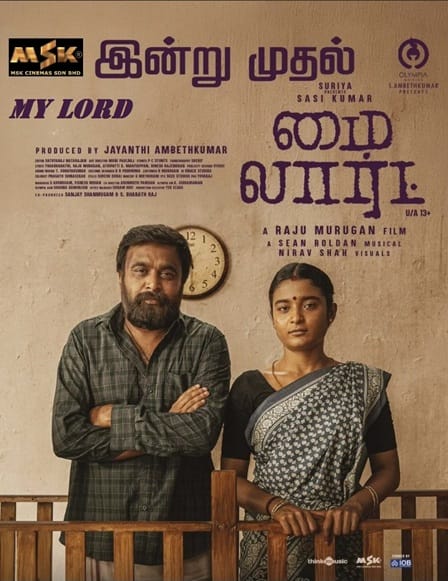
Directed by Raju Murugan, My Lord (2026) is a Tamil-language political satire that blends biting social commentary with unexpected humour.
Featuring M. Sasikumar and Chaithra J. Achar in lead roles, alongside Asha Sharath, Guru Somasundaram, Jayaprakash, Gopi Nainar, and Vasumithra, the film was produced by Jayanthi Ambethkumar of Olympia Films and released on February 13, 2026.
At its core, My Lord confronts the grim realities of organ trafficking. Yet Murugan avoids heavy-handedness, opening instead with striking close-up shots of characters’ waists — not for the allure of sexual appeal, but to underscore a chilling truth: in a society where wealth dictates power, even the human body becomes a commodity. A stark reality for the impoverished: accept that even their own bodies are saleable and worth a price.
The Plot
The narrative begins in Kovilpatti, where Muthusirpy (Sasikumar) and his wife Suseela (Chaithra J. Achar) are falsely declared dead due to the machinations of a local moneylender.
Meanwhile, in Chennai, Central Minister Sujatha Mohan (Asha Sharath) urgently needs a kidney transplant, and Muthusirpy is identified as a donor. What follows is a tense unravelling of corruption, desperation, and survival.
Tone and Style
Though the premise suggests a gritty social drama, My Lord cleverly pivots into satire, weaving humour into its critique of systemic exploitation. As the story progresses, it morphs into a cat-and-mouse thriller, keeping audiences engaged while never losing sight of its moral core.
Strengths
- Emotional storytelling: The film balances suspense with sincerity, delivering moments of quiet emotional power.
- Performances: Sasikumar’s understated strength and Chaithra’s resilience shine, while the supporting cast adds depth without theatrics.
- Music and atmosphere: The background score enhances tension and emotion, grounding the satire in lived reality.
- Themes: Class divides are portrayed with nuance, avoiding melodrama while exposing the stark contrast between privilege and struggle.
Perhaps most refreshing is the depiction of love: Muthusirpy’s loyalty and quiet integrity redefine cinematic romance, proving that devotion need not rely on grand gestures.
Limitations
While the film’s situations are gripping, some characters could have been written with greater complexity to match the weight of the predicaments they face. At times, the storytelling hovers between satire and earnest drama, diluting its emotional punch.
Verdict
Despite minor shortcomings, My Lord is a bold, thought-provoking work that rejects spectacle in favour of substance. By rooting itself in cultural authenticity and emotional depth, it delivers a powerful social message without ever feeling preachy. It is a moving, human experience — one that lingers long after the credits roll.
WE