SEREMBAN, Dec 9: Malaysia should be moving decisively toward faster and more efficient Disaster Victim Identification (DVI), as experts and national agencies recognise the value of adopting Rapid DNA technology, which can confirm identities in as little as 90 minutes.
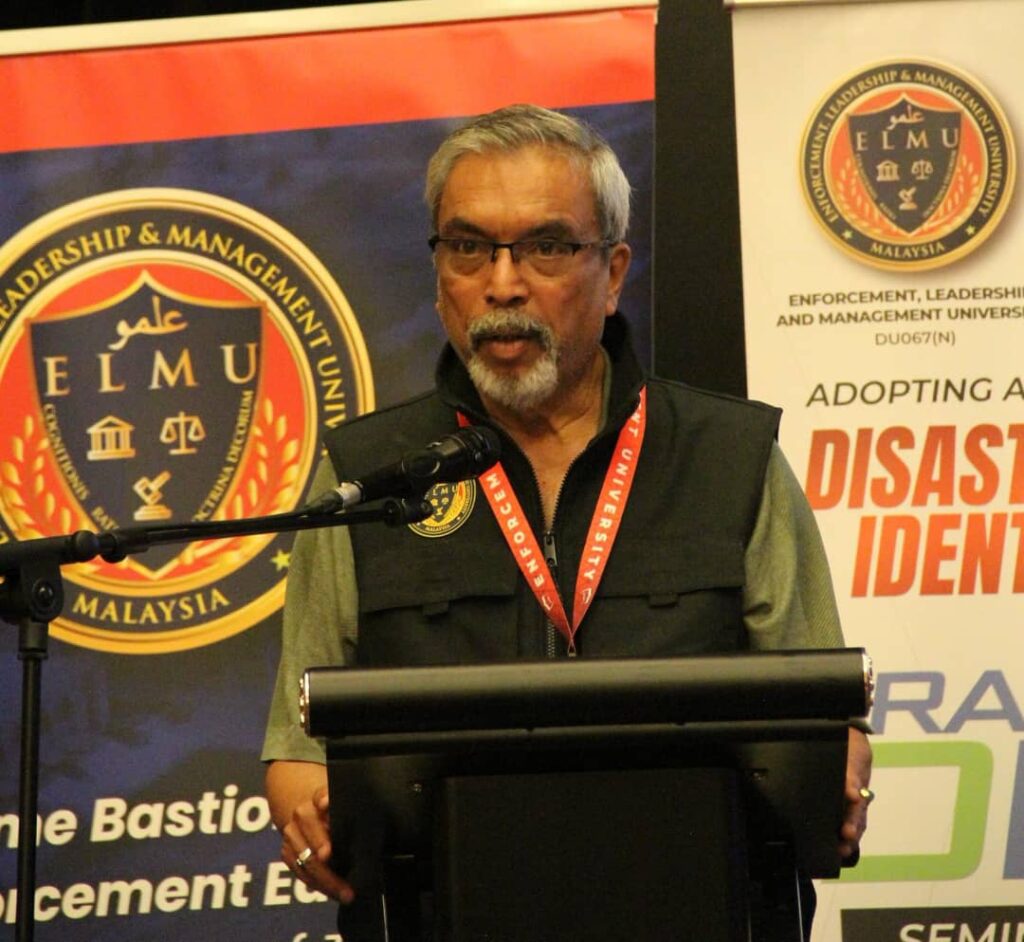
At a recent national seminar titled ‘Adopting a New Approach in Disaster Victim Identification via Rapid DNA’ organised by Enforcement, Leadership and Management University’s (ELMU) Centre for Crime Science and Investigation (CSI), speakers, practitioners and enforcement leaders highlighted the need to modernise forensic capabilities to meet the country’s growing public safety demands.
ELMU’s Vice Chancellor, Professor Datuk Dr. Kassim Noor Mohamed said, the university’s CSI was established to drive innovation in crime science by enhancing Malaysia’s forensic capacity, strengthening evidence-based enforcement and translating research into real-world solutions.
“CSI acts as a bridge between the academic community, enforcement agencies, industry experts and policymakers, with areas of expertise spanning DNA analytics, biometrics, forensic investigation and financial crime forensics. The centre’s international partnerships, including collaborations with Foster & Freeman, Innovatrics, Staffordshire University, Eskan, IPS Italy and others, position Malaysia to build world-class forensic capabilities for both national and regional benefit,” a recent statement issued by ELMU quoted him saying when officiating the seminar at the university’s Grand Hall in Bandar Enstek recently.
He said, natural disasters, transportation tragedies, mass casualty events and cross-border challenges have placed new pressure on national agencies.
“While existing forensic methods remain reliable, they are often time-consuming and resource-heavy. Rapid DNA technology offers a transformative solution, one that does not replace traditional methods, but complements them,” he added.
Dr. Kassim further stressed that ELMU, through CSI, expressed readiness to support national rollout, with potential partners such as the Chemistry Department Malaysia, PDRM Forensics, Universiti Sains Malaysia, Universiti Kebangsaan Malaysia and Universiti Teknologi MARA.
“International developments also served as reference points. Countries such as the United States, France, Ukraine, the United Kingdom, Australia and the Netherlands have advanced Rapid DNA through operational deployments and rigorous trials. Their experiences offer lessons for Malaysia as it prepares its own national adoption roadmap,” he said.
Taking the stage as the first presenter, ELMU’s Deputy Vice Chancellor ((Enterprise & External Engagement), Dato’ Dr Yew Chong Hooi stressed that Malaysia also needs to invest in skilled manpower to operate modern forensic systems.
He said strong knowledge and advisory support would help agencies adapt to fast-changing challenges, particularly in digital crime, disaster response and technology-driven investigations.
“Criminal activity and disaster threats are evolving quickly. Our systems and people need to evolve at the same pace,” he said.
Programme Coordinator for Disaster Management, School of Leadership and Resilience, ELMU University, Dr Rabieahtul Abu Bakar, in her paper titled Strengthening Malaysia’s Disaster Risk Reduction Framework through Integrated Disaster Victim Identification (DVI) Systems said, improving Malaysia’s disaster victim identification capability was not only a technical issue but a humanitarian one.
Faster identification, she said, helps families gain closure and ensures victims are treated with dignity.
She stressed that success would require collaboration between government bodies, forensic labs, emergency services, NGOs and community groups.
“Malaysia’s readiness depends on decisions made today,” she said. “We must build a unified system that uses technology to serve families with respect and compassion.”
UK forensic expert Lewis Shaw, who has 15 years of hands-on DNA lab and field experience, shared examples of Rapid DNA being used effectively in disaster zones, crime scenes and border control operations overseas.
He said the system can produce results in about 90 minutes and can be operated by non-specialists, making it ideal for on-site deployment.
“Internationally, Rapid DNA has already supported identity verification, human trafficking investigations, immigration cases and time-sensitive policing,” he said.
Shaw added, its greatest advantage is reducing the waiting time for families and lowering logistical burdens during large-scale disaster responses.
CSI Project Director, Kurian Thomas, in his closing remarks said, Rapid DNA should be viewed as strengthening Malaysia’s current forensic capabilities.
“By providing fast, initial results, lab specialists would be free to focus on complex and high-priority examinations,” he said.
He suggested that Malaysia work toward a structured national plan involving inter-agency partnerships, research and a clear roadmap for adoption.
Over 80 participants from law enforcement, government agencies, academia, and industry attended the inaugural seminar hosted by the Asia-Pacific region’s first full-fledged law enforcement university.