By Kaywen Z
Malaysia is no longer short of vision documents. In the span of a year, Malaysia helped champion WHA78.5, “Promoting and prioritising an integrated lung health approach,” at the 78th World Health Assembly. It also moved forward with its own National Lung Health Initiative 2025–2030 and officially launched the National Planetary Health Action Plan (NPHAP) in November 2025.
The WHA78.5 resolution is significant because it reframes lung disease as a broader systems problem shaped by primary care, air pollution, occupational exposure, and cross-sector coordination, rather than as a narrow specialist issue.
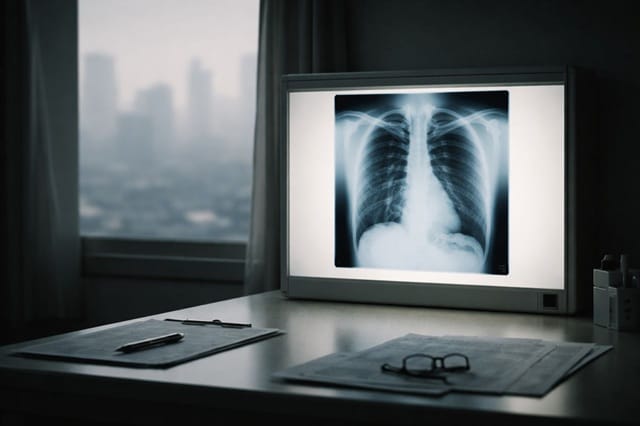
That global shift now has a domestic counterpart. Public reporting shows that AI-assisted chest X-ray screening has begun in selected primary care facilities and referral hospitals as part of the National Lung Health Initiative.
So, the question is no longer whether Malaysia should start; it has already started. The more serious question is whether the country can build the system behind the scan.
But screening is only part of the equation. The harder test begins after the abnormal result. Can the patient move quickly to confirmatory diagnostics and treatment? Can they afford the next step? Is there a pathway that works in practice, not just one that exists on paper?
This is where the public conversation still feels incomplete.
That is why action point (7) of WHA78.5 deserves much more attention. The resolution calls for improved access, affordability, and availability of safe, effective, quality medicines, vaccines, and health technologies, backed by essential lists, regulation, procurement strategies, and fair pricing.
In policy terms, this is the access backbone of the whole agenda. A health system that can detect disease but cannot reliably carry patients to diagnosis, treatment, and follow-up is not yet delivering integrated lung health in any meaningful sense.
Public reporting in February 2026 described 2025 as a pivotal year for lung cancer care, with new clinical practice guidelines, stronger emphasis on diagnostic timeliness, and efforts to reduce the financing gap that opens after an abnormal scan.
The same report described LungShield as a micro-insurance tool intended to cover key follow-up investigations, including low-dose CT, biopsy, staging CT, and molecular biomarker testing. Those developments matter because they make the policy challenge much clearer: the real bottleneck is no longer only detection. It is access to the next step.
Malaysia should therefore be careful not to mistake visible activity for system readiness. The short-term gains are likely to come less from grand claims of self-sufficiency and more from better procurement, more reliable regulation, and fairer pricing for high-value respiratory products.
Patients do not benefit from industrial narratives. They benefit from a system that can get the right diagnostic and treatment pathway to them quickly, consistently, and at a cost they can sustain.
This is also where Malaysia’s National Planetary Health Action Plan (NPHAP) becomes more than background context.
Officially launched in November 2025, it gives the country a whole-of-nation framework built around six Key Result Areas, 53 strategies, and 222 action plans, with the explicit aim of aligning development within planetary boundaries.
The public updates so far suggest that NPHAP has steadily moved through launch, dissemination, and early leadership and coordination work.
The next question is whether it can do the harder thing: align ministries and incentives around concrete delivery problems.
Lung health may be one of the clearest places to test that. Few issues show more directly how polluted air, unsafe work, delayed access, and weak coordination are translated into lived illness.
Malaysia should judge this agenda by a simple standard: whether a patient with an abnormal result can move through a system that is timely enough to diagnose, affordable enough to treat, and coordinated enough to follow through.
That is where policy stops being rhetoric and becomes public value. If Malaysia can close that gap, lung health may become one of the first areas where planetary health is translated from framework into lived reality.