How a classic MG‑style roadster reveals the evolution of motoring heritage, Malaysia’s role in preserving retro craftsmanship, and the remarkable journey from handcrafted sports cars to today’s modern electric vehicles.
By Dr Mohd Safar Hasim
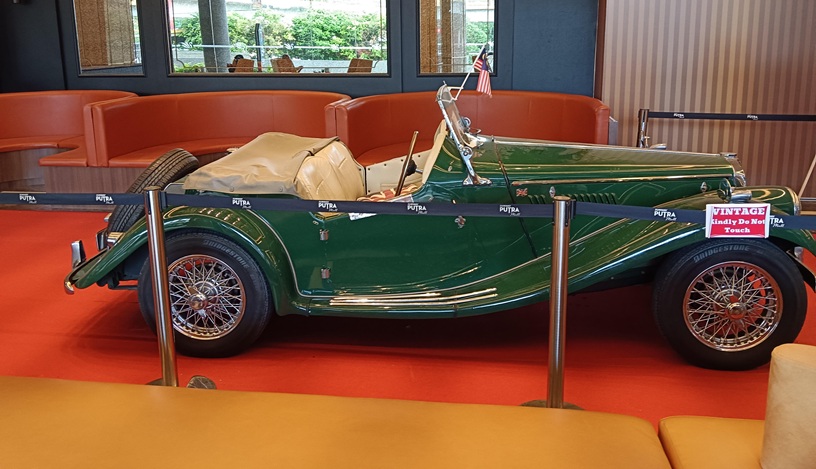
A vintage MG-style roadster currently on display at Sunway Putra Hotel, Kuala Lumpur, becomes an unexpected bridge between eras, transforming the hotel’s contemporary interior into a quiet gallery of motoring heritage. The polished chrome, the red carpeted platform, and the careful cordoning elevate the car from a simple exhibit to a cultural statement.
In a hotel environment where ambience and storytelling matter, the presence of this classic British-inspired roadster feels intentional. It invites guests to pause, reflect, and appreciate a machine that once defined aspiration and modernity in Malaya.
Origins of MG: The Birth of the Accessible Sports Car
The MG marque, short for Morris Garages, began in the 1920s as a small British workshop that specialised in turning ordinary cars into spirited, lightweight sports machines.
MG’s philosophy was simple but revolutionary: take modest, reliable mechanical components and wrap them in elegant, handcrafted bodies that ordinary people could afford. This formula created a new category — the accessible sports car — and by the time the MG T series emerged after World War II, MG had become one of the world’s most recognisable automotive names.
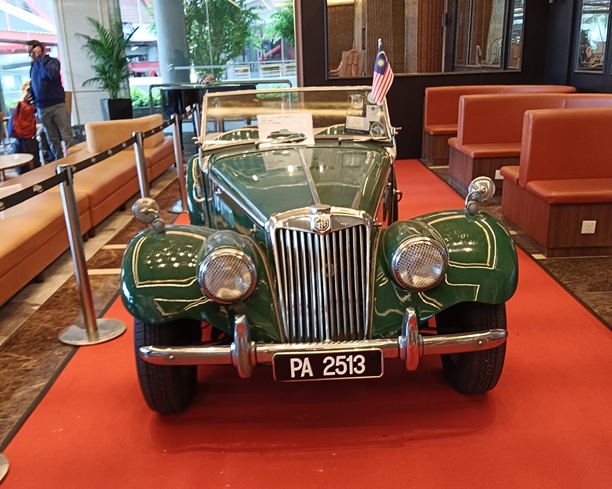
The MG TD and TF, which this displayed car closely resembles, were icons of their time. They combined prewar styling — sweeping fenders, upright grilles, exposed headlights — with improved suspension, better handling, and a more comfortable ride. They were not fast by modern standards, but they were spirited, charming, and beautifully balanced.
More importantly, they were export champions, shipping across to North America, Europe, and the Commonwealth, including Malaya.
Why This Car Is Considered a Vintage Car
A car becomes “vintage” not simply because it is old, but because it represents a distinct era of design, engineering, and cultural meaning. MGs of the 1950s embody:
* Handcrafted construction, including wooden frame elements
* Mechanical purity, free of electronics or digital controls
* Prewar design language, with exposed wheels and chrome accents
* Historical significance, as MG helped popularise sports cars globally
Each surviving MG is a piece of rolling heritage, a reminder of the early days of motoring in Malaya when the roads were quieter, the pace of life slower, and the automobile itself a symbol of aspiration.
MG and Bufori: A Shared “Design” Heritage
Interestingly, MG’s car’s appearance also echoes the design language of Bufori, the boutique luxury marque founded in Australia and later moved to Malaysia. Early Bufori models were intentionally styled after 1930s–1950s British roadsters, drawing heavily from the same visual DNA as the MG TD.
The resemblance — even down to the number plate style — is not accidental.
Malaysia is one of the few countries in the world that has produced both:
* a luxury retroclassic brand (Bufori)
* a retroclassic MG-inspired car (the TD2000)
This gave Malaysia a unique place in preserving this design heritage.
The TD2000: Australia to Malaysia
The TD2000 story adds another layer to Malaysia’s automotive narrative. In the early 1980s, an Australian entrepreneur revived the MG TD design using original jigs. About 100 units were produced in Australia before the project was acquired by a Malaysian company in the late 1990s.
Production moved to Malaysia around 1998–2000, where local engineers and craftsmen assembled the car in limited numbers.
Although this occurred after Proton’s establishment, it demonstrated Malaysia’s ability to produce speciality vehicles with international appeal — a different kind of leadership rooted not in mass production but in craftsmanship and heritage.
Who Owns Cars Like This?
Cars like this MG-style roadster are almost always owned by passionate custodians — private collectors, vintage car clubs, corporate collections, or families who inherited them. The immaculate condition of the car at Sunway Putra Hotel suggests ownership by someone who invests significant time, money, and emotional commitment into its preservation.
From Classic MG to the EV Era
The contrast between this MG-style roadster and today’s electric vehicles is dramatic, yet the connection is deeper than it appears. Both represent the cutting edge of their respective eras. The MG was built for lightness and efficiency, a principle central to modern EV design.
It symbolised technological progress, just as EVs today represent the next frontier.
In a twist of history, the MG name itself has been reborn under new ownership as a global EV brand. China’s Shanghai Automotive Industry Corporation (SAIC) is the new owner.
Today, MG electric vehicles are officially imported and sold in Malaysia, with models such as the MG ZS EV, MG 4 EV, MG S5 EV, and the striking MG Cyberster electric roadster already available to Malaysian buyers.
The brand is also preparing for local assembly, signalling a deeper commitment to the Malaysian market. This marks a remarkable full-circle moment: a name once associated with handcrafted British sports cars now represents accessible, modern electric mobility in Malaysia.
A Bridge Between Eras
Seeing this car at Sunway Putra Hotel is a reminder that the road from petrol to electrons is not a rupture but a continuum. From wooden frames to digital dashboards, from hand-cranked engines to
silent motors, the spirit of innovation remains the same. This MG-inspired roadster is not just a vintage car. It is a bridge between eras, a symbol of where we began and how far we have travelled.
WE